

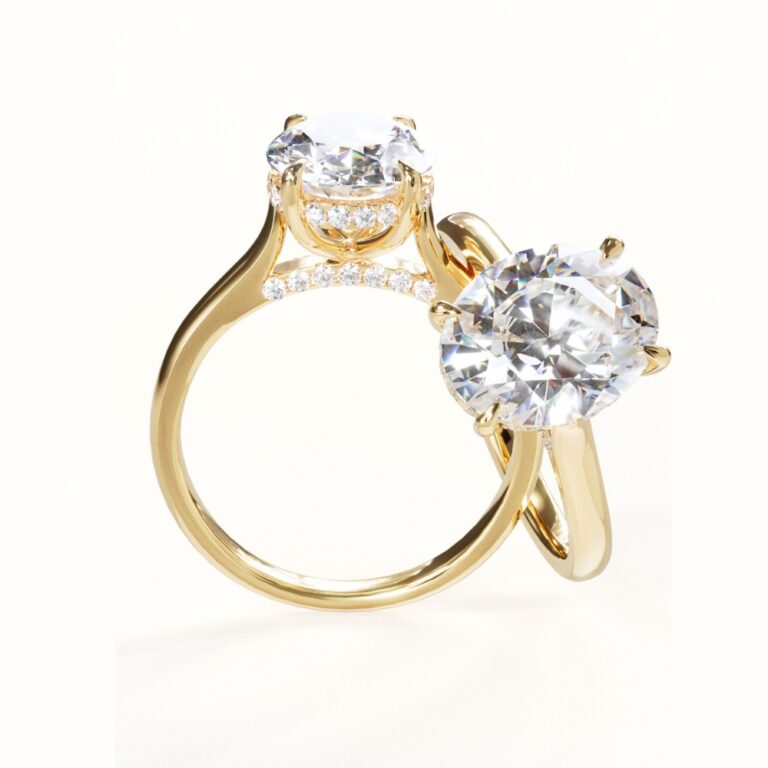
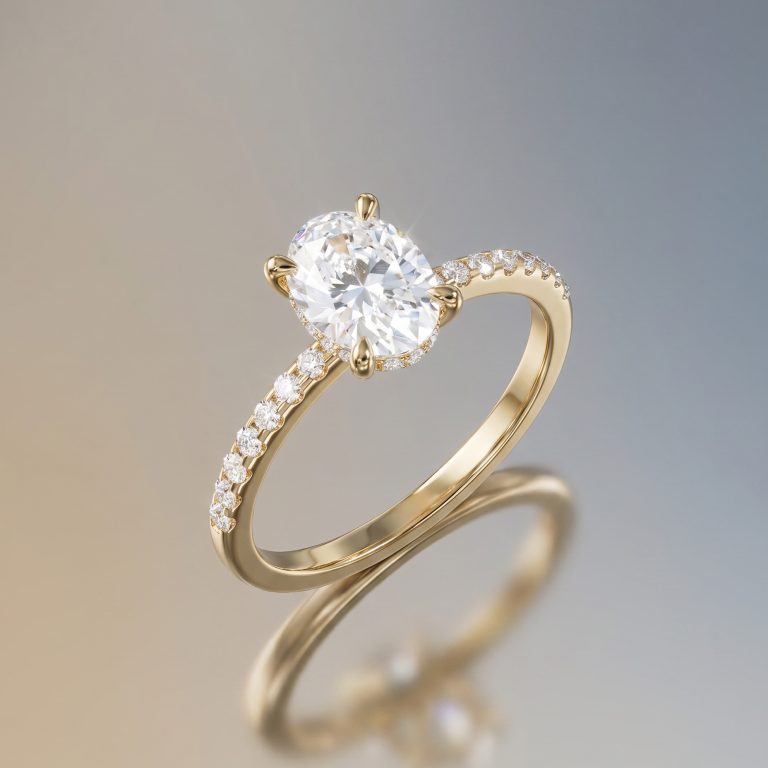




Does a lab-grown diamond hold its value? The honest answer
Myths, Marketing, and Hard Facts: We break the jewellery industry’s biggest taboo and analyse the true value of diamonds.
Summary
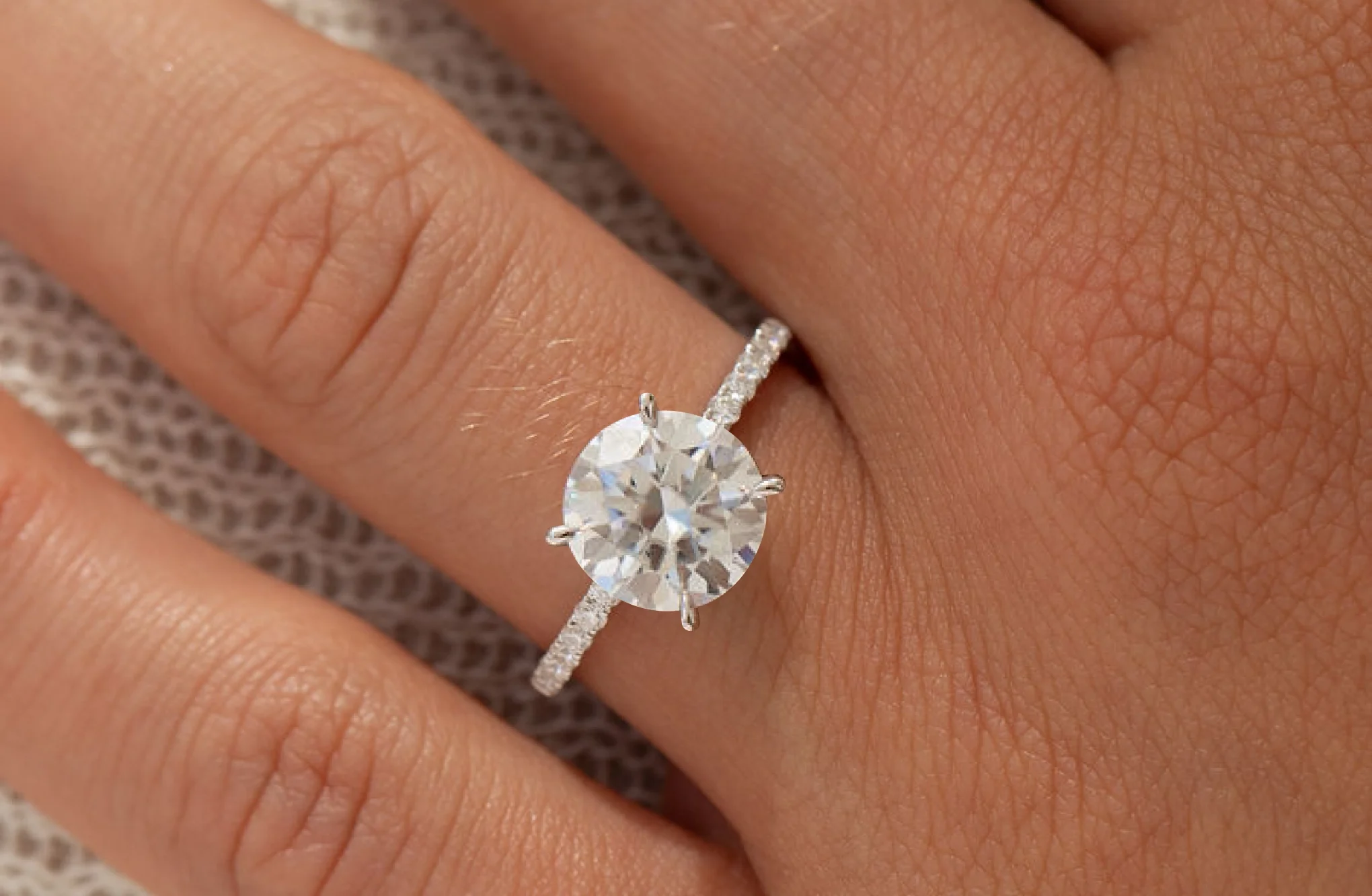
To put it bluntly: Neither commercial natural diamonds nor lab-grown diamonds are a lucrative financial investment. A natural diamond immediately loses 50% to 70% of its value the moment it leaves the jeweller’s store. A lab-grown diamond has an even lower resale value. The key difference lies in the purchase price: With a lab-grown diamond, you save thousands of euros right from the start. The true value of an engagement ring is emotional, not financial. Both stones are made of pure carbon and will last forever.
It’s probably the most common, most hotly debated, and at the same time most misunderstood question we’re asked here at Velur: “Does a lab-grown diamond actually retain its value?” or “Isn’t a natural diamond a much better investment?”
The diamond industry is rife with romantic marketing, decades-old slogans (“A Diamond Is Forever”), and deliberate lack of transparency when it comes to money. Many traditional jewellers use the “investment” argument as a last resort to justify the significantly higher prices of mined diamonds. But if we set emotions aside for a moment and look at the hard economic facts, the reality is completely different.
In this article, we break the biggest taboo in the jewellery industry. We provide you with a brutally honest, transparent, and data-driven analysis of the performance, resale value, and true cost of diamonds. No marketing fairy tales—just facts.
1. The Big Myth: Are Natural Diamonds an Investment?
Let’s start with the biggest illusion in the history of jewellery. The renowned GIA and financial experts worldwide agree: A standard engagement ring is not a financial investment. Period. This truth is often concealed by the traditional jewellery industry or glossed over with romantic slogans. The famous slogan “A Diamond Is Forever” was coined in the 1940s by an advertising agency—not to describe the stone’s durability, but to discourage people from ever selling their diamonds again—because a thriving secondary market would have undermined the artificially inflated prices set by the monopolists.
An investment is defined as an asset that you purchase today with the reasonable expectation of being able to resell it in the future at a profit (or at least break even)—such as stocks, real estate, government bonds, or physical gold. Diamonds work fundamentally differently. They do not pay dividends, they do not generate rental income, and their price on the secondary market is extremely volatile and illiquid.
If you buy a natural, mined diamond today (e.g., 1 carat, excellent cut, colour G, clarity VS2) for €8,000 at a traditional downtown jewellery store and try to resell that exact same stone to another jeweller or diamond dealer the next day, you’re in for a financial shock. At best, you’ll be offered €3,000 to €4,000 for it. That’s an immediate, irrecoverable loss in value of 50% to 60% the moment you walk out of the store. It’s a greater loss in value than you’d see with a new car.
Why is that? It’s due to the structure of the diamond market. That’s because when you buy from a jeweller , you pay what’s known as the retail price. This price includes not only the stone’s actual material value but also substantial markups for the jeweller (often a 100% to 300% markup). With this markup, the jeweller pays for the expensive rent on their store in a prime location, the sales staff, elaborate marketing campaigns, insurance, and the long, inefficient supply chain—from the mine through the rough diamond dealer, the cutter, the wholesaler, all the way to the end retailer. However, if you want to resell the stone, the dealer will not buy it back at the retail price, but at the wholesale price— and even then, only if they happen to need exactly that stone (in that specific carat size, colour, and clarity) for their current inventory. Since most jewellers purchase diamonds on consignment from wholesalers, they have little interest in tying up their own capital in used stones from private individuals.
The only real exception to this rule is extremely rare, historically significant diamonds. We’re talking about flawless, intensely coloured diamonds (Fancy Vivid Pink or Fancy Vivid Blue) weighing well over 5 or 10 carats, with a fully documented provenance, that sell for millions at international auctions at houses like Sotheby’s or Christie’s. These stones do indeed serve as an asset class for billionaires. But for 99.9% of consumers who want to buy a beautiful engagement ring for their partner, the natural diamond is purely a consumer good that loses a massive amount of financial value. Anyone who tells you otherwise is trying to sell you something.
The "A Diamond Is Forever" Effect
Did you know that the slogan “A Diamond Is Forever” was created in 1947 by the advertising agency N.W. Ayer for De Beers? The primary goal of this campaign was not only to establish diamonds as the ultimate symbol of love, but above all to socially stigmatize the resale of diamonds. If a diamond is “forever,” you don’t sell it. This prevented used diamonds from flooding the market and driving down prices. It was one of the most brilliant and far-reaching marketing campaigns in history, one that continues to shape our perception of “value” to this day.
2. The Hard Math: A Concrete Calculation Example
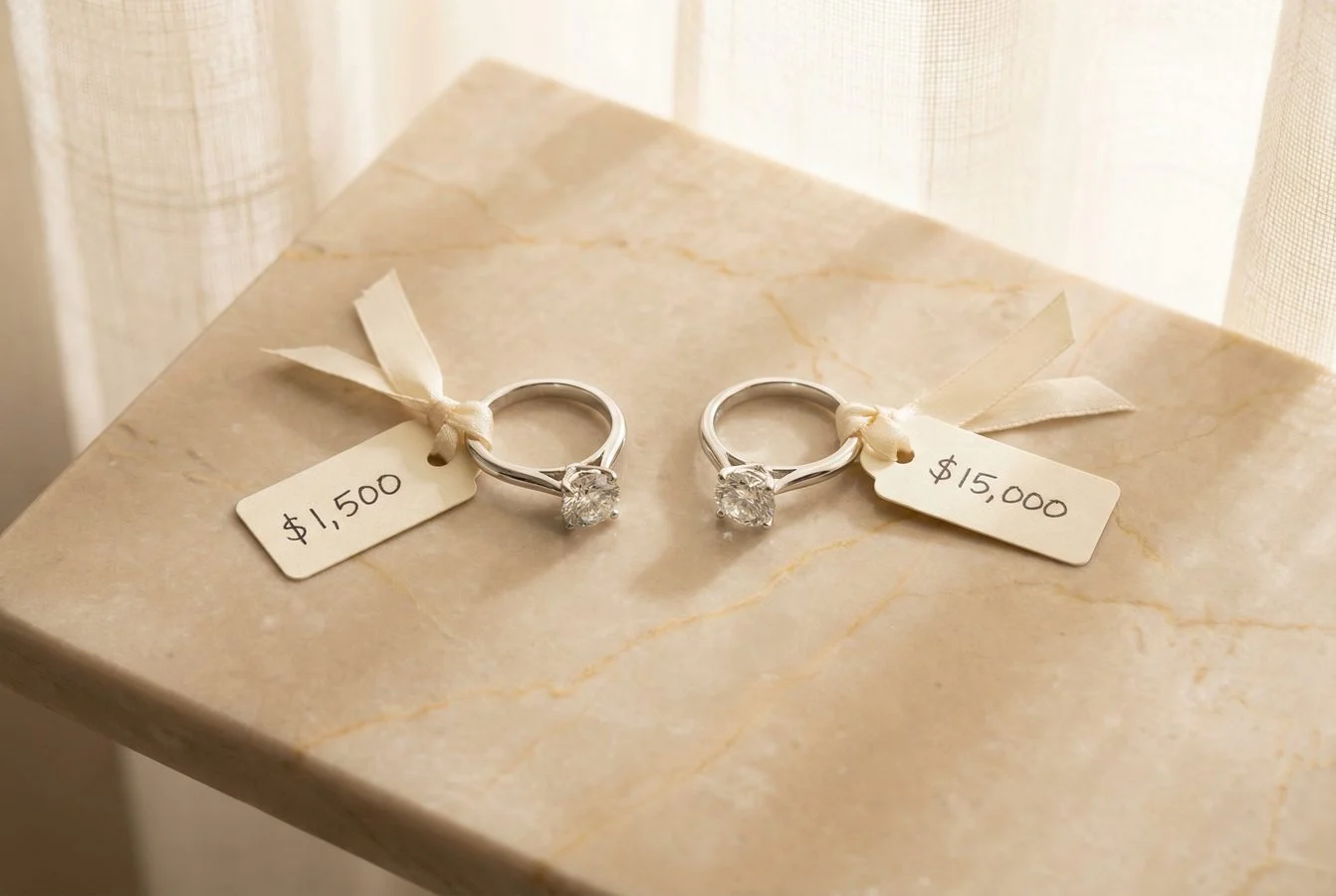
Let’s break down the financial reality using a concrete, realistic example from the year 2026. We’ll compare the purchase of a 2.00-carat diamond (colour E, clarity VS1, excellent cut, certified) as both a natural diamond and a lab-grown diamond.
| factor | Natural Diamond (Mine) | Lab-Grown Diamond (CVD) |
|---|---|---|
| Purchase Price (Retail) | approx. 18,000 € | approx. 2,500 € |
| Optics & Chemistry | 100% Diamond | 100% diamond (often pure, Type IIa) |
| Resale Value (Estimate) | approx. 7,000 € (wholesale) | approx. €250–€500 |
| Actual financial loss | - 11.000 € | - 2.250 € |
This table reveals a truth that is often kept hidden: Yes, in absolute terms, a natural diamond has a higher resale value. But the financial loss you incur (the money that has actually left your wallet) is nearly five times as high with a natural diamond!
With the lab-grown diamond, you’ve saved €15,500 from day one. You can invest that money in an unforgettable honeymoon, use it as a down payment on a house, or actually invest it in ETFs or stocks—things that generate real financial returns.
Never buy a diamond—whether natural or lab-grown—with the expectation of selling it later for a profit. Buy it because it’s beautiful, because it’s a symbol of your love, and because it fits within your budget without forcing you to go into debt.
3. The Resale Value of Lab-Grown Diamonds: The Unvarnished Truth
At Velur, we stand for absolute transparency, even when it’s uncomfortable. That’s why we don’t want to mislead you: The resale value of a lab-grown diamond engagement ring on the open secondary market is currently very low and is unlikely to rise in the foreseeable future. If you buy a lab-grown diamond today, from a purely financial perspective, you should expect to be able to resell it on the open market (e.g., to pawn shops, online buyers, or other jewellers) for only a small fraction of the original purchase price—realistically, perhaps 10% to 20%.
The reason for this is not that lab-grown diamonds are “inferior” or “fake” (they are 100% chemically, physically, and optically identical to natural diamonds). The reason lies in the nature of technology and the market economy. Over time, technology becomes increasingly efficient and affordable. Think of flat-screen TVs, smartphones, or solar panels. Production costs for modern manufacturing processes such as CVD (Chemical Vapor Deposition) have fallen steadily and significantly over the past five years. At the same time, more and more state-of-the-art labs around the world have ramped up production, leading to a massive increase in the supply of high-quality, flawless stones.
Since wholesalers and jewellers can purchase brand-new, perfectly cut, and certified lab-grown diamonds directly from the labs at extremely low prices at any time, there is simply no economic incentive for them to buy used lab-grown diamonds from private individuals at high prices. The secondary market for lab-grown diamonds is therefore extremely illiquid.
But—and this is the crucial “but”—as we explained in detail in the calculation example above, this low resale value is completely irrelevant in the bigger picture. Why? Because the “value” of the lab-grown diamond lies not in its future selling price, but in the money you didn’t have to spend in the first place. If you save €15,000 on the purchase, it’s mathematically and logically irrelevant whether you could later sell the ring for €500 or €5,000. You already have that capital in your pocket today and can put it to profitable use elsewhere.
Opportunity Costs: What You Can Do with the Money You Save
In economics, there is a concept known as “opportunity cost.” This refers to the lost profits that result from choosing one course of action over others, thereby ruling out those alternatives. If you invest €18,000 in a natural diamond, that money is tied up. It does not generate interest.
If, instead, you spend €2,500 on an identical-looking lab-grown diamond from Velur and invest the remaining €15,500 conservatively (e.g., in a broadly diversified global ETF with a historical average return of approximately 7% per year), that €15,500 will have more than doubled to over €30,000 after 10 years thanks to the power of compound interest. After 20 years, it would be nearly €60,000. That is the true financial value of a lab-grown diamond: the financial freedom and opportunities it affords you.
4. Why are lab-grown diamonds so much cheaper in the first place?
A common psychological fallacy, especially in the luxury segment, is: “If it’s cheaper, the quality must necessarily be lower.” With lab-grown diamonds, the exact opposite is true. They aren’t cheaper because they’re inferior—on the contrary, many CVD lab-grown diamonds fall into the rare Type IIa classification, which is chemically purer than 98% of all mined diamonds. They’re cheaper because the way they’re produced and traded is fundamentally more modern, efficient, and ethically sound.
Here are the three main reasons for the huge price difference:
- Elimination of extremely expensive and environmentally harmful mining: To find a single carat of high-quality natural gem-grade diamond, an average of 250 metric tons of soil and rock must be blasted, mined, and transported from the Earth’s crust. This requires the operation of gigantic mine craters stretching for kilometres, the use of massive heavy machinery, the consumption of millions of liters of diesel fuel, and an enormous—and often dangerous—amount of human labor. The environmental and social costs of this process are immense—and these costs are directly factored into the final price of natural diamonds. None of this is necessary with lab-grown diamonds. The labs require only advanced technology, carbon gases (in the CVD process), and energy, which is increasingly sourced from renewable sources.
- A drastically shortened and more transparent supply chain: The supply chain for a natural diamond is notoriously long, opaque, and inefficient. On its journey from the mine (for example, in Botswana, Canada, or Russia) through the rough diamond dealer, the cutting facility (usually in Surat, India), the wholesaler (in Antwerp, Tel Aviv, or New York), and various intermediaries to the local jeweller, a natural diamond often changes hands a dozen times. At each of these stages, the respective dealer adds their own profit margin. In the end, the consumer pays for all these accumulated margins. In contrast, the supply chain for lab-grown diamonds is extremely short: the stone often goes directly from the high-tech lab to the cutting facility and from there directly to direct-to-consumer brands like Velur. We cut out the middlemen and pass these massive savings directly on to our customers.
- The End of the Artificial Monopoly: For nearly a century, the market for natural diamonds was strictly controlled by a handful of large cartels (led by De Beers). These companies owned most of the mines and controlled global distribution. They artificially restricted the supply of rough diamonds and held them back in vaults to keep prices on the world market astronomically high. Geologically speaking, diamonds are not nearly as rare as marketing would have us believe—their rarity has been artificially manufactured. The market for lab-grown diamonds, on the other hand, is a free, technology-driven, and highly competitive market without monopolists. Here, prices are determined by actual production costs, efficiency, and innovation, not by artificial scarcity.
5. The True Value: An Emotional Legacy for Eternity
So, if we’ve established that a diamond—regardless of its origin—is not a sound financial investment, what is it then? The answer is more profound: It is an emotional investment. It is the ultimate symbol of love, devotion, loyalty, and a promise of a shared future. It marks the beginning of a new family. And in this very respect, a lab-grown diamond is absolutely identical to a natural diamond, yet offers additional ethical and financial benefits.
A lab-grown diamond is not a "fake" stone. It consists of 100% pure, crystallized carbon in a cubic crystal lattice. It possesses the exact same optical properties (refractive index, dispersion, fire) and the same physical properties as a mined diamond. It has an unmatched hardness of 10 on the Mohs scale, making it the hardest known material on Earth. In practical terms, this means: A lab-grown diamond will never get scratched (unless scratched by another diamond); unlike cubic zirconia or cheap imitations, it will never become cloudy, milky, or dull; and in 500 years, it will still sparkle just as brilliantly as it did on the day you slipped it onto your partner’s finger.
Is a lab-grown diamond a worthy heirloom? This question is often asked by skeptics who doubt the “romance” of the lab. Our answer is a clear, unequivocal “yes.” Think about it: When you pass this engagement ring down to your daughter, son, or daughter-in-law in 40 or 50 years, the emotional value of this ring will not be defined by the geological origin of the carbon. Half a century from now, no one will ask whether the carbon in this stone was compressed under high pressure deep underground for millions of years, or whether it was grown in a modern, high-tech laboratory using clean energy in just a few weeks.
The true, priceless value of this heirloom lies in the story it holds. It is the story of your marriage. It is the memory of the day of the proposal, of all the years you’ve spent together, and of the ups and downs you’ve weathered side by side. A lab-grown diamond is a flawless, ethically sourced, and conflict-free vessel for these priceless memories. It is a symbol untainted by environmental destruction or questionable labor practices. What could be a more beautiful legacy?
Maximum Value, Uncompromising Quality
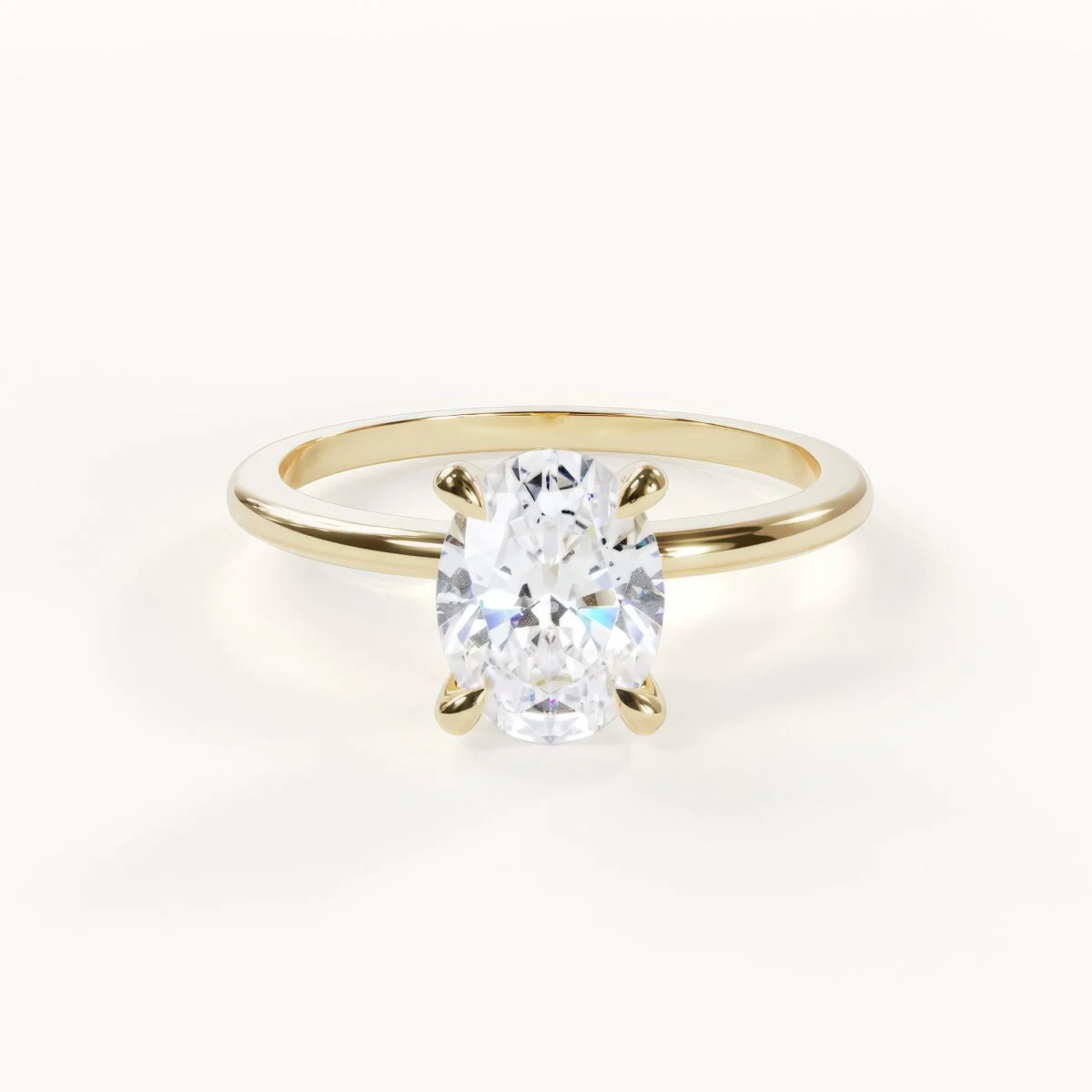 Bestseller
Elegance Solitaire Oval
Bestseller
Elegance Solitaire Oval
Classic oval cut for maximum apparent size and elegance.
starting at €1,120 Discover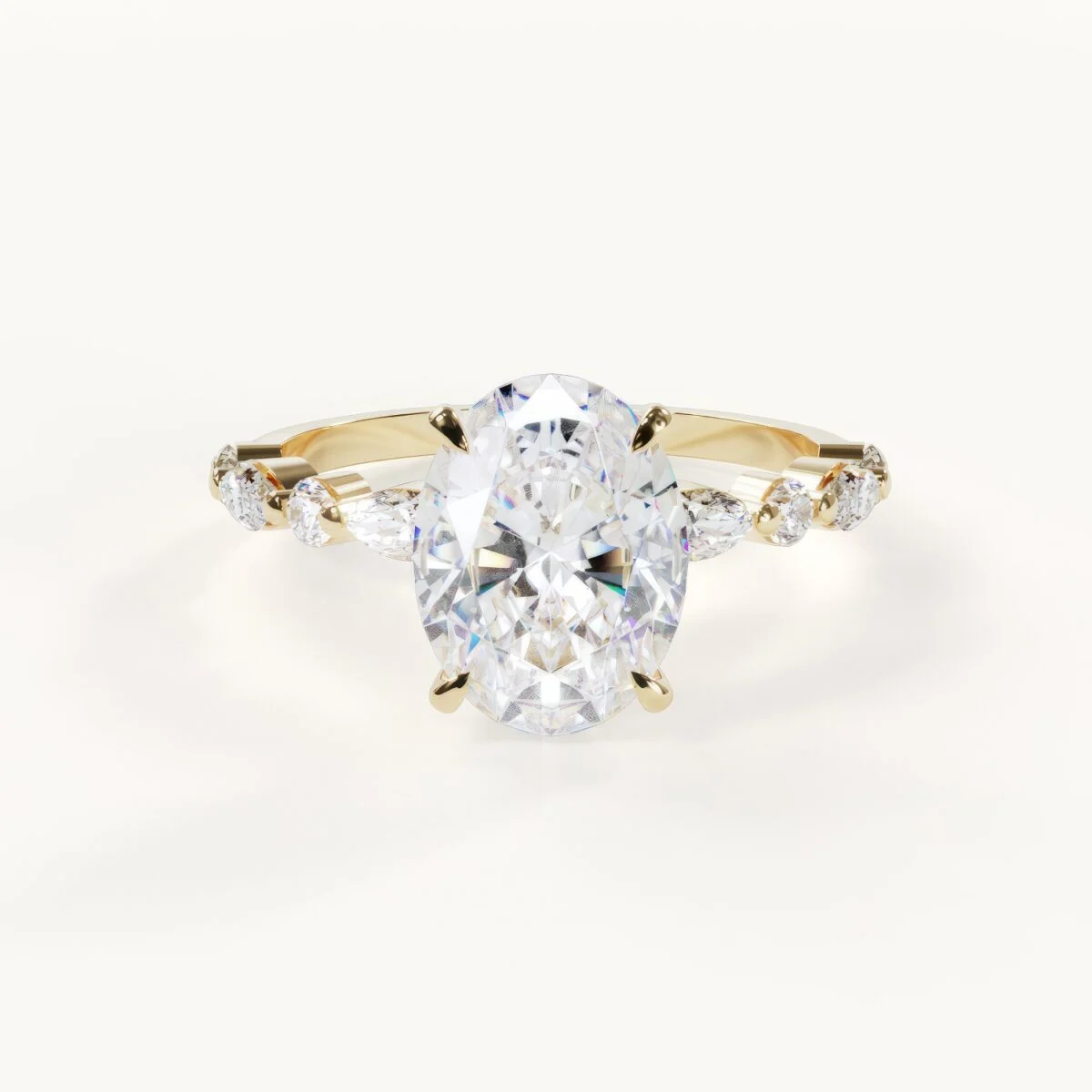 Premium
Eternal Light
Premium
Eternal Light
A radiant brilliant-cut diamond with a sparkling hidden halo detail.
starting at €1,600 Discover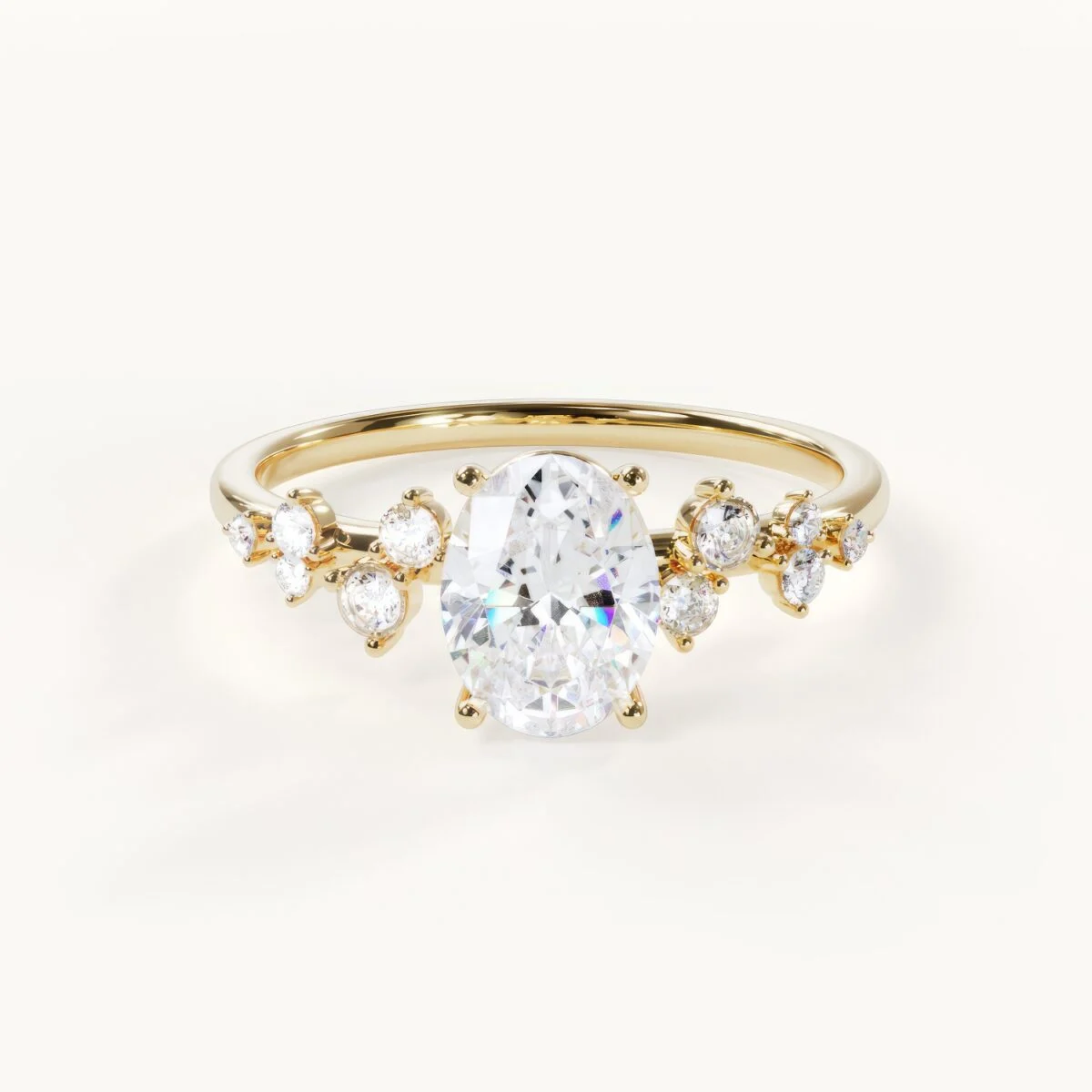 New
Floral Oval Ring
New
Floral Oval Ring
Romantic design with floral accent stones.
starting at €1,300 DiscoverFrequently Asked Questions (FAQ)
No. If you buy a commercial natural diamond (under 5 carats) from a jeweller, you’ll lose about 50% to 70% of the price you paid as soon as you leave the store. With the exception of extremely rare coloured stones, natural diamonds are not a good financial investment.
Yes, there are now platforms and retailers that buy lab-grown diamonds. However, the resale value on the open market is low (about 10–20% of the purchase price), as production costs are steadily declining. The true financial value lies in the enormous savings realised at the time of the initial purchase.
Absolutely. A lab-grown diamond has a hardness of 10 on the Mohs scale and will last forever. It can be passed down through generations. The emotional value of an heirloom is defined by the love and family history associated with it, not by the geological origin of the carbon.
The price difference is primarily due to the drastically shorter and more efficient supply chain. A natural diamond must be mined deep underground, transported halfway around the world, and traded through dozens of middlemen, all of whom add their own markup. Lab-grown diamonds go directly from the lab to the cutting facility and then to us.
Ready to make a smart decision?
Save on price, not on quality. Discover our engagement rings featuring flawless lab-grown diamonds.