

Engagement Ring Budget: How Much Should You Really Spend?
Average costs in Germany, honest budget recommendations, and why the "three months' salary" rule is long outdated.
In a nutshell
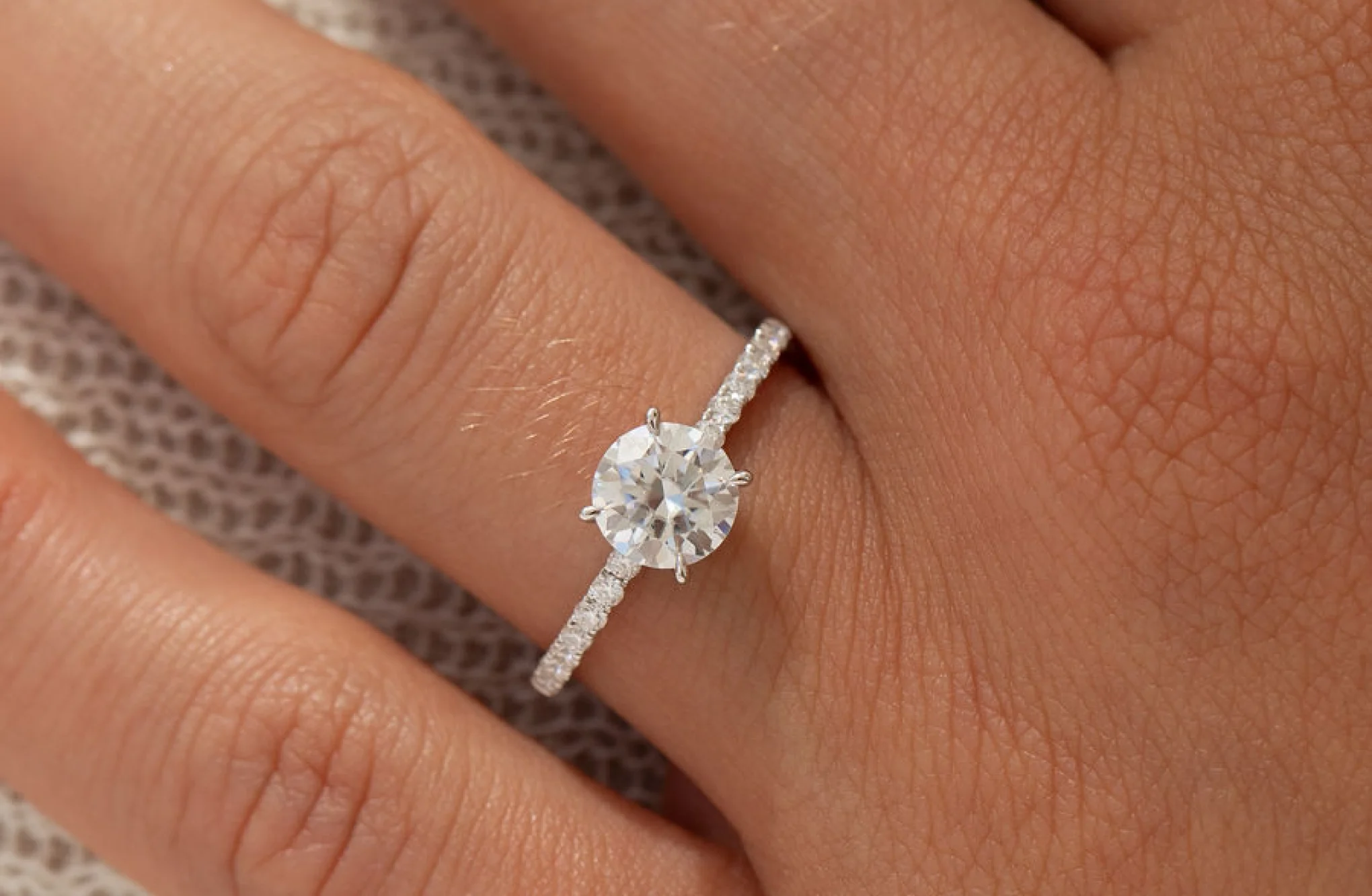
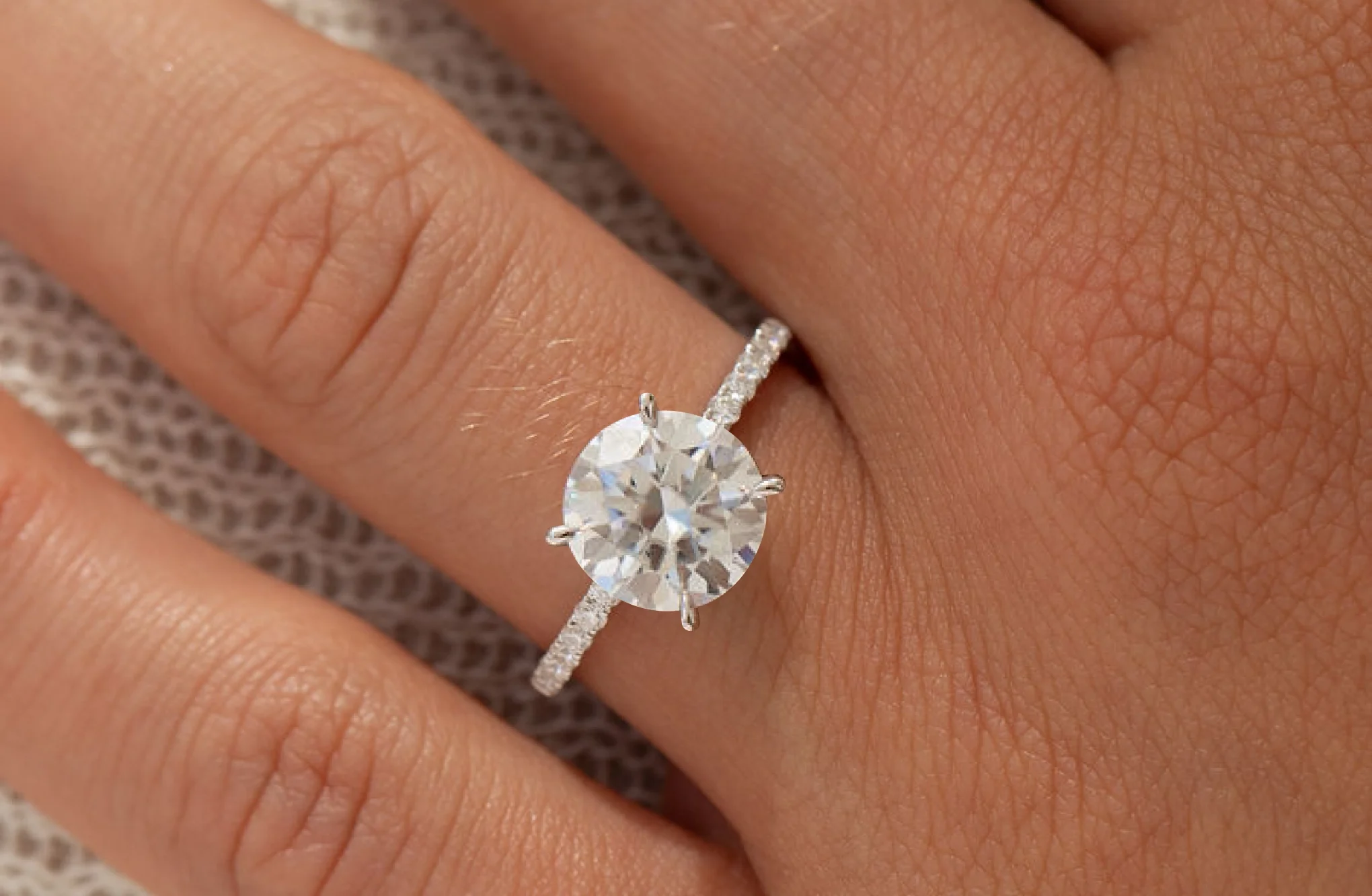
Couples in Germany spend an average of about 1,125 euros on an engagement ring. The typical range is between 250 and 2,000 euros. The famous “three-months’ salary rule” originated in an advertising campaign from the 1930s and has no tradition in Germany. What matters most is that the ring fits your budget—not some arbitrary rule of thumb. At Velur, you can find handcrafted engagement rings made of solid gold with certified gemstones starting at 780 euros, including free engraving and 180 days of resizing.
You've made up your mind: You want to propose to her. Now comes the question that makes almost every man break out in a sweat—not "Will she say yes?" but "How much do I have to spend on the ring?"
If you Google “engagement ring costs,” you’ll find everything from “Three months’ salary is a must” to “It’s all about the gesture.” The truth lies somewhere in between—and depends mainly on what you get for your money.
In this guide, we’ll debunk outdated rules of thumb, show you what engagement rings really cost in Germany, and explain why you can get more for your budget than you think—if you know where to shop.
The Myth of the Three Months' Salary
The idea that an engagement ring should cost three months' salary is one of the most persistent myths in the jewellery industry. And that's exactly what it is: a myth—invented by a marketing department.
How It All Began: De Beers and the Greatest Advertising Campaign of All Time
In the 1930s, the South African diamond company De Beers had a problem: The Great Depression had caused the diamond market to collapse. Most engagement rings didn’t even contain diamonds. So De Beers commissioned the advertising agency N.W. Ayer to create a campaign that would change that.
The result? The famous slogan “A Diamond Is Forever” (1947) and the rule of thumb that a man should spend one month’s salary on the ring. In the 1980s, that became “two months’ salary,” and later even three. Not because it was tradition—but because De Beers wanted to sell more diamonds.
“The tradition of the diamond engagement ring is not a tradition. It is one of the most successful marketing campaigns of the 20th century.”
BBC News, “The De Beers Myth: Do People Spend a Month’s Salary on a Diamond?”
Why the rule has never worked in Germany
While the campaign was hugely successful in the U . S. and Japan, it never really caught on in Germany. German couples are more pragmatic: Most men spend less than 2,000 euros on an engagement ring, and many even spend less than 1,000 euros. And that’s perfectly fine.
Because let's be honest: Anyone who spends three months' salary on a ring might have a problem afterward—namely, financing the wedding. And in Germany, that costs an average of between 15,000 and 30,000 euros.
The Honest Rule of Thumb
Spend as much as you can afford without going into debt or feeling guilty. Whether that’s 500 euros or 5,000—the ring should bring you joy, not financial stress.
How much does an engagement ring really cost in Germany?
The answer depends on who you ask. Various studies come to slightly different conclusions—but the picture is clear: German couples spend significantly less than American couples.
| Source | Average (DE) | Typical range |
|---|---|---|
| Bridebook Weddings Report 2026 | 1.125 € | 250–1,400 € |
| Research and Knowledge (2023) | Less than €2,000 (57%) | 100–2,000 € |
| Statista / Industry Estimate | 500–2,000 € | Typical for DE |
By way of comparison: In the U.S., the average is around $6,800 (approx. 6,300 euros). That is more than five times the German average. The reason? In the U.S., the De Beers tradition is more deeply rooted, and the market is dominated by large jewellery chains that charge high margins.
Don't let average figures put pressure on you. The "right" amount is whatever gets you a ring that makes her happy—without having to eat pasta with ketchup for three months. If you're unsure, message us on WhatsApp —we'll help you get the most out of your budget.
The 5 Biggest Price Factors
Why does one ring cost 500 euros and another one that looks almost identical cost 5,000? These five factors determine the price—and with some of them, you can save money without compromising on quality.
The Stone: The Biggest Price Driver
In most engagement rings, the stone accounts for 60 to 80 percent of the total price. For diamonds, the “4 Cs” determine their value: carat (weight), cut, clarity, and colour. A small, perfectly cut diamond can be more expensive than a larger one with visible inclusions.
This is also where the greatest potential for savings lies: moissanite and lab-grown diamonds offer the same appearance at a fraction of the price. Learn more in the section on moissanite.
The material: gold, platinum, or silver?
The precious metal affects not only the price but also the durability. 14K gold (585) is the most popular choice in Germany—it offers the best balance of luster, hardness, and price. 18K gold (750) has a richer golden hue but is softer and more expensive.
Platinum is the most durable material, but it costs significantly more than gold. Silver is inexpensive, but it tarnishes and isn't ideal for a ring worn every day. All Velur rings are made of solid gold (14K or 18K)—no gold-plated silver, no brass.
The Setting: Solitaire, Halo, or Pavé?
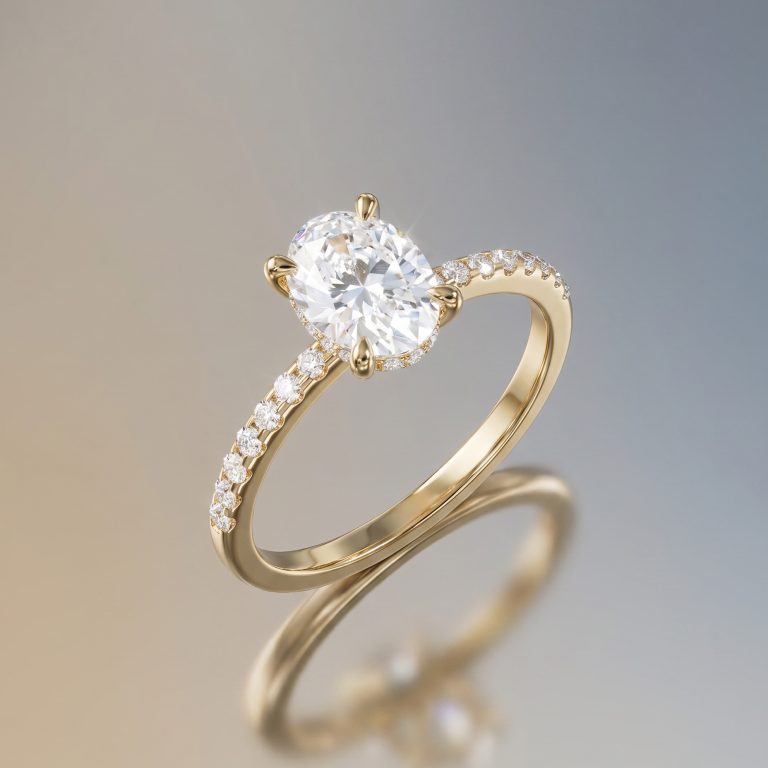
A simple solitaire (a single stone) is usually less expensive than a halo ring (a centre stone surrounded by smaller stones) or a pavé ring (stones set in a band). The reason: More stones mean more material and more manual labor involved in setting them.
The advantage of halo and pavé settings: The centre stone appears larger than it actually is. A 0.5-carat stone in a halo setting can look like a 1-carat solitaire—at a significantly lower price. Learn more: Solitaire, Halo, or Pavé?
The Brand: Jewellery Store Markup vs. Direct Sales
A ring from Tiffany, Cartier, or Christ can cost two to three times as much as a comparable ring—even if the materials are of the same quality. Why? Because you’re also paying for the downtown store rent, the sales staff, inventory, and the brand name.
Direct-to-consumer brands like Velur bypass these costs and pass the savings on to you. The result: the same quality, at up to 50% less.
Extras: Engraving, Certificate, Packaging
An engraving at a jeweller often costs an extra 30 to 80 euros. A gemstone certificate (GIA, IGI, or GRA) is standard at high-quality retailers, but some charge extra for it. And what about the packaging? A nice ring box should go without saying—but that’s not always the case.
At Velur , engraving, a certificate, and a ring box are included with every ring. No hidden costs.
Budget Guide: What Do You Get for Your Money?
Instead of telling you how much you “should” spend, we’d rather show you what you actually get for different budgets. Because in the end, it’s not the price that counts—it’s what you get in return.
- Solitaire Ring in 10K Solid Gold
- Moissanite 0.5–1 carat
- Classic Cuts (Round, Oval)
- Includes engraving and certificate
- Solitaire or Halo in 14K/18K solid gold
- 1–2-carat moissanite or lab-grown diamond
- All Cuts & Settings
- Accent stones are an option
- Includes all extras
- Intricate Designs (Hidden Halo, Pavé)
- Larger stones (2–5 carats)
- Lab-grown diamonds with higher carat weights
- 18K gold or platinum
- Custom-Made Products
The Sweet Spot for Most Couples
Most Velur customers opt for a budget between 1,000 and 1,600 euros. Within this price range, you’ll receive a handcrafted solid-gold ring featuring a stunning stone—comparable to rings that would cost between 2,500 and 4,000 euros at a jewellery store.

Jewellery Store vs. Online: An Honest Price Comparison
Why do rings cost so much more at a jewellery store? And is “buying online” really safe? Here’s a transparent comparison.
| Criterion | Traditional Jeweller | Velur (D2C) |
|---|---|---|
| price premium | 100–300% above the material value | Fair direct price, no middlemen |
| Material | Silver, often gold-plated, in the entry-level segment | Always 14K or 18K solid gold |
| Certificate | Often only for an additional fee | GRA/IGI certificate included |
| Engraving | 30–80 € extra | Included for free |
| Size Adjustment | One-time, often subject to a fee | 180 days free |
| Consulting | In-store (subject to availability) | WhatsApp, anytime, in person |
| Warranty | Statutory Warranty (2 years) | Lifetime Warranty Against Material Defects |
"At a jewellery store, you're not just paying for materials and craftsmanship, but also for store rent, staff, and brand image. That can quickly double the price—even for comparable quality."
Stiftung Warentest, Guide to Buying Jewellery
That doesn't mean every jeweller is bad. But it does mean that for the same price, you can often get a much better ring online—provided you buy from a reputable seller that offers certificates, a warranty, and transparent communication.
Moissanite: The Smart Alternative
If you want to get the most out of your budget, there’s no getting around moissanite. This lab-created gemstone is perhaps the biggest revolution in the jewellery industry—and the reason why Velur rings can offer such high quality for so little money.
What is moissanite?
Moissanite (silicon carbide) was discovered in 1893 by Henri Moissan in a meteorite crater. Today, it is produced under controlled conditions in a laboratory—chemically pure, ethically sound, and visually stunning. With a hardness of 9.25 on the Mohs scale (diamond: 10), it is the second-hardest gemstone in the world and perfectly suited for everyday wear.
| Property | Moissanite | Natural Diamond | Lab-grown diamond |
|---|---|---|---|
| Price (1 carat, comparable) | 300–600 € | €4,000 – €8,000 | 1,500–4,000 € |
| Hardness (Mohs) | 9,25 | 10 | 10 |
| Brilliance (Index of Refraction) | 2.65 – 2.69 (higher) | 2,42 | 2,42 |
| Fire (Dispersion) | 0.104 (more rainbow colours) | 0,044 | 0,044 |
| Origin | Laboratory (ethical) | Mining | Laboratory (ethical) |
| Certificate | GRA | GIA / IGI | IGI / GIA |
| Visible to the naked eye? | Hardly—it actually sparkles even more intensely | Reference | Indistinguishable |
What does that mean for the budget?
To be specific: For the price of a 0.5-carat diamond at a jeweller’s, Velur offers you a 2-carat moissanite set in solid gold —including engraving, a certificate, and a ring box. The visual difference? Practically nonexistent to the naked eye. The price difference? Enormous.
Calculation Example
Jeweller: 1-carat solitaire diamond in 18K gold → approx. 5,000 – 8,000 €
Velur: 1-carat solitaire moissanite in 14K solid gold → starting at 1,120 €
Savings: 3,880 – 6,880 € – with comparable appearance and durability.
You can learn more about the differences between moissanite and lab-grown diamonds in our in-depth comparison: Why Moissanite?

7 Tips for Getting More Value for Your Money
Choose moissanite or a lab-grown diamond instead of a natural diamond
By far the greatest value. You save 70–90% on the stone—the most expensive part of the ring—without compromising on appearance. Moissanite actually sparkles even more intensely than a diamond.
Buy directly from the manufacturer
Every middleman drives up the price. With direct-to-consumer brands like Velur, you pay the manufacturer’s price—no jeweller’s markup, no brand premium. The quality stays the same, but the price goes down.
14K instead of 18K gold
14K gold (585) is not only more affordable, but also harder and more scratch-resistant than 18K gold. For a ring worn every day, 14K is often the better choice—visually, the difference is minimal.
Take Advantage of the Halo Effect
A smaller centre stone in a halo setting appears significantly larger. A 0.5-carat stone with a halo can look like a 1-carat solitaire—at a fraction of the price.
Pay attention to the included extras
Engraving, certificate, ring box, resizing—these “extras” can quickly add 100–200 euros to the total at a jewellery store. At Velur, everything is included in the price.
Choose an oval or marquise cut
Oval and marquise engagement rings appear larger than round stones of the same carat weight because they have a longer surface area. At the same time, they are often slightly more affordable than the classic round cut. Read more: Why the oval cut will dominate in 2026
Get advice—for free
A good advisor helps you get the most out of your budget. At Velur, you can chat with our team on WhatsApp anytime—for free, with no obligation, and without any sales pressure. We also craft custom rings tailored to your exact preferences.
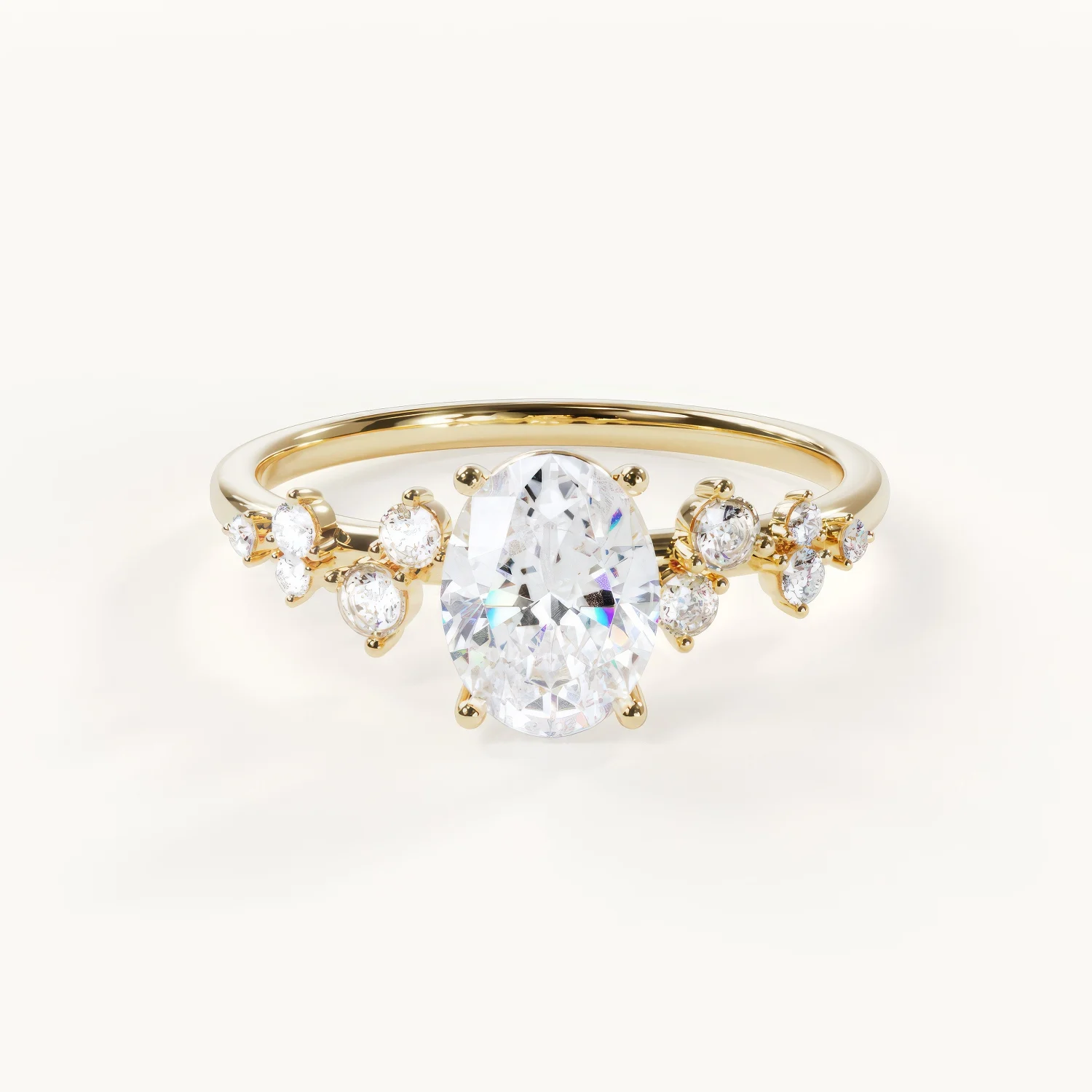
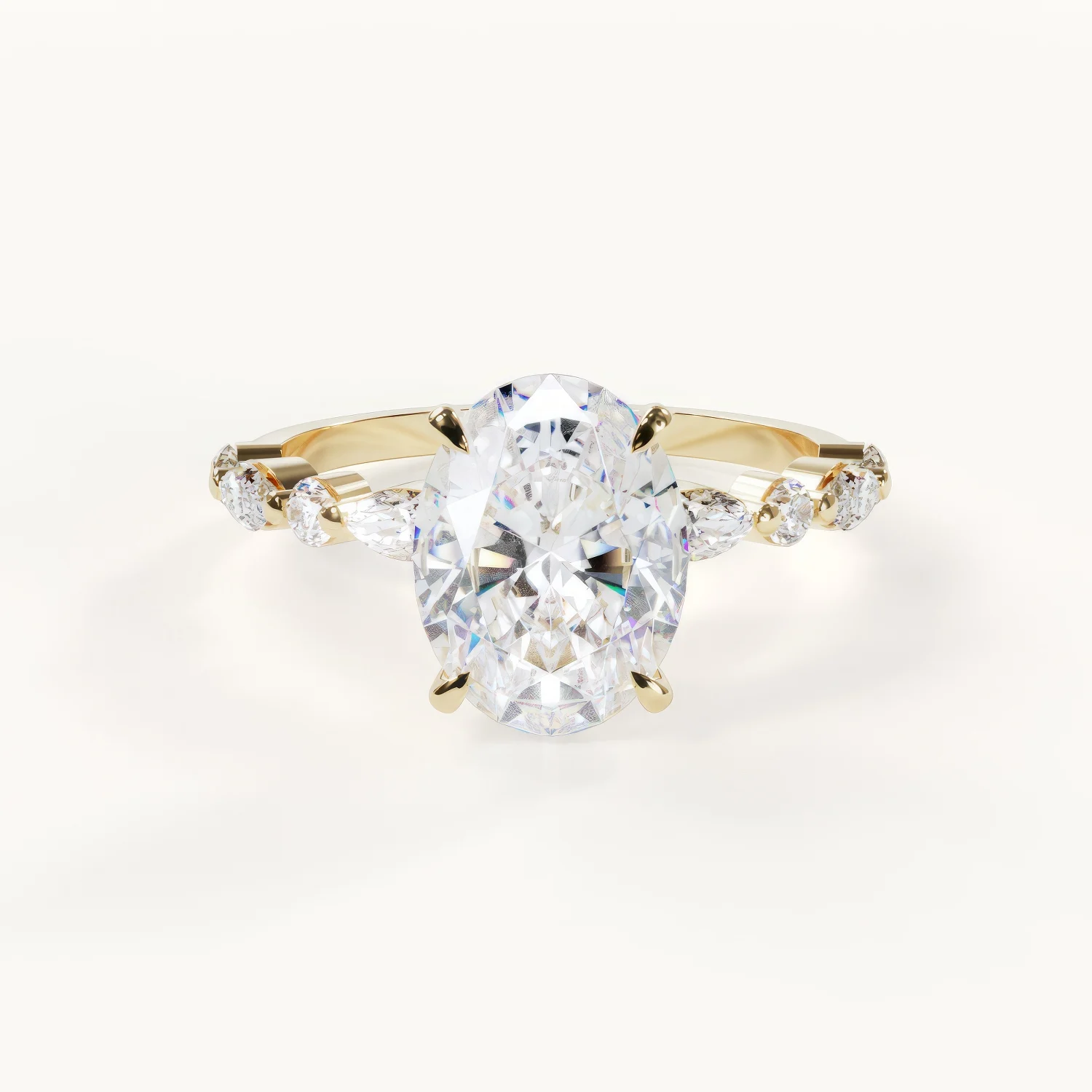
Our Most Popular Engagement Rings
Handcrafted from solid gold. With certified gemstones. No jeweller's markup.
Frequently Asked Questions About the Engagement Ring Budget
According to the Bridebook Weddings Report 2026, couples in Germany spend an average of about 1,125 euros on an engagement ring. The typical range is between 250 and 1,400 euros, with about 10% of couples spending more than 2,440 euros. By comparison, the average in the U.S. is about 6,800 dollars.
No. This “rule” originated from a marketing campaign by the De Beers diamond company in the 1930s. It has never really been a tradition in Germany. Most German couples spend between 500 and 2,000 euros—regardless of their income. Spend as much as you can afford without going into debt.
Traditional jewellers have high fixed costs: store rent in downtown locations, sales staff, inventory, and brand licenses. These costs are added to the price of the ring—often 100 to 300% above the cost of materials. Direct-to-consumer brands like Velur bypass these markups and pass the savings directly on to you.
Moissanite costs about 70 to 90 percent less than a comparable diamond. A 1-carat moissanite costs approximately 300–600 euros, while a 1-carat diamond of comparable quality costs 4,000–8,000 euros. Visually, the two are virtually indistinguishable to the naked eye—moissanite even sparkles more intensely thanks to its higher refractive index.
Yes. Lab-grown diamonds are chemically, physically, and optically identical to natural diamonds, but cost 30–50% less. They are produced under controlled conditions and are the more ethical choice. At Velur, all lab-grown diamonds are IGI-certified.
Yes. Velur offers 180 days of free resizing for all engagement rings. In addition, you have the option to exchange the ring for a different model free of charge or receive a refund (minus a 20% processing fee, provided the ring meets the specifications).
Studies show that, for most women, the emotional significance of the proposal is more important than the price of the ring. A well-thought-out proposal with a ring that fits your budget is better than an expensive ring accompanied by a half-hearted proposal. Tip: Save money on the ring in a smart way (e.g., with moissanite) and invest in an unforgettable proposal experience. More ideas: The Perfect Marriage Proposal
For around 1,000 euros, Velur offers a handcrafted engagement ring made of 14K solid gold with a GRA-certified moissanite stone (up to 1 carat). Includes free engraving, an elegant ring box, a certificate of authenticity, and 180 days of size adjustments. Comparable rings often cost two to three times as much at a jeweller’s.
Related Articles
Ready for the next step?
Find the ring that fits your budget and your story—without compromising on quality.