Is it possible to tell lab-grown diamonds apart from real diamonds?
An honest look behind the scenes: What happens when you examine a lab-grown diamond under a magnifying glass? The answer surprises even the experts.
In a nutshell
In short: No. To the naked eye, with a jeweller’s loupe, or using a standard diamond tester, a lab-grown diamond cannot be distinguished from a natural diamond. Both are 100% carbon. Only specialized gemological laboratories can determine their origin based on their atomic structure (Type IIa) and growth patterns.
The Test with the Naked Eye
It's the most common question we get asked at Velur: "Can you tell that it's not a 'real' diamond?" The answer is a clear, scientifically proven "no."
A lab-grown diamond is neither cubic zirconia nor moissanite. It is a real diamond. It has the same hardness (10 on the Mohs scale), the same refractive index (2.42), and exactly the same fire (dispersion). If you place two stones with the same 4C grading side by side—one from a mine, one from a lab—not even an expert can tell which is which with the naked eye.
Why Diamond Testers Fail
Perhaps you've seen a jeweller hold a small pen (known as a "diamond tester") up to a stone, causing it to beep and glow green. Many people believe this test will expose a lab-grown diamond. That's not true.
Standard diamond testers measure a stone's thermal conductivity and, in some cases, its electrical conductivity. Since a laboratory-grown diamond consists of 100% crystallized carbon, it conducts heat exactly the same way as a natural diamond. Therefore, the device will always display "diamond."
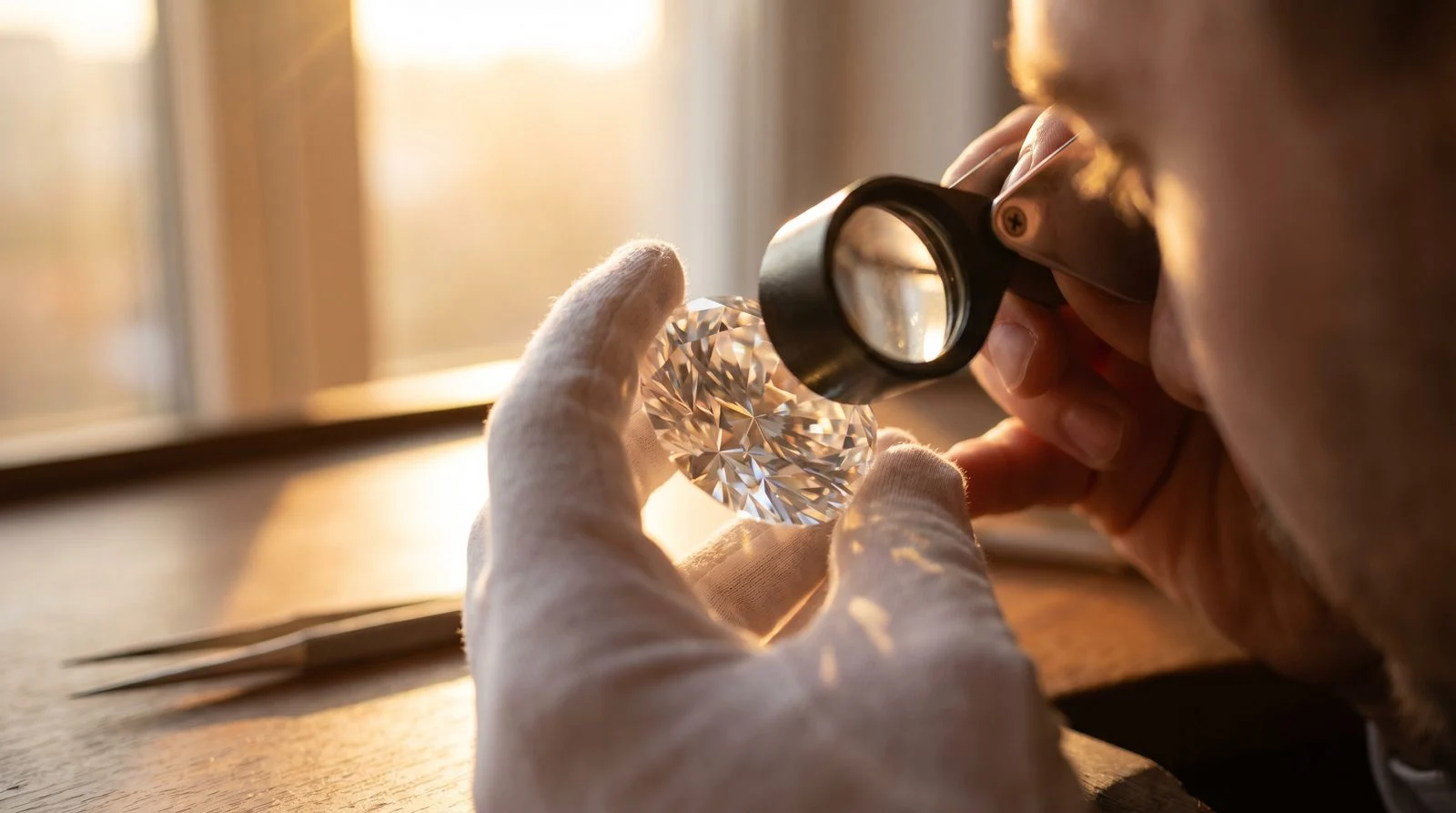
What does the jeweller see under the magnifying glass?
Even under a 10x jeweller’s loupe, the secret usually remains hidden. Natural diamonds have inclusions—small imperfections that formed during their growth over billions of years. Lab-grown diamonds also have inclusions, since their growth process in the lab (CVD or HPHT) mimics natural conditions.
Just one small note
Diamonds grown using the HPHT (High Pressure, High Temperature) process may sometimes contain tiny metallic inclusions. These are not typical of natural diamonds. However, in high-quality stones with VVS or VS clarity, these inclusions are microscopic anyway and can hardly be detected without specialized equipment.
How the Lab Finds the Difference
If neither the naked eye, nor a tester, nor a magnifying glass can help—how do certification institutes like IGI or GIA know for sure? They use highly complex machines that cost millions.
The Nitrogen Test (Type IIa)
About 98% of all natural diamonds contain tiny traces of nitrogen (Type Ia). Laboratory-grown diamonds, on the other hand, are usually grown completely pure, without nitrogen (Type IIa). A spectrometer measures this. If a stone is Type IIa, there is an extremely high probability that it was grown in a laboratory.
Fluorescence Patterns (DiamondView)
Devices such as De Beers’ DiamondView expose the stone to extremely short-wavelength UV light. Natural diamonds exhibit a different fluorescence pattern (usually blue) than lab-grown diamonds, which reveal specific fluorescence patterns due to their layer-by-layer growth (CVD) or sector-by-sector growth (HPHT).
In addition, all lab-grown diamonds feature a microscopic laser engraving on the girdle (the edge of the stone). It includes the certificate number and a notation such as "LG" or "Lab Grown." This engraving protects you as the buyer.
Conclusion: Should you care?
To be honest: No. The fact that a lab-grown diamond can only be identified as such using large-scale equipment in specialized laboratories is the ultimate proof of its quality.
You’ll receive a real diamond that is optically and chemically perfect. The only difference is where it was formed—and the fact that you’ll pay significantly less for an engagement ring with a lab-grown diamond and help protect the environment.
All of our Velur diamonds weighing 0.5 carats or more come with an independent IGI or GRA certificate. Do you have questions about quality? Message us directly on WhatsApp.
Frequently Asked Questions (FAQ)
Yes, a conventional diamond tester that measures thermal conductivity will always give a positive reading ("Diamond") for a lab-grown diamond. Chemically and physically, a lab-grown diamond conducts heat exactly the same way as a natural diamond.
No. Even with a 10x jeweller's loupe, it is nearly impossible for experts to distinguish a lab-grown diamond from a natural diamond. Both types may contain tiny inclusions resulting from natural or lab-induced crystal growth.
Renowned institutions such as the IGI and GIA test diamonds using specialized spectrometers. Among other things, they determine whether the stone contains nitrogen (natural diamonds) or not (mostly Type IIa lab-grown diamonds). The certificate then clearly identifies the origin as "Laboratory-Grown."
Yes, certified lab-grown diamonds typically feature a microscopic laser engraving on the girdle (the outer edge). This engraving includes the certificate number and, in most cases, an abbreviation such as "LG," which indicates that the diamond was created in a laboratory.
Type IIa is an extremely rare classification for natural diamonds (only about 1–2%), which contain virtually no nitrogen and are therefore exceptionally pure and colourless. Nearly all lab-grown diamonds are grown as Type IIa, which gives them exceptional optical clarity.








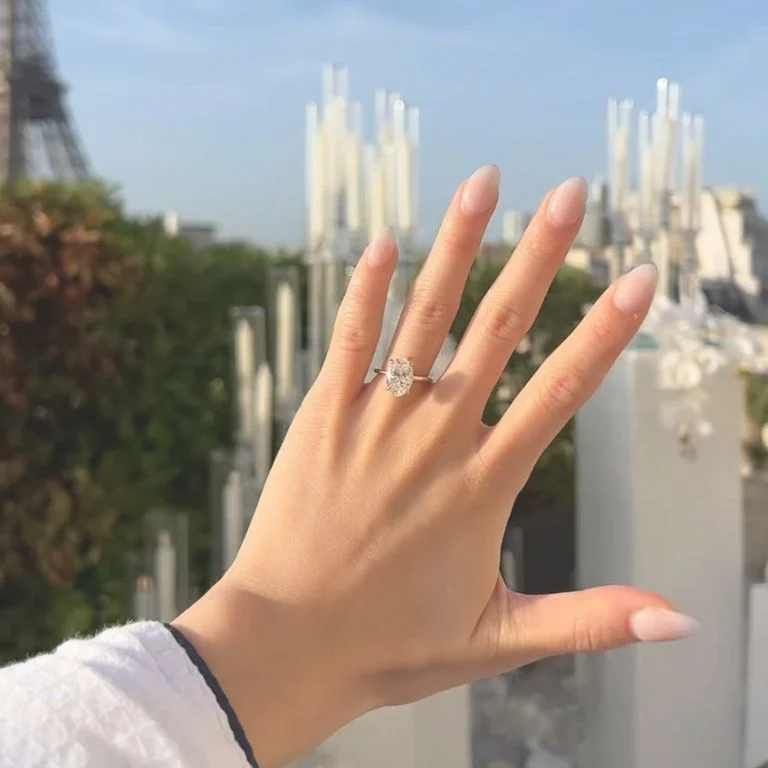


Find Your Perfect Ring
Discover our handcrafted engagement rings featuring premium-quality, lab-certified diamonds.