Princess-Cut Diamond: Proportions, Corners, and Secure Settings
The Princess Cut combines a clean, square outline with a vibrant sparkle. What matters most are not just the carat weight and certificate, but the visible size, the way it catches the light, and the protection of its four corners.
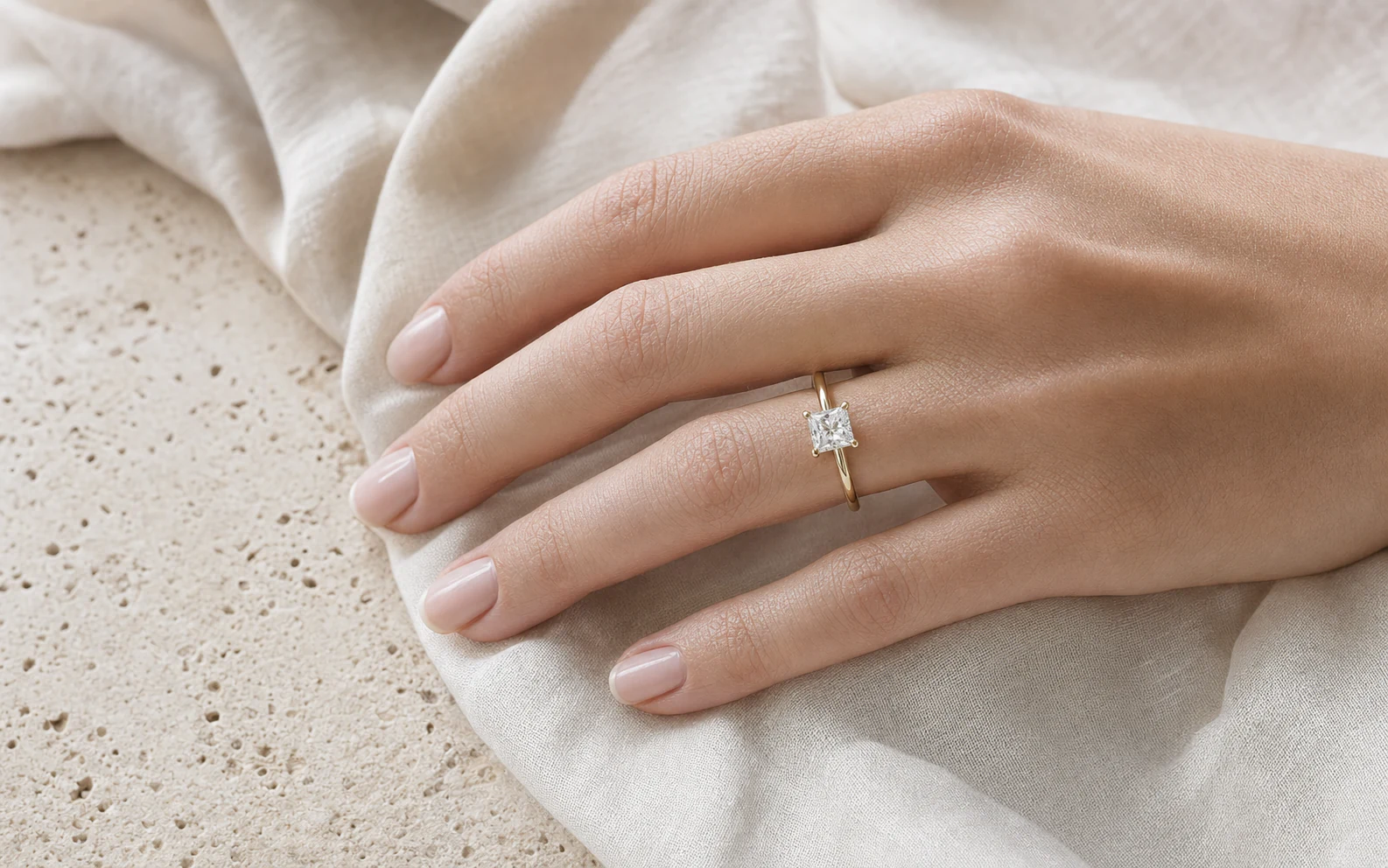
A good princess cut appears distinctly square when viewed from above, exhibits a balanced play of light across its surface, and does not lose an excessive amount of weight in depth. All four corners of the ring must be protected. Therefore, compare actual millimeter measurements and videos rather than just the carat weight, color, and clarity listed on the certificate.
The princess cut is often described as the square alternative to the round brilliant cut. While this captures its appearance, it does not reflect its design. Beneath the straight outer line lies a brilliant-cut-style faceting pattern. This creates many subtle shifts in light, while the silhouette remains clean and geometric.
It is precisely this combination that makes the cut so challenging. Two stones with the same carat weight may appear to be different sizes when viewed from above. A stone set too deep carries weight that is barely visible on the finger. Added to this are four sharp corners where the setting and the stone must fit together perfectly. Anyone who compares only the values listed on the certificate overlooks three of the most important purchasing criteria.
What is a princess-cut diamond?
Viewed from above, the classic princess cut has four straight sides and nearly right angles. In profile, the stone tapers downward like an inverted pyramid. The Gemological Institute of America notes that, as a result, some of the carat weight may be hidden within the pavilion. For this reason, a princess cut may appear smaller than a flatter, more proportionate stone of a different shape, even if they have the same weight.
On the inside, chevron-like facets create a finely detailed, lively pattern. This is not a step cut like that of an emerald. A princess cut should not only feature large, reflective surfaces but also display many clear light-dark contrasts when moved. Some stones appear sharp and high-contrast, while others are more delicate and sparkling. Which style is better depends on personal taste; however, gray, glassy, or permanently dark areas are a red flag.
Clearly square
Straight sides and precise corners give the stone its graphic, modern look.
Brilliant-cut
Many small reflections create a visible sparkle rather than smooth gradations.
Low Pavilion
The weight may be less than the frame's weight; therefore, millimeter measurements are crucial when making a purchase.
Most female buyers are looking for a stone that appears square. A length-to-width ratio close to 1.00 is a good starting point, but it’s not a strict quality standard. Even small deviations can be noticeable. If symmetry is important to you, don’t just ask for the measurements—be sure to look at the stone straight from above. Otherwise, the camera angle and the angle at which you view the ring can distort what is actually a square shape.
You can find other silhouettes and their effects in our comparison of engagement ring shapes. The princess cut fits in between the softer surface of the cushion cut and the elongated geometry of the radiant or emerald cuts.
Why Carats Don't Explain the Visible Size of a Princess Cut
Carat measures weight, not the surface area visible from above. Of two 1-carat stones, one may appear wider and more open, while the other may contain more material in a deep pavilion. That’s why the certificate lists the length, width, and total depth in millimeters. These three measurements, along with a video, should be included in the shortlist.
A stone with a large visible surface area isn’t necessarily good. If it’s cut too flat, light can escape, making the center appear transparent or lifeless. If it’s cut too deep, it loses its visual impact. The goal is to strike the right balance: a usable surface area, even brightness, and a pattern that responds across the entire surface when the stone is tilted.
| Checkpoint | What you'd like to see | What Can Be Critical |
|---|---|---|
| Length × Width | A visually square outline and a clearly defined area | Compare only carats, without taking millimeter measurements into account |
| Depth | A balanced ratio between surface area and light output | A lot of hidden weight, or a glassy, too-flat center |
| Symmetry | Straight sides, matching corners, and a balanced center | Distorted outline or noticeably uneven facet pattern |
| Video | Reflexes in Motion Under Neutral Daylight and Indoor Lighting | Just a heavily edited photo under a harsh spotlight |
We first compare Princess-cut stones based on their actual dimensions and the photo. A higher carat weight isn't worth it if the extra weight is concentrated at the bottom of the ring. What matters on the finger is what's visible from above and what sparkles as it moves.
Why the Four Corners Must Be Protected
Diamonds are very hard, but hardness does not mean they are unbreakable. The corners of a princess cut are thin and lie close to the crystal’s potential cleavage planes. The GIA specifically identifies these corners as areas that can chip off upon impact. Therefore, a ring should not allow them to protrude freely beyond the setting.
V-shaped prongs enclose a corner on two sides. Well-made corner prongs can also work if each tip is fully protected. A bezel or partial bezel setting surrounds more of the outer edge and reduces the surface area exposed to damage. It looks more closed off, but may be the safer choice for activities involving a lot of manual work or a very active lifestyle.
The key point is the design. A V-clasp must not simply apply pressure to the point of the stone. The GIA’s technical quality standard notes that direct contact between the corner and the V-clasp during an impact can contribute to breakage. The stone requires a properly prepared setting, a secure fit, and sufficient relief at the point.
Here's how to check the version
Look at the ring straight from above and from all four diagonals. Each corner should be covered equally. When viewed from the side, the stone should not be crooked. Then gently run a soft cloth over it: If a prong consistently catches on the cloth, it should be inspected.
A bezel setting isn’t just for round stones. Our guide to bezel settings explains protection, light effects, and everyday wear. The anatomy of an engagement ring also shows how the prongs, shank, shoulders, and band work together.
Is the Princess Cut right for you—and which setting goes best with it?
The following checklist combines style and everyday practicality. It is not a substitute for examining the actual stone, but it helps you determine whether you're looking for the clean lines of a princess cut and how much protection the setting should provide.
For each question, choose the answer that best reflects your tastes and daily life.
No data is stored or transmitted.
Correctly Assessing Luster, Color, and Clarity
With princess cuts, there is no single certificate rating that guarantees a good overall appearance. The GIA traditionally assigns its standardized overall cut grade for natural diamonds to round brilliant cuts, but not in the same way for princess cuts. The polish and symmetry listed on the lab report are important, but they do not indicate whether the stone appears uniformly bright and lively when viewed from above.
Therefore, test three lighting conditions: diffused daylight, normal indoor lighting, and focused evening light. In daylight, you can see whether large areas remain gray or transparent. Under indoor lighting, you can see whether the shape works even without a decorative spotlight. Focused light makes the individual flashes of light visible. A good stone may have contrast; however, when moved, it should not remain with a permanently dark center.
The finely detailed faceting pattern can visually conceal small inclusions. This often makes the princess cut more forgiving in terms of clarity than an open step cut. The key factor remains the location of a feature. Dark crystals below the center may be visible. Inclusions or stresses near a corner warrant closer attention because the mechanical stress is higher there.
When it comes to color, it helps to compare the stone against the chosen metal. Yellow gold can harmoniously frame a slightly warmer stone, while white gold creates a stronger contrast. Don’t base your decision on heavily color-corrected product photos. Ask for a neutral white balance and a shot taken from above. We explain the basics of carat, color, clarity, and cut in the Velur guide to the 4Cs.
Does the princess cut work with lab-grown diamonds and moissanite?
Yes. The name “Princess” primarily describes the shape and faceting, not the origin of the material. A lab-grown diamond has the same crystal structure as a mined diamond and, when cut in the Princess cut, can exhibit the same clear outline and the characteristic play of light typical of diamonds. The same practical considerations apply when selecting one: dimensions, light performance, clarity at the corners, and a secure setting.
Moissanite is a different mineral with stronger light dispersion. As a result, more colored flashes may be visible in a princess cut, especially under a point light source. Some people like this vibrant effect, while others prefer the more subdued color distribution of a diamond. Product photos often do not reliably show the difference; a video taken under the same lighting conditions is more informative.
With both materials, the setting should protect all four facets. A certificate also doesn't answer the question of style. If you're torn between a lab-grown diamond and a moissanite, compare stones with similar dimensions in millimeters rather than just the same carat weight. That way, the visible surface area and proportions remain comparable.
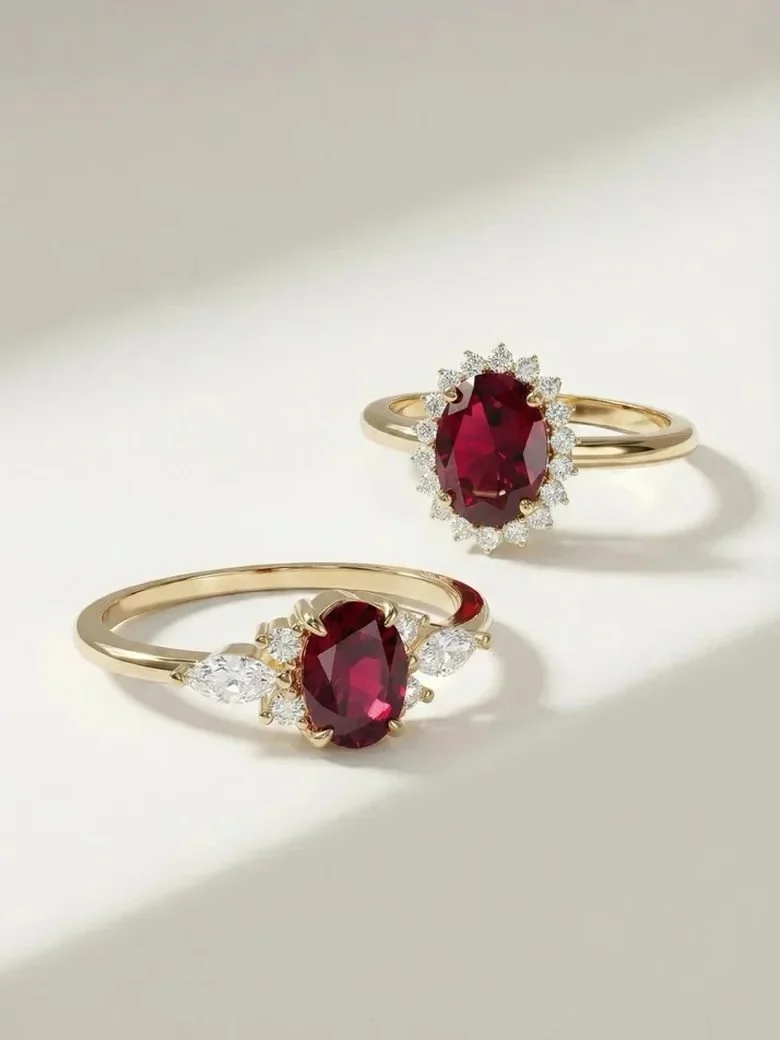
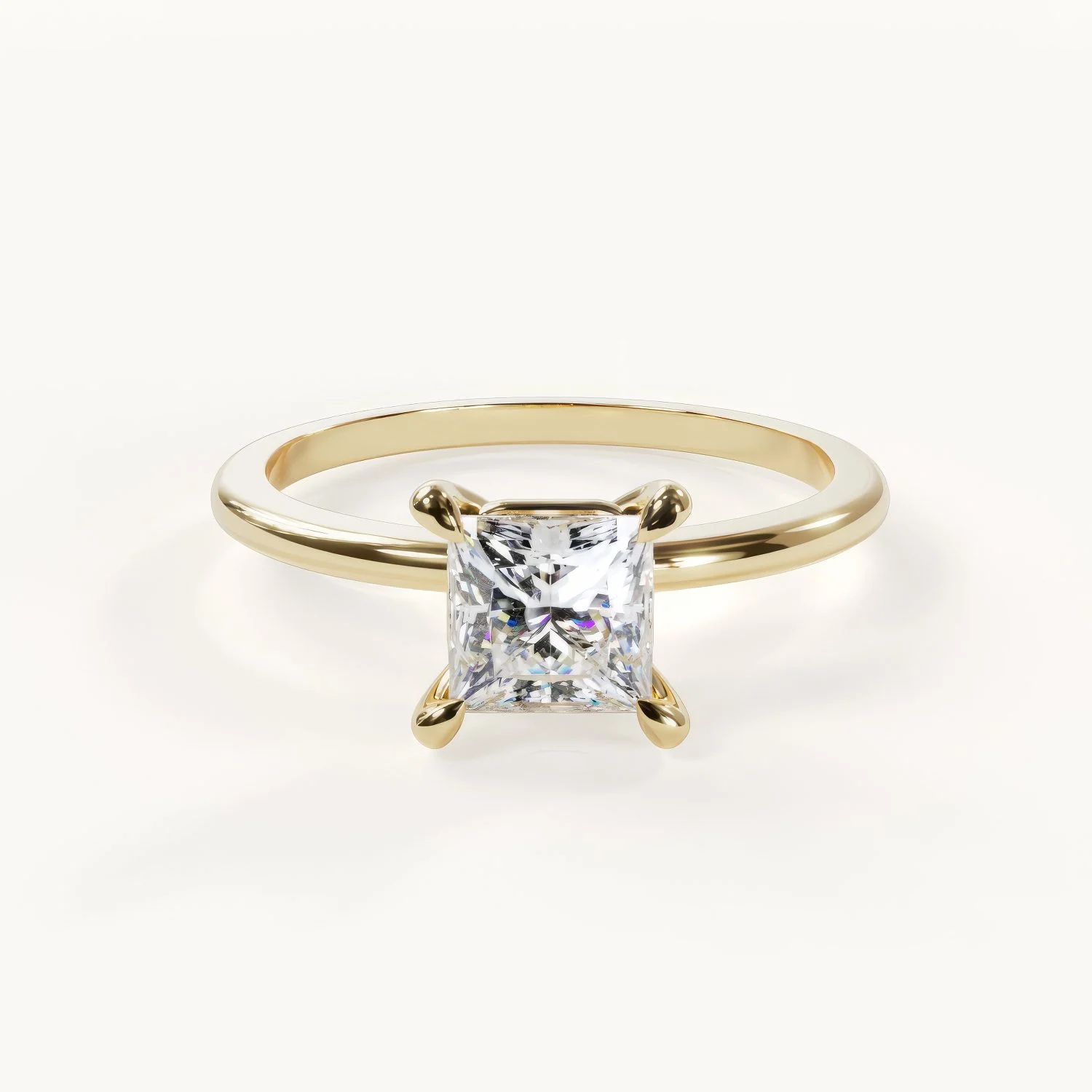
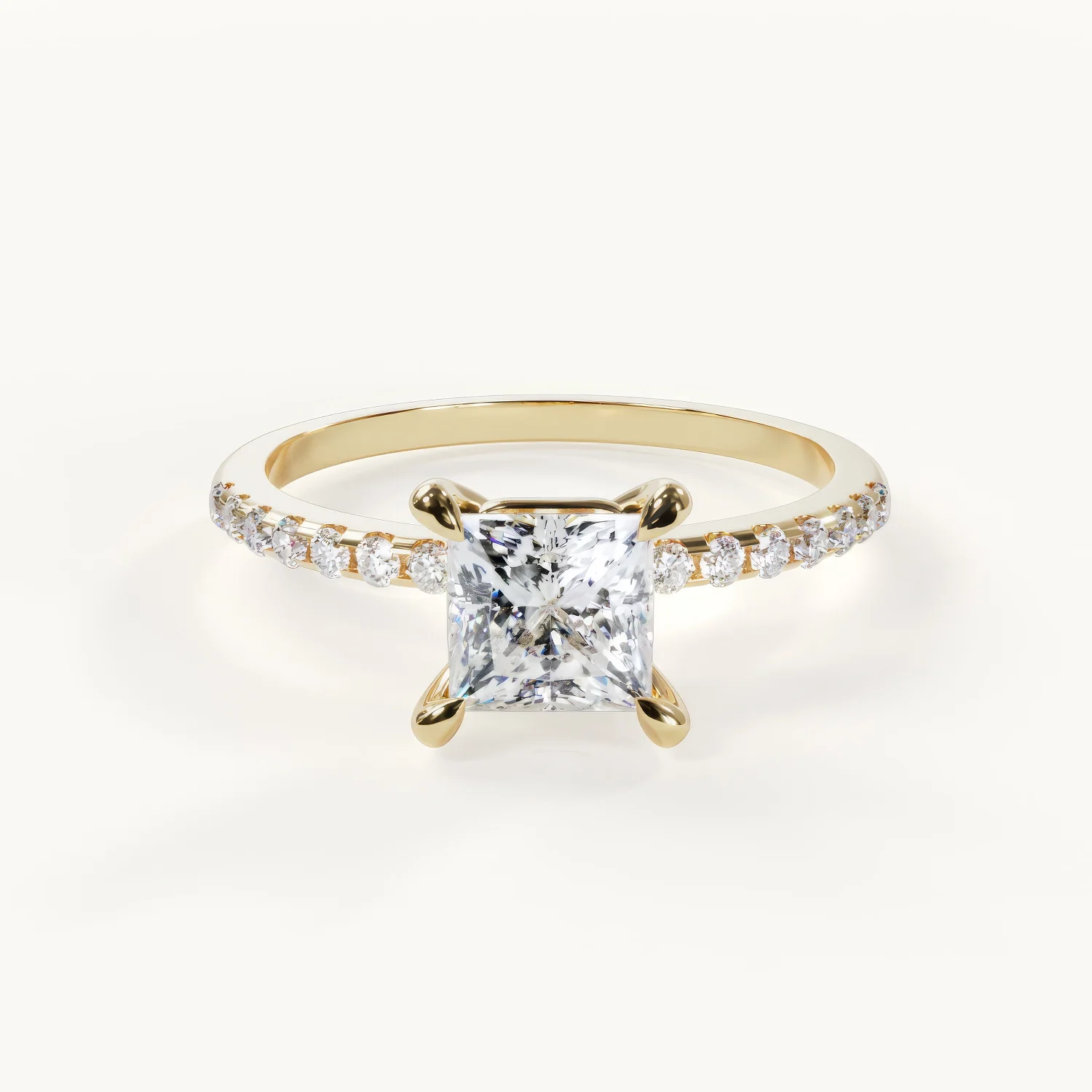
Two princess-cut rings from Velur
The Mira Vérité features the princess cut as a understated solitaire. The Étoile is complemented by a pavé band, which reflects more light along the ring shank. Images, product names, and available variations are loaded directly from WooCommerce.
From the Velur Collection
Princess Cut Rings by Velur


Our Six-Step Guide to Buying a Princess-Cut Diamond
Start with the shape. Look at the stone from above and check whether the sides are straight, the corners are even, and the length and width appear balanced. Next, check the exact measurements: Compare two or three stones with similar carat weights and note which one actually has a larger surface area.
Next comes the photograph. Slowly tilt each stone in the same neutral video. Don't focus on the brightest single moment, but rather on the distribution across the entire surface. Then check for inclusions—first from above, then specifically at the four corners.
Now is the time to decide on the setting. For everyday wear, four cleanly crafted corner prongs can combine an open look with good protection. Those who do a lot of manual work or prefer not to have to think about the ring should consider a stronger V-prong, partial bezel, or bezel setting. The side view shows how high the stone sits and whether a future wedding band will sit flush against it.
Finally, take a look at the finished ring on your finger. A large stone can appear dominant on a very delicate band; a wider band softens the square geometry. Pavé setting enhances the sparkle, while a smooth solitaire setting highlights the outer shape of the princess cut more clearly. None of these options is universally better—they should simply support the desired effect.
1. Shape and dimensions, 2. Photograph, 3. Corners and clarity, 4. Setting, 5. Side profile, 6. How it looks on the finger. If you follow this order, you won’t just be buying a good lab report—you’ll be buying a stunning ring.
The princess cut is a great choice if you want to combine clean, square lines with a striking sparkle. If softer corners are more important to you, check out the cushion cut. If you're looking for a longer silhouette, the radiant, oval, or emerald cuts might be a better fit. Take our ring quiz or browse the princess cut collection.
Frequently Asked Questions About the Princess Cut Diamond
What is a princess-cut diamond?
A princess cut is a diamond cut that is usually square in shape, with straight sides, pointed corners, and a brilliant-cut faceting pattern. It combines a graphic exterior shape with many small reflections of light.
Why does a princess cut sometimes appear smaller even though it has the same carat weight?
Some of the weight may be located in the deep pavilion below the visible surface. Therefore, in addition to carats, you should always compare the length, width, and depth in millimeters, as well as the actual photo of the stone.
Which setting best protects a princess cut diamond?
V-shaped brackets, neatly crafted corner brackets, as well as partial frames or full frames can protect the four corners. The key factors are proper support, an even fit, and no harmful pressure applied directly to a corner.
Is a princess cut too delicate for everyday wear?
Not necessarily. The corners are more susceptible to impact than rounded edges, but they can be well protected with the right setting. You should remove the ring when playing sports, doing crafts, or engaging in strenuous activities.
What clarity grade is recommended for a princess cut?
A specific clarity grade does not guarantee a flawless appearance. The faceting pattern can conceal small imperfections; dark inclusions in the center and imperfections near the corners should be examined on the actual stone.
Is the princess cut also available as a lab-grown diamond or moissanite?
Yes. Lab-grown diamonds and moissanite are available in the princess cut. Lab-grown diamonds exhibit the typical light effects of diamonds, while moissanite often produces more colorful flashes of light when viewed under a point light source.
We'll show you the actual dimensions, a photo, a side view, and the corner protection—all on the actual stone and tailored to your everyday life.