Radiant Cut or Emerald Cut: Which Cut Is Right for You?
Both are rectangular, both have beveled corners—and yet they look completely different on the finger. We compare their brilliance, clarity, proportions, settings, and everyday wear.
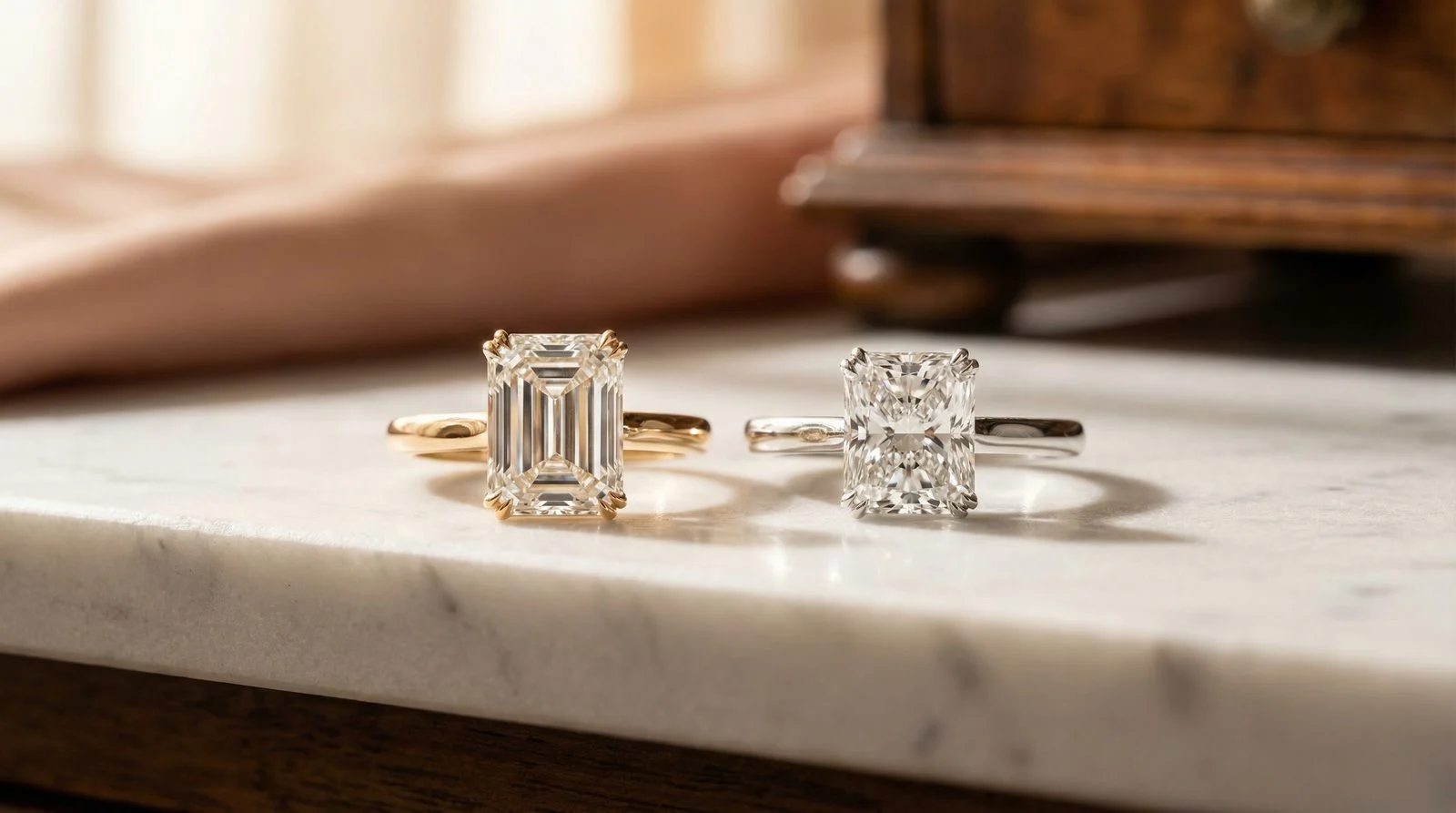
Choose the Radiant Cut if you're looking for a rectangular shape with a lively sparkle. Choose the Emerald Cut if clean lines, large areas of light, and a subtle "hall of mirrors" effect suit you better. The Radiant Cut is generally more forgiving of visible inclusions; the Emerald Cut showcases the stone more openly and therefore requires a more rigorous visual inspection.
From a distance, Radiant and Emerald cuts can look like siblings: usually rectangular, with parallel sides and cut corners. However, if you compare only their outer shapes, you’ll overlook the part that defines their character. The facets inside direct light in two fundamentally different ways.
That’s exactly why the question isn’t simply “Which shape do I like?” It’s more like: Do you want lots of quick flashes of light, or just a few broad streaks of light? Should the stone visually downplay small details, or do you want to consciously see its inner clarity? And should the ring sparkle from a few meters away, or have a graphic look up close?
What is the main difference between a radiant cut and an emerald cut?
The Radiant Cut is a mixed cut. Its crown may feature stepped elements, while the lower part incorporates brilliant-cut facets. The Gemological Institute of America describes it as a square or rectangular shape with an octagonal outline and rounded corners. The result is a dense, dynamic play of light with many small light and dark areas.
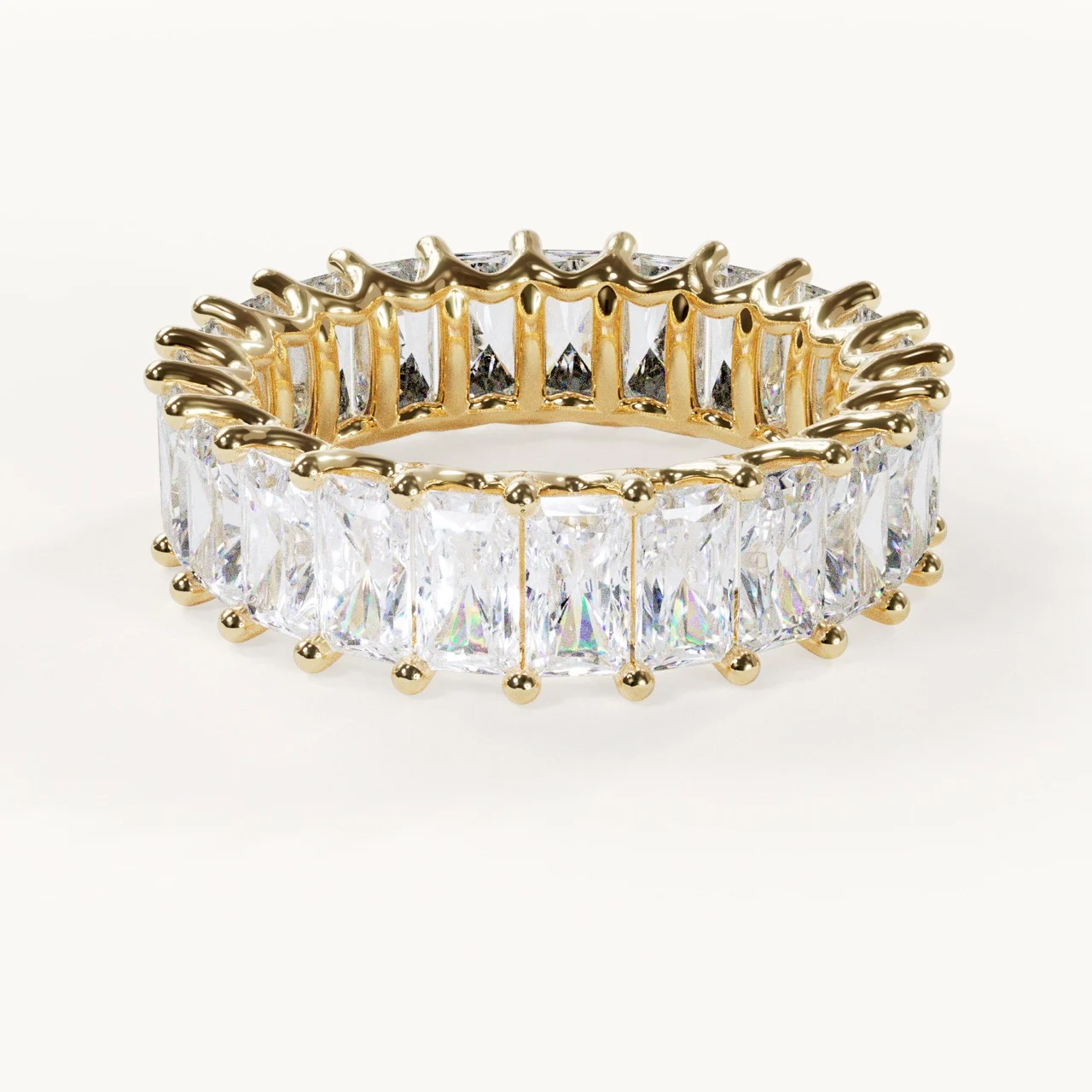
The emerald cut, on the other hand, is a step cut. Long, nearly parallel facets create broad reflections that alternate between light and dark steps as the ring is moved. The GIA calls this effect the “Hall of Mirrors.” Instead of a constant sparkle, it creates a calm rhythm in which symmetry and internal clarity really catch the eye.
Brilliant and moving
Many small reflections, strong scintillation, and a rectangular outline with rounded corners.
Clear and visual
Wide light bands, open stepped facets, and a minimalist, architectural look.
Geometric Shape
Both can appear elongated or more compact and can be combined with a solitaire, pavé, or side stones.
Neither cut is objectively better. A well-selected radiant cut should not simply sparkle “as much as possible,” but rather display an even pattern without distracting dark areas. A good emerald should not be consistently bright; the interplay of contrast and broad reflections is part of its character. It only becomes problematic when the center appears glassy and empty, or when large dark areas remain visible at normal viewing angles.
Radiant Cut vs. Emerald Cut: An Overview
| Characteristic | Radiant Cut | Emerald Cut |
|---|---|---|
| Faceted Style | Mixed cut with a brilliant-cut lower section | Step Cut with long, open layers |
| Photograph | Many small, quick reflexes | Wide areas of light and sharp contrast |
| Purity | Inclusions are often less noticeable in a dynamic pattern | Features are more easily visible due to the open facets |
| Formative Effect | Lively, modern, and distinctly present | Calm, austere, and graphic |
| Visual inspection | Watch for dark “crushed ice” areas and choppy sections | Pay attention to windows, symmetry, and large, solid dark areas |
| Fits better with | People who want to combine sparkle and rectangular lines | People who like clean, uncluttered spaces and subtle changes in lighting |
The table is for reference only; it is not a quality rating. Two Radiant cuts with the same carat weight can exhibit very different patterns. The same applies to Emerald cuts: a harmonious movement cannot be fully determined by length, width, and depth alone. Fancy shapes must therefore be evaluated on a case-by-case basis, not merely based on the information listed on the certificate.
Which cut sparkles more?
If “sparkle” refers to many rapid flashes of light, the Radiant takes the lead. Its facets divide the visible light into smaller areas. When you move your finger, these areas rapidly alternate between light and dark. Under spot lighting—such as in a restaurant or at night—this difference is usually quite noticeable.
The emerald cut doesn’t look dull. It simply reflects light differently: in broad, mirror-like bands. With a slight movement of the hand, the pattern seems to shift across the stone. Some find this calm quality more refined, while others miss the intense sparkle of a brilliant-cut stone. In a static product photo, the emerald cut may appear less striking as a result, even though it has great depth when in motion.
With Radiant Cuts, you’ll often come across the term “crushed ice.” It describes a very fine faceting pattern, often at the ends. Some of this is normal in many Radiant cuts. However, if entire areas look milky, gray, or consistently uneven, you should check a video under neutral lighting. Our advice: don’t base your decision on the label alone; instead, check whether the light distribution remains vibrant and balanced across the entire surface.
The simplest test
Watch both stones in a short video under diffused daylight, a point light, and normal room lighting. Rotate them slowly. A good stone remains appealing even outside the brightest spotlight; a poor one is attractive only from certain angles.
Clarity, Color, and Certificate: How Do They Differ?
The open steps of an emerald cut act like a display window. Inclusions in the center or directly beneath the large table facet are easier to see. However, a high clarity grade alone is not enough: the position, color, and type of a feature are more important than the letters. That’s why we always examine emerald cuts from above and in motion as well.
The intricate pattern of a Radiant Cut tends to conceal smaller inclusions within its reflections. However, “more forgiving” does not mean that just any certificate will suffice. Dark crystals near the center, cloudiness, or imperfections at a compromised corner remain relevant. The appearance of being “eye-clean” should be confirmed on the actual stone.
Color can also appear different. The GIA notes that Radiant cuts can appear lighter or darker depending on the facet pattern. In an emerald cut, the long facets act like mirrors; as a result, a warm tone may become more pronounced at certain angles. The metal color also plays a role: yellow gold deliberately accentuates warmth, while white gold and platinum create a stronger contrast.
A laboratory report from GIA or IGI confirms the gem’s identity, dimensions, carat weight, color, clarity, polish, and symmetry. However, for radiant and emerald cuts, it does not replace a visual inspection. GIA currently assigns a standardized overall cut grade only for round brilliant cuts, not for fancy shapes. A seller should therefore not pretend that the designation “Excellent Cut” on any list automatically guarantees a good light pattern for a Radiant or Emerald cut diamond.
We explain the basics of color, clarity, cut, and carat in the Velur guide to the 4Cs for lab-grown diamonds and moissanite. For detailed information on the emerald cut—including the window and back test—check out our Emerald Cut Guide.
Which cut makes your fingers look longer, and which one makes them look shorter?
Carat refers to weight, not visible surface area. A flatter stone may appear larger from above, even though it weighs the same. At the same time, a stone with too little depth may lose some of its brilliance. That is why, in addition to carat weight, we always compare the actual dimensions in millimeters and the distribution of weight.
Radiant and Emerald cuts are available in compact, nearly square shapes and in distinctly elongated rectangles. A higher length-to-width ratio elongates the silhouette on the finger. This does not automatically indicate higher quality; rather, it is a stylistic choice. Very long stones require a harmonious faceting pattern that extends all the way to the ends and a setting that does not appear tilted.
For the same weight, an Emerald can display a larger surface area thanks to its large, open table facet. A Radiant can appear more striking because of its more dynamic pattern, even if its external dimensions are smaller. Therefore, the question of which “appears larger” cannot be answered solely by measuring with a ruler: one wins out due to surface area, the other due to light play.
We don't start with a fixed ratio. First, we determine whether you'd like a slender or more substantial silhouette. Then we compare two or three real stones with similar dimensions. This prevents a mathematically perfect shape from looking too long, too wide, or too uneven on your finger.
Which setting works best with radiant and emerald cuts?
Both shapes feature rounded corners. This is more practical for everyday wear than a sharp, unprotected point, but it doesn’t make the setting any less important. Four neatly set prongs can accentuate the corners and showcase a lot of the stone. A bezel provides greater protection for the outer edge and clearly defines the rectangular outline. With pavé or side stones, additional light is reflected off the ring band.
With the Radiant cut, even a simple solitaire often looks very lively. A pavé band enhances the brilliance, but can quickly become overwhelming when paired with a large center stone. With the Emerald cut, a smooth band complements the clean, graphic lines. Side stones in a baguette or trapezoid style extend the lines, while a halo creates a stronger contrast.
Be sure to consider your wedding band as well. A low-set band can keep a straight wedding band at a distance. A higher profile often creates more space, but stands out more in everyday life. The key is the side view: Does the band fit under the setting, do the settings touch, and should both rings sit flush? Our stacking guide for engagement and wedding rings shows the most important combinations.
Two cuts, two photographs
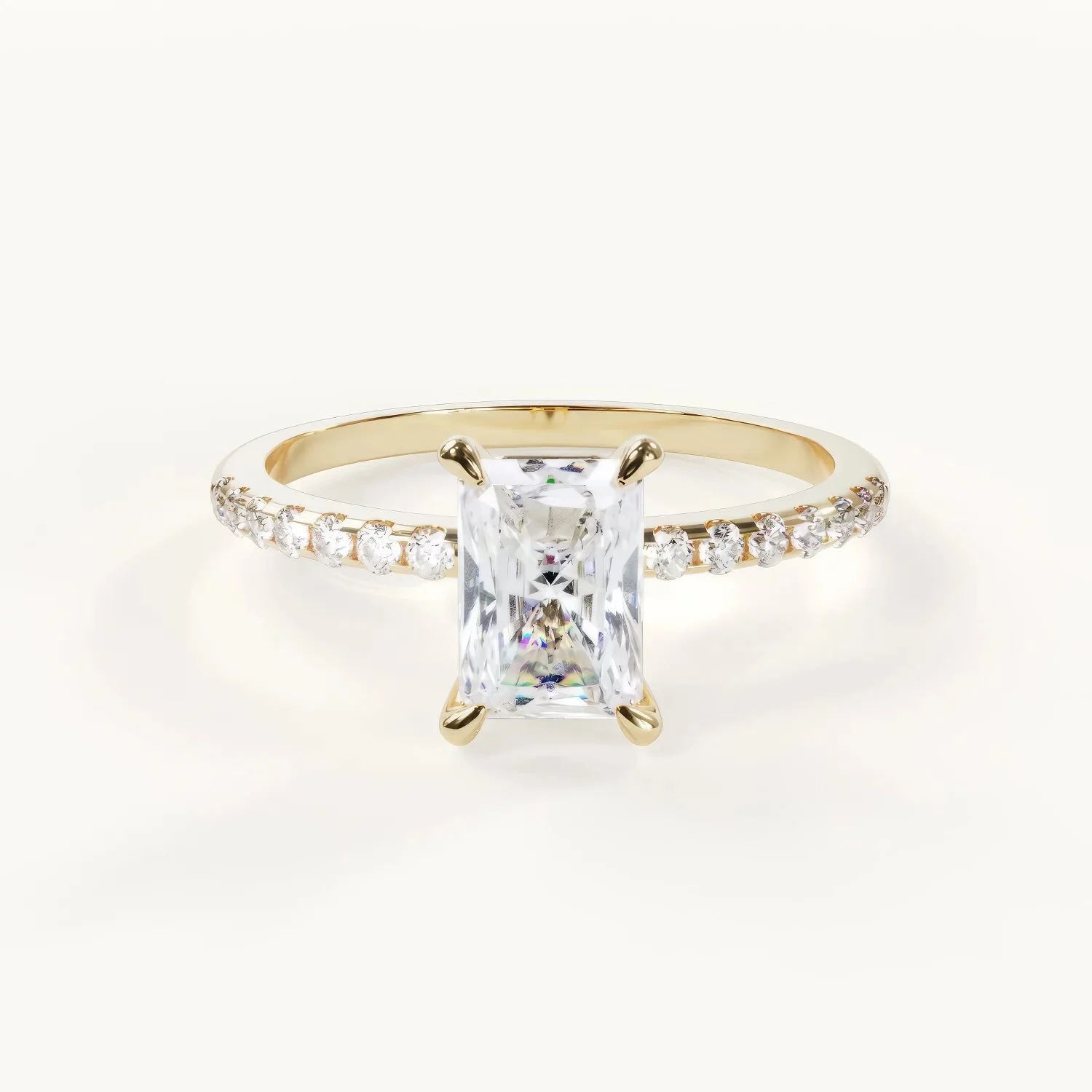
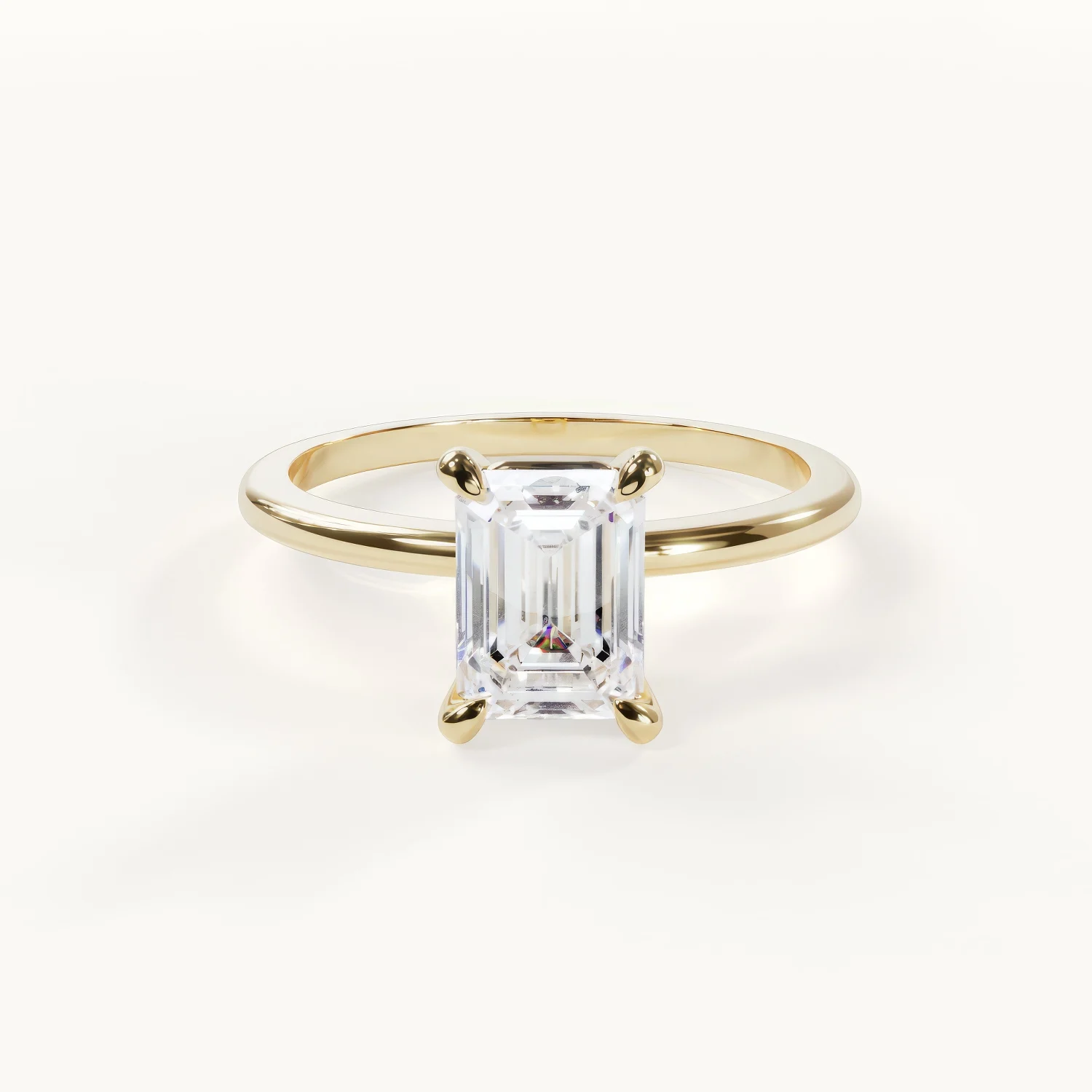
The Lumina features a radiant cut with a pavé band and plenty of movement. Émeraude showcases the emerald cut as a striking solitaire. Product names, images, and available variations are loaded directly from WooCommerce.
From the Velur Collection
Radiant vs. Emerald


Radiant or Emerald: How to Make Your Choice
Don't base your decision on a single Instagram photo. These images are often taken under strong spot lighting that highlights the radiant's maximum sparkle. Emerald cuts, on the other hand, benefit from movement, shadows, and varying contrast. A fair comparison requires the same lighting, similar dimensions in millimeters, and a comparable setting.
The Radiant is a better fit if you love rectangular shapes but don’t want to compromise on brilliance. It works well as a solitaire, with pavé, and with a hidden halo. The Emerald is a better fit if you’re looking for clean lines, visible depth, and large, calm reflections. It rewards careful attention to clarity and light distribution.
If you’re torn between the two, try asking yourself this question: What should catch your eye first—the sparkle or the shape? Those who answer “sparkle” usually end up choosing the Radiant. Those who say “shape” are often drawn to the Emerald. After that, consider the practical details: desired length, metal color, ring height, and your future wedding band.
Recent reports show that radiant cuts are set to make a stronger comeback in fashion and wedding media in 2026. For a decision that will last for many years, this is just another reason to explore this option. The shape should still suit you even after the next trend has long since passed. You can find more silhouettes in our comparison of engagement ring shapes.
Ask to see a Radiant and an Emerald of similar lengths. Request a video taken in natural light and a side view. Decide on the cut first, then choose between pavé, halo, or solitaire. That way, you’ll be comparing the character of the stone first—not the ring’s design.
Frequently Asked Questions About the Radiant Cut and the Emerald Cut
What is the difference between a radiant cut and an emerald cut?
The Radiant is a mixed cut with brilliant-cut facets and many small flashes of light. The Emerald is a step cut with long stepped facets and broad, mirror-like beams of light.
Which cut sparkles more: Radiant or Emerald?
The Radiant typically displays more rapid flashes of light, giving it a more sparkling appearance. The Emerald reflects light over larger areas, creating a calmer "hall of mirrors" effect.
Which cut shows inclusions more clearly?
With an emerald cut, inclusions are more easily visible due to the large, open facets. The intricate light pattern of a radiant cut can tend to mask small imperfections; nevertheless, the specific stone must still be examined from above.
Which looks bigger, the Radiant or the Emerald cut?
That depends on the dimensions in millimeters, the depth, and the ratio of length to width. An Emerald can have a lot of open surface area, while a Radiant can appear more striking due to its more dynamic play of light.
Is the radiant cut more durable than the emerald cut?
Both shapes have rounded corners and are well-suited for engagement rings. Actual durability in everyday wear depends more on the quality of the stone, the design of the setting, the height of the ring, and how the ring is worn than on the name of the cut.
Which goes better with a lab-grown diamond—Radiant or Emerald?
Both cuts work well with lab-grown diamonds. For the Radiant cut, an even light pattern is key, while for the Emerald cut, a clean, open step effect is essential; a certificate, video, and visual inspection are all part of the process for both.
We'll compare Radiant and Emerald in similar proportions and show you photos, side profiles, and matching settings.