

CEO Memo · Ring Design 2026
Design an Engagement Ring with AI: Here's How to Turn Your Picture into a Real Ring
ChatGPT, Gemini, Midjourney, or Firefly can bring an idea to life. What matters next is what is technically feasible, reliably definable, and actually producible.
The short answer
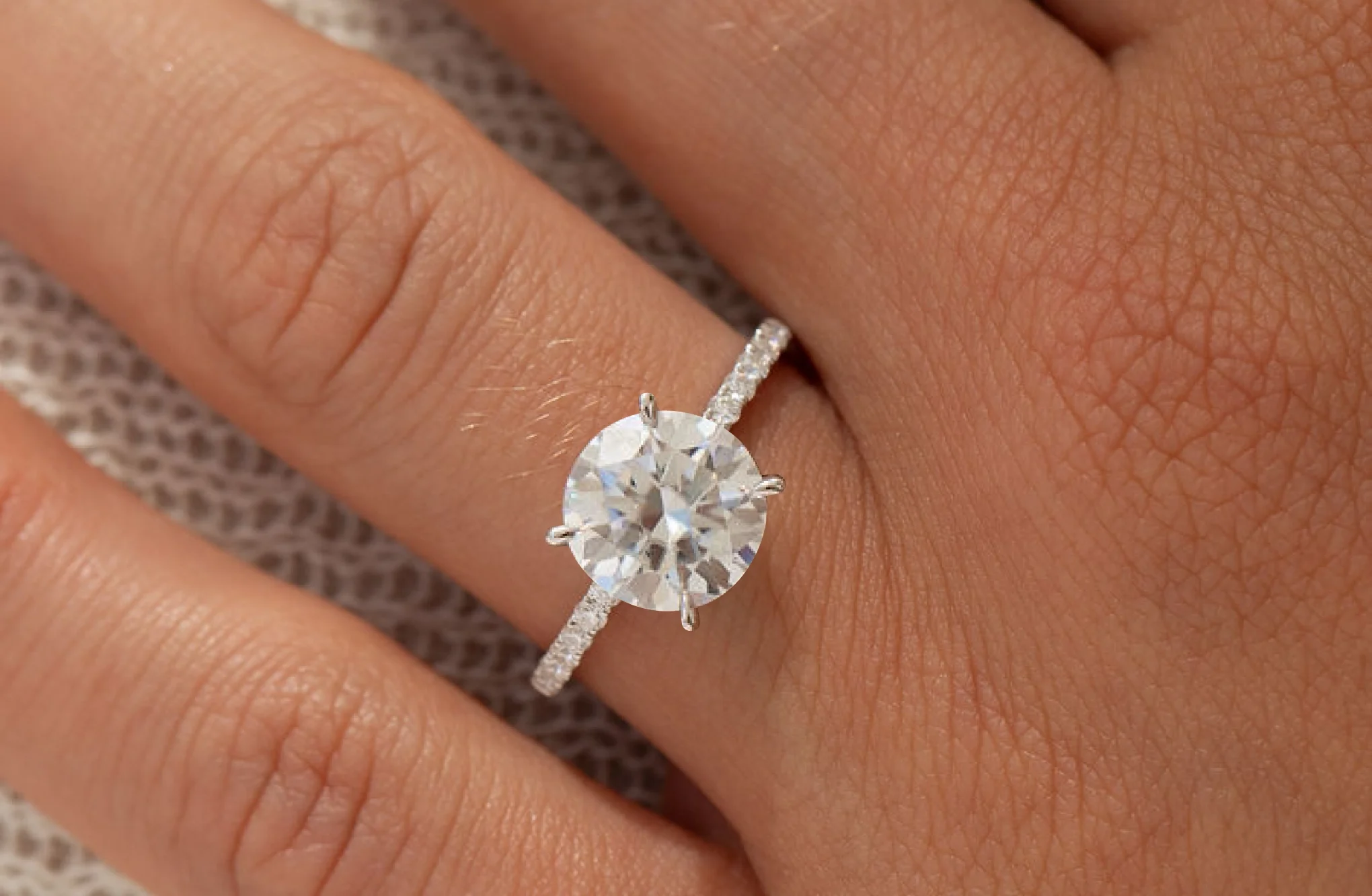
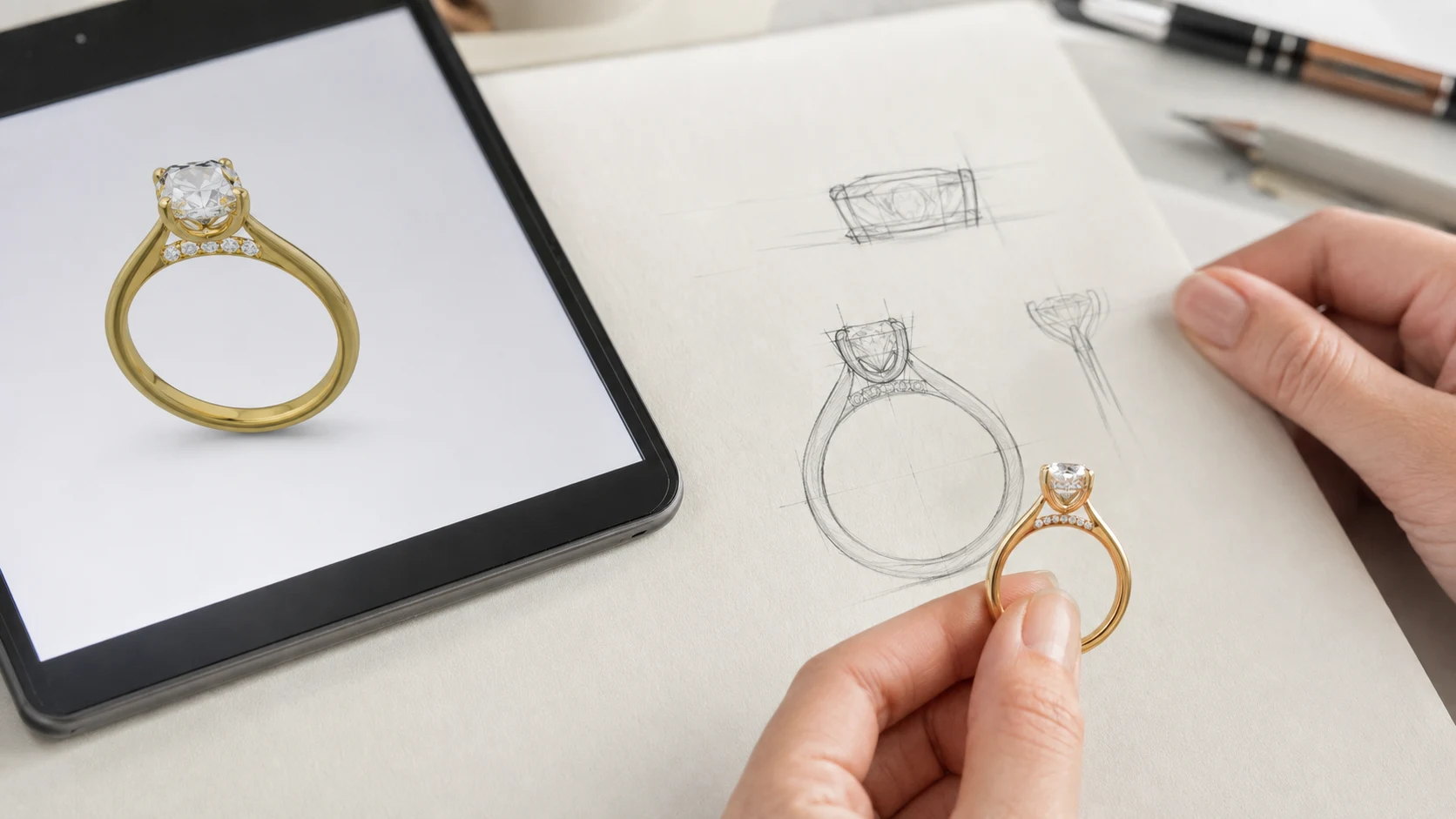
Yes, you can design an engagement ring using AI and send the design to Velur for review. However, the image is not yet a technical drawing: the stone, prongs, band, profile height, and all views must be technically translated. We’ll assess which elements work, develop a feasible design based on them, and, upon request, craft the ring using moissanite or a lab-grown diamond.
On this page
From Real-World Experience
Why I've Come to Take AI-Generated Images Seriously
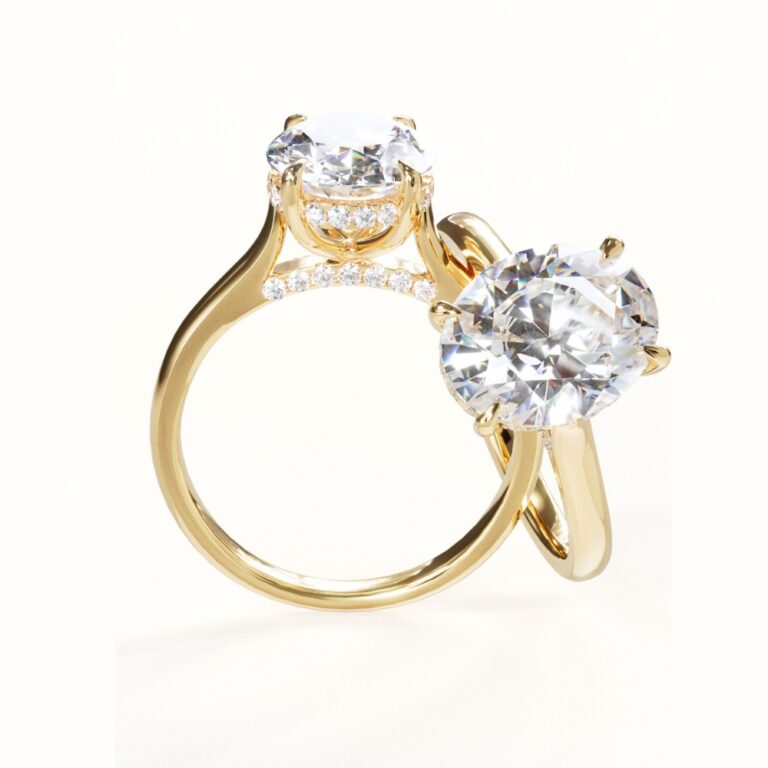
In our inquiries, I’m seeing more and more often a ring that doesn’t yet exist in this form: an AI-generated image. This is helpful to us—not because the AI has already designed finished jewelry, but because customers can very quickly show us the shape, style, or detail they have in mind.
This is useful because an image can convey preferences that many people don’t know how to describe using technical terms. You don’t need to know whether the desired profile is called “Cathedral,” “Basket,” or “Hidden Halo.” The image first shows whether the ring should have a sleek or playful look, a high or low profile, and a geometric or organic design.
My Perspective as the Founder of Velur
AI doesn't deliver the finished ring. It provides a common language between you and our ring experts. Our work begins where the image ends: with proportions, comfort, stone selection, construction, and the ring you'll be able to wear every day.
That is precisely the difference between inspiration and jewelry design. An image generator first creates a visually plausible representation, but does not automatically check whether the prongs will hold the stone, whether the ring will remain stable after casting, or whether a wedding band will fit flush against it later on. The GIA therefore classifies generative AI primarily as a tool for brainstorming: A trained designer must then translate the two-dimensional image into a three-dimensional model, as well as into dimensions and tolerances suitable for manufacturing.[1]
Tool Selection
Which AI is best suited for designing an engagement ring?
There isn't a single "best" model for every design. The most sensible choice depends on whether you want to develop your idea through discussion, combine multiple references, experiment with various styles, or build on an existing sketch. Features and pricing plans change quickly; the following classification was verified on September 5, 2026, based on official provider information.
| AI tool | Strength in Ring Design | What You Should Keep in Mind |
|---|---|---|
| ChatGPT Images | This is a good starting point if you want to develop the idea through dialogue and gradually adjust specific requests. You can incorporate your own reference images. | Check the entire ring after every change. According to OpenAI, even marked edits can alter adjacent areas of the image.[2] |
| Gemini | This is useful if you want to combine several inspirational images or refine a design over several editing steps. | Multiple reference images and local modifications are supported.[3] Even then, the result is still an image, not a technical drawing. Double-check the flanges, side stones, and symmetry in each variant.[1] |
| Midjourney | Great for setting the mood, establishing a design language, and exploring many visual directions. It works well before the technical details have been finalized. | Aesthetic impact is not the same as structural accuracy. According to Midjourney, results from the current Edit Model appear by default to other members on midjourney.com, unless Stealth Mode is enabled.[4] |
| Adobe Firefly | This is handy if you already have a sketch or a clear composition and want to use its basic structure as a reference. | A structural reference aligns the result with the outline, depth, and layout of the template.[5] However, it generates an image rather than dimensioned CAD geometry; millimeter dimensions must be defined separately for manufacturing.[7] |
Our Recommendation
Start with the tool you already know how to use. Three views from a simple dialog that are as consistent as possible are more valuable for the consultation than twenty spectacular images that show a different ring each time.
Template for copying
A prompt to make your AI ring design more useful
Don't start with "Make me a beautiful engagement ring." First, define the decisions that will shape the result. This prompt works as a starting point in image-generating AI models and can be supplemented with your own reference images:
Copy-and-paste prompt
Create a realistic jewelry design visualization of an engagement ring. Center stone: [stone type]; for elongated shapes, [North-South/East-West]; approximately [length × width] mm. Setting: [four/six clearly visible prongs/bezel]; if prongs are used, their number must remain the same in all views. Ring: [yellow gold/white gold/platinum], [plain band/pavé/organic shape], [thin/medium/substantial or, if known, approximately x mm]. Side view: [low/medium/high], with space for [a straight wedding band/no flush wedding band]. Personal detail: [engraving/hidden birthstone/none]. Create views of the same design that are as consistent as possible from above, the side, and at an angle from the front. No floating stones, no fused components, no varying number of prongs, no unrealistically thin metal parts, no text, and no logo.
For your first attempt, approximate details are sufficient. It’s more important to identify the essential characteristics than to use technical jargon. If the stone shape, metal color, and silhouette have already been determined, be sure to explicitly state that these elements should remain the same across all variations.
Here's How to Improve Your Design in Four Iterations
First, the silhouette
Decide on the center stone, ring band, and overall look. Minor details are just a distraction in the first round.
Then the side view
Show the same ring from the side. This way, you can see the profile height and connection the AI suggests. Treat this view as a suggestion, not as a design verification.
Change Details One by One
Change only one element per round—such as the width or the shape of the tabs. That way, you'll notice if the AI swaps out other elements without you realizing it.
Save Favorites and Alternatives
Save the best image, along with one or two alternatives. Mark what you want to use and what is just for inspiration.
Reality Check
Seven Common Mistakes in AI-Generated Ring Images
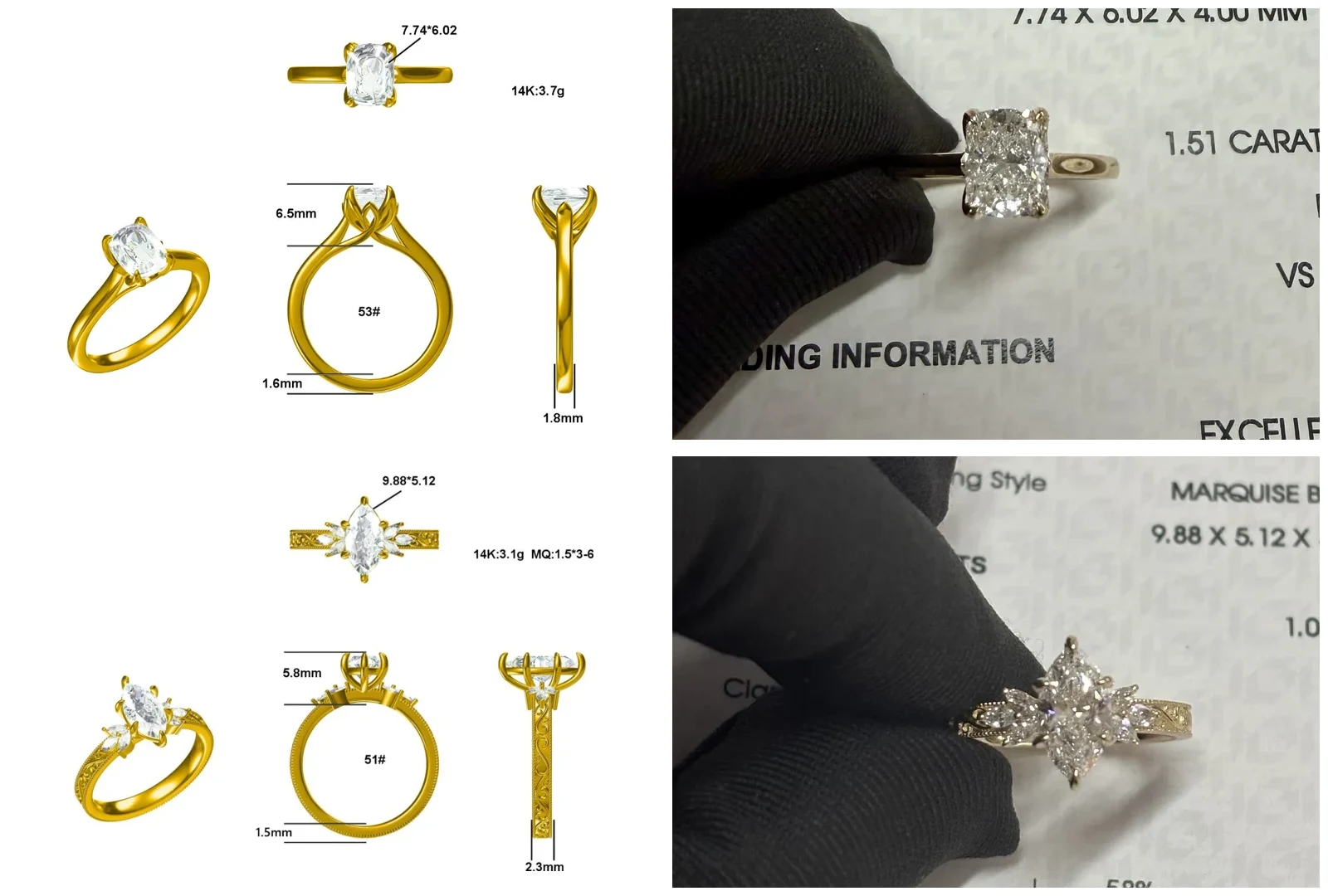
An AI-generated image may look convincing at first glance but still not be usable. These are the first things we check when we receive a request:
| In the AI image | The Technical Question | What follows from this |
|---|---|---|
| Stone and Krappen | Do the corbels actually touch and support the main stone? Does their number remain the same in all views? | The setting will be designed to fit the stone shape and the standard stone sizes. |
| Ring Rail | After casting, setting, and polishing, is the metal still strong enough to withstand everyday use? | Areas that are too delicate may need to be reinforced or redesigned. In doing so, we strive to preserve the desired overall sense of lightness as much as possible. |
| Tread depth | How high should the stone be set in terms of everyday wear, protection, the desired side view, and the future wedding ring? | The height is chosen to suit the stone, everyday use, and the desired appearance. |
| Side stones | Are the stones mirrored, merged, or present on only one side? | The position, quantity, and barrel type are clearly specified. |
| Carats and Dimensions | Does the visible size match the stated weight? Carat refers to weight, not length or width.[6] | The actual dimensions of the selected stone are what matter for the design. |
| Wedding ring next to it | Will a straight wedding band fit flush later on, and does the design allow enough room for that? | The bridge, crown, and lateral profile are designed together. |
| Visual Impact | Is this impression created solely by oversized stones, false reflections, or an impossible perspective? | We distinguish the desired style from effects that do not appear identically in the actual piece of jewelry. |
The greatest uncertainty often arises when a single view is treated as the absolute truth. A top view may explain the silhouette well, but it says little about height, the base structure, or compatibility with a wedding ring. That’s why having multiple views—as consistent as possible—is valuable for consultation.
From Pixels to Gold
How Velur Turns an AI-Generated Image Into a Real Engagement Ring
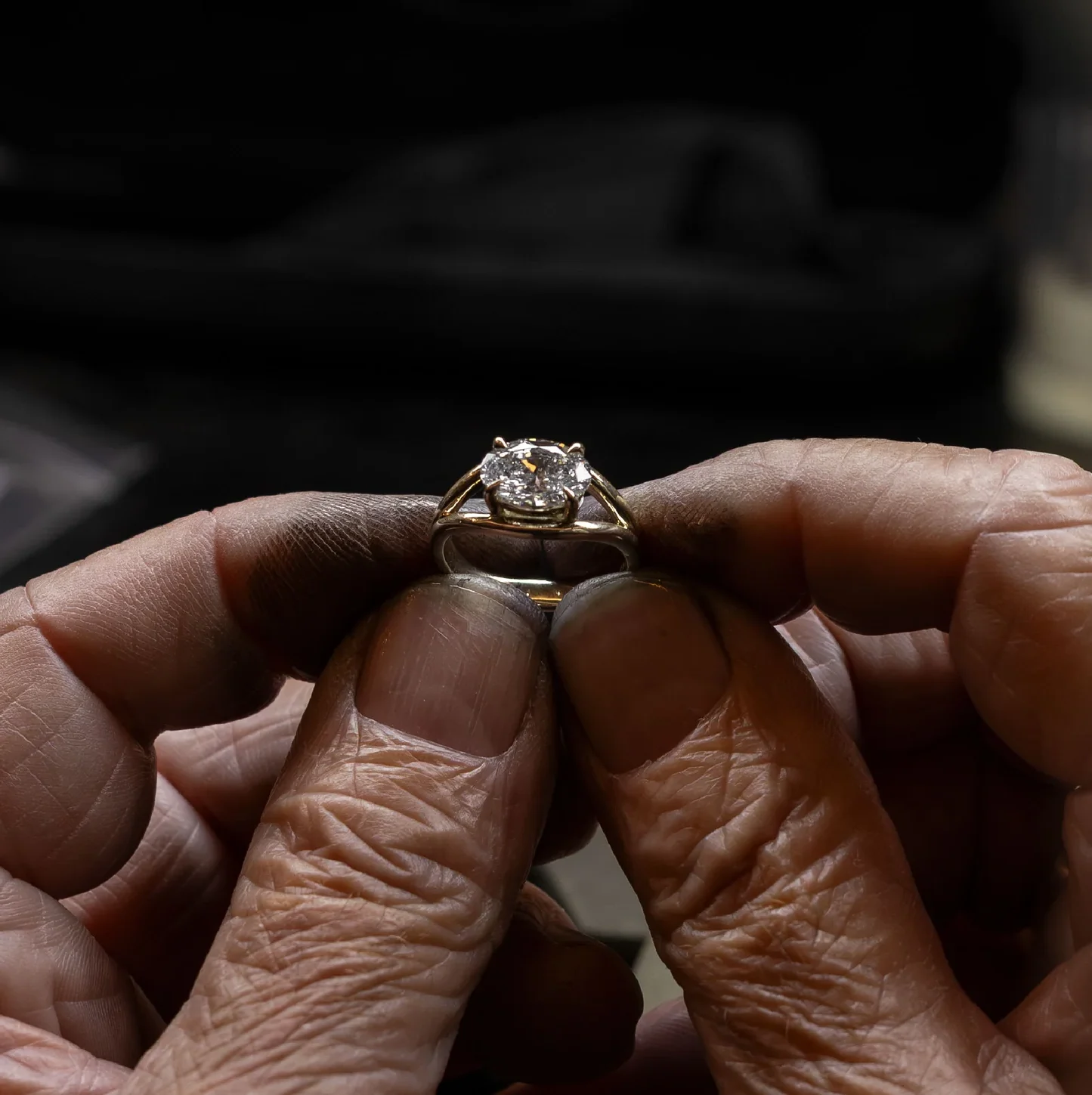
You can send us the AI design directly via WhatsApp. The initial assessment isn't about recreating every pixel. We analyze the image to understand the choices behind it: What silhouette defines the ring? Which proportions do you like? Which details hold personal significance?
Step 1
Read the idea
We categorize the stone cut, setting, band, metal color, and personal details, and determine what should remain unchanged.
Step 2
Check feasibility
Our ring experts examine the proportions, stone dimensions, prongs, profile, stability, and how well the ring pairs with a wedding band.
Step 3
Translate the draft
The visual concept gives rise to a clearly defined jewelry design. Only with this technical foundation can the piece be reliably produced.
Depending on the concept, an existing Velur model can be customized, or a custom design may be the better option. The type of stone, alloy, and finish also determine how closely the visual concept can be replicated. Moissanite or lab-grown diamonds are suitable options for many designs; we determine the appropriate shape and size based on the design, availability, and budget.
We explain the entire process—from the initial consultation to the finished piece of jewelry—in our guide, “Having an Engagement Ring Custom-Made.” If you’d like to compare different personal options first, check out our guide, “Designing a Custom Ring.”
What Velur Doesn't Promise
We do not promise a copy of an AI-generated image that is accurate down to the millimeter until the stone and construction have been reviewed. We promise an honest assessment of which ideas can be adopted, where adjustments are needed, and why.
Inspiration, yes; copying, no
When uploading reference images, be sure to follow the terms of use for the respective AI tool and respect the image rights. Designs from other brands should be used to illustrate stylistic features, not as templates for creating identical copies. The GIA expressly points out potential conflicts with intellectual property rights when using generative AI.[1]
For the first exam
What You Should Send to Velur Along With Your AI Design
You don't need to know anything about jewelry. With this information, we can more quickly determine which style is right for you and identify any remaining questions:
- your preferred AI image and one or two alternatives,
- if possible, a view from above, from the side, and from the front at an angle,
- desired stone type and approximate size,
- Moissanite or lab-grown diamond—if you already have a preference,
- Yellow gold, white gold, rose gold, or platinum,
- your ideas regarding the band, prongs, side stones, and profile height,
- Ring size, if known,
- the planned budget,
- A note indicating whether a straight wedding band is to be placed flush next to it later,
- A quick note: What needs to stay the same, and what can change?
If you only have a rough idea, a picture, your metal color, and a budget are enough to get started. Our "Dream Ring" request form will guide you through the most important details. Alternatively, you can send the design directly via WhatsApp.
If you'd like to compare actual ring designs in advance, you'll find real Velur models, settings, and side views in the Velur engagement ring collection to help you make your decision.
FAQ
Frequently Asked Questions About AI-Designed Engagement Rings
Can Velur craft any AI-generated engagement ring?
Not every detail of an AI-generated image is technically feasible. Velur reviews the frame, lens dimensions, material thicknesses, profile, and comfort, and explains which elements should be retained or adjusted.
Which AI is best for designing a ring?
ChatGPT is well-suited for a dialogue-based starting point, Gemini for multiple reference images, Midjourney for determining a visual style, and Adobe Firefly for creating designs based on a sketch. None of these tools can replace a technical jewelry design.
Is a single AI image enough for the request?
One photo is enough for an initial assessment. For a more detailed evaluation, additional photos from above, from the side, and at an angle from the front, as well as information about the gemstone, metal color, ring size, and budget, are helpful.
Can the AI ring be made with moissanite or a lab-grown diamond?
Moissanite or lab-grown diamonds are good options for many custom designs. The appropriate shape, size, and setting depend on the actual stone measurements, the approved design, and availability.
Does the AI-generated image already determine the price?
No. The price is determined by the type of stone, the stone's dimensions, the precious metal, the ring size, the complexity of the setting, and other details. The AI-generated image gives you an idea of what to expect but does not provide a reliable estimate.
Can I use a ring from another brand as a reference?
You can use someone else's image to explain the style, proportions, or specific requests. However, Velur does not produce an identical replica of a brand-name item; instead, we work with you to develop a unique design.
Sources
Technical Basis and Tool Documentation
- GIA: Artificial Intelligence in Jewelry Design.
- OpenAI: Create and edit images in ChatGPT.
- Google: Create and edit images in Gemini.
- Midjourney: Visibility of Editor Results.
- Adobe Firefly: Structure Reference.
- GIA: Carat weight and apparent diamond size.
- Rhino: Jewelry Design, CAD, and Manufacturing.
Is your AI design finished?
Send us the photo and your key requests. We'll see what kind of wearable velour ring we can create from it.