


Moissanite vs. Lab-Grown Diamond vs. Natural Diamond: A Scientific Comparison
A direct comparison of all gemological properties. Objective, data-driven, and free of sales pitches.
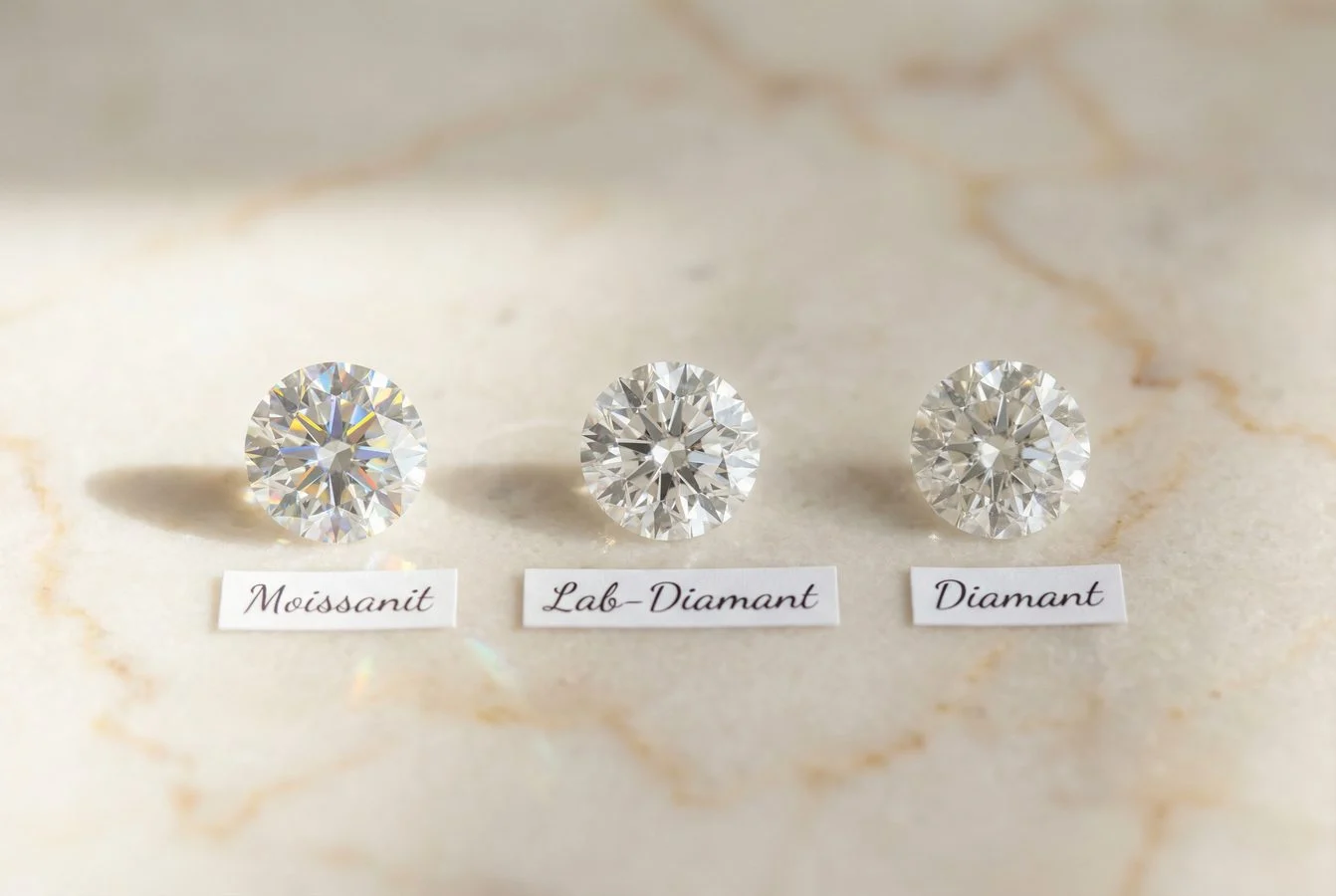
You’re facing one of the most important decisions when buying a ring: Which stone should you choose? Moissanite, lab-grown diamond, or a classic natural diamond? The answer isn’t as clear-cut as most guides claim. That’s because all three stones have their merits, and none is universally “better” than the others.
What sets this article apart from other comparisons: We rely exclusively on measurable, gemmological data. No opinions, no sales pitches. Refractive index, hardness, dispersion, density, chemical composition. The numbers speak for themselves. You decide what matters most to you.
In a nutshell
Moissanite (SiC) has 2.4 times more fire than a diamond and a higher refractive index, but is slightly softer at 9.25 on the Mohs scale. Lab-grown diamonds are chemically, physically, and optically identical to natural diamonds (both are pure carbon, with a hardness of 10). The only difference between lab-grown and natural diamonds lies in their formation: laboratory vs. the Earth’s mantle. All three stones are suitable for everyday use in engagement rings.
What are moissanite, lab-grown diamonds, and natural diamonds?
Moissanite (SiC)
Moissanite is crystalline silicon carbide. The stone was discovered in 1893 by the French chemist Henri Moissan in a meteorite crater in Arizona. Natural moissanite is extremely rare. All moissanites used in jewellery today are synthesised in a laboratory. Moissanite has been commercially available as a gemstone since 1998, initially through Charles & Colvard.
Chemically, moissanite has nothing in common with diamond. While diamond consists of pure carbon, moissanite is a compound of silicon and carbon. This gives it unique optical properties: a higher refractive index and significantly more fire than any diamond.
Lab-grown diamond (laboratory-grown diamond)
A lab-grown diamond is a real diamond. It consists of pure carbon and has exactly the same crystal structure as a mined diamond. The Gemological Institute of America (GIA) confirms that lab-grown diamonds have “essentially the same chemical composition, physical properties, and optical properties” as natural diamonds.
Diamonds are produced using two methods: HPHT (High Pressure High Temperature), which simulates the conditions in the Earth’s mantle, and CVD (Chemical Vapor Deposition), which builds up the diamond layer by layer from a carbon gas. Both methods produce real diamonds that can only be distinguished from mined diamonds through specialised laboratory analysis.
Mine-Cut Diamond (Natural Diamond)
Natural diamonds were formed 1 to 3 billion years ago at depths of 150 to 200 kilometres in the Earth's mantle. Under extreme pressure and temperatures exceeding 1,000 °C, pure carbon crystallized into diamond. Volcanic eruptions carried the stones to the Earth's surface, where they are now mined from kimberlite pipes.
Chemically and physically, there is no measurable difference between a lab-grown diamond and a mined diamond. The only difference lies in their origin.
The Comprehensive Comparison Chart
| Property | Moissanite | Lab-grown diamond | Mine Diamond |
|---|---|---|---|
| Chemical Formula | SiC (silicon carbide) | C (Carbon) | C (Carbon) |
| Hardness (Mohs) | 9,25 | 10 | 10 |
| Refractive Index | 2,648 – 2,691 | 2,417 – 2,419 | 2,417 – 2,419 |
| Dispersion (Fire) | 0,104 | 0,044 | 0,044 |
| Density (g/cm³) | 3,21 | 3,52 | 3,52 |
| Refraction | Birefringent | Single-refractive | Single-refractive |
| Crystal system | Hexagonal | Cubic | Cubic |
| Origin | Laboratory synthesis | Laboratory (HPHT / CVD) | Earth Mantle (Mining) |
| Certification | GRA | IGI, GIA (LGDR) | GIA, IGI, HRD |
| Thermal Test | Positive (like a diamond) | Positive | Positive |
| Suitability for everyday use | Very high | Highest | Highest |
Sources: GIA Research, GIA Moissanite Study, Blue Nile
Brilliance and Fire: Which One Sparkles More?
This is where it gets interesting. Brilliance and fire are two different optical phenomena, and moissanite and diamond behave fundamentally differently in this regard.
Brilliance describes how much white light a stone reflects. It depends on the refractive index. With a refractive index of 2.65 to 2.69, moissanite has a higher refractive index than diamond (2.42). This means that moissanite reflects more light back to the viewer. It appears brighter.
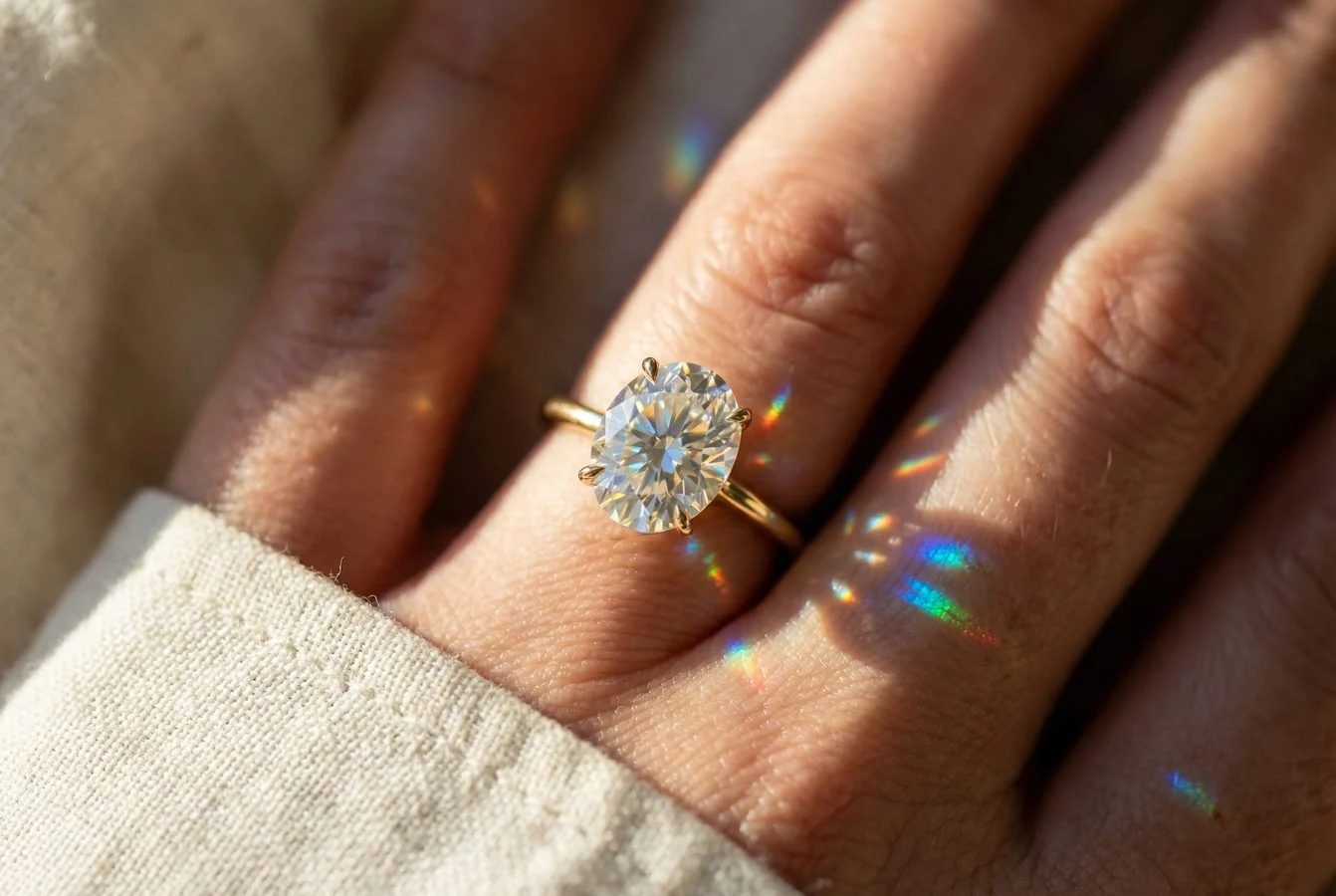
Fire (dispersion) describes how effectively a stone breaks white light into spectral colours. The difference here is dramatic: Moissanite has a dispersion index of 0.104, while diamond has only 0.044. That’s 2.4 times more fire. In practice, this means that moissanite produces significantly more rainbow reflections, especially in sunlight or under spot lighting.
Lab-grown diamonds and mined diamonds are identical in brilliance and fire. Both have the same refractive index (2.42) and the same dispersion (0.044). A jeweller cannot tell them apart by sight.
"Moissanite has a higher refractive index and therefore exhibits more fire and brilliance than diamond."
Charles & Colvard, a pioneer in the moissanite jewellery industry
What does that mean in practice?
Moissanite sparkles with more colour and is more eye-catching. Diamonds sparkle with a whiter, more subtle brilliance. Neither is “better.” It’s a matter of personal taste. Many women prefer the vibrant rainbow fire of moissanite, while others prefer the classic white brilliance of diamonds.
Durability and Longevity in Everyday Life
The Mohs scale measures the scratch resistance of minerals on a scale from 1 (talc) to 10 (diamond). Diamond ranks at the top with a score of 10. Moissanite follows in second place with a score of 9.25. For comparison: sapphire scores 9, ruby scores 9, and quartz scores 7.
What does this mean for everyday life? Both stones are extremely scratch-resistant. A moissanite won’t be damaged by normal everyday contact (door handles, keyboards, pots and pans). Only a diamond could theoretically scratch a moissanite—and vice versa. In practice, the difference between 9.25 and 10 is irrelevant for an engagement ring.
Tenacity is more important than hardness. In this regard, moissanite actually performs better than diamond. Diamond can cleave along its crystal planes (cleavage), but moissanite cannot. This makes moissanite more resistant to impact in certain situations.
Whether it's moissanite or a diamond, both stones will last a lifetime. Don't base your decision on hardness—choose the one with the visual qualities you like best. Not sure? Message us on WhatsApp, and we'll give you personalised advice.
Certification: GRA, IGI, and GIA
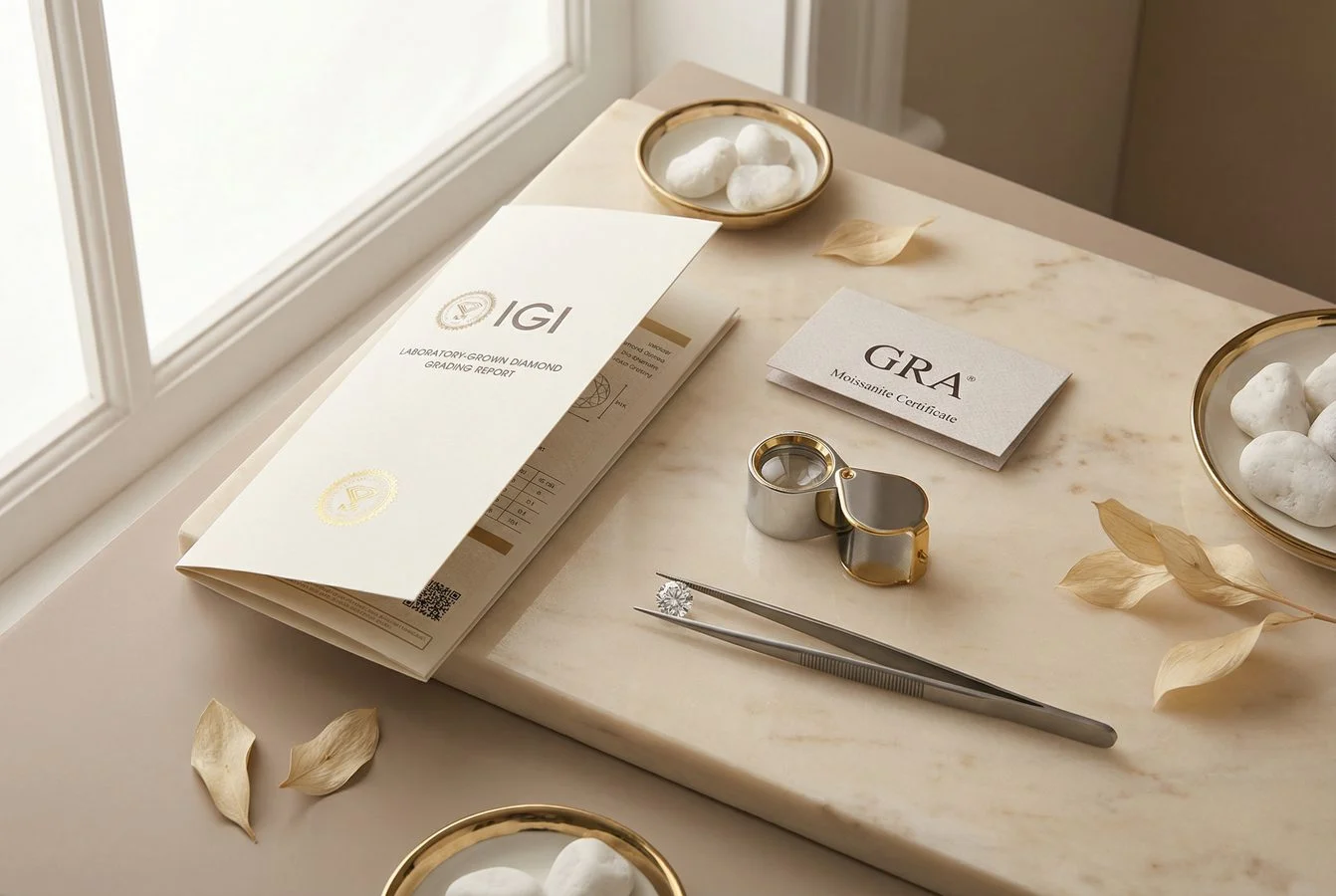
Every genuine gemstone is certified by an independent laboratory. The certification confirms the gemstone’s authenticity and evaluates its quality according to standardised criteria. There are different certification bodies for the three types of gemstones.
| Certification | Responsible for | Evaluation Criteria |
|---|---|---|
| GRA | Moissanite | Cut, Colour, Clarity, Carat |
| IGI | Lab-Grown Diamonds & Natural Diamonds | 4C (Cut, Colour, Clarity, Carat) + Fluorescence |
| GIA | Mine-Cut Diamonds & Lab-Grown Diamonds (LGDR) | 4C + Symmetry, Polish, Proportions |
| HRD | Mine Diamond | 4C according to European standards |
At Velur, all moissanites come with a GRA certificate, and all lab-grown diamonds come with an IGI certificate. Both certificates confirm the exact characteristics of your stone and serve as proof of authenticity.
"Laboratory-grown diamonds have essentially the same chemical, physical, and optical properties as their natural counterparts."
Gemological Institute of America (GIA)
Ethics and Sustainability
For many couples, the ethical aspect is a decisive factor. According to The Knot (2025), 40% of respondents said it was explicitly important to them to choose a lab-grown stone. The reasons are varied.
Moissanite and lab-grown diamonds are both produced in a laboratory. There is no mining, no conflict zones, and no child labor. The supply chain is completely transparent and traceable. The environmental footprint is significantly smaller than that of mining, even though lab-grown production requires energy.
Mined diamonds have made significant strides in ethical standards over the past few decades. The Kimberley Process has been certifying conflict-free diamonds since 2003. Nevertheless, concerns remain regarding working conditions in certain mining regions and the environmental impact of open-pit mining.
Velur's Perspective
At Velur, we work exclusively with moissanite and lab-grown diamonds. Not because mined diamonds are bad, but because we want to guarantee a fully transparent supply chain. Every stone we use is conflict-free, certified, and traceable.
Which stone is right for you?
After considering all the facts and figures, the question remains: Which stone is right for you? The answer doesn't depend on objective measurements, but on your personal priorities.
Moissanite is perfect for you if...
You love maximum brilliance and fire. You want a stone that stands out and casts rainbow-coloured reflections in any light. You value ethical practices and are looking for excellent value for your money. You want a larger stone without compromising on quality.
Lab-grown diamonds are perfect for you if...
You want a real diamond that is chemically and optically identical to a mined diamond. You prefer the classic, white brilliance of a diamond. IGI certification based on the 4Cs is important to you. You want to make an ethical purchase, but don’t want to sacrifice the “diamond factor.”
Minen-Diamant is perfect for you if...
The natural history of its formation (billions of years, the Earth's mantle) is emotionally important to you. You view a stone as an investment. Tradition and the classic "diamond myth" are important to you.
Most Popular Engagement Rings
FAQ
Is it possible to tell moissanite apart from a diamond?
To the naked eye, the difference between high-quality moissanites is barely noticeable. Even jewellers need special equipment. The main difference lies in birefringence: Moissanite causes light to refract twice, which, in larger stones, is visible under a magnifying glass as a slight doubling of the facet edges. Thermal diamond testers cannot distinguish moissanite from diamond, as both stones conduct heat similarly.
Is a lab-grown diamond a "real" diamond?
Yes. Lab-grown diamonds consist of pure carbon and have the same crystal structure as natural diamonds. The GIA confirms that lab-grown diamonds possess the same chemical, physical, and optical properties. They are produced using HPHT or CVD processes and can only be distinguished from natural diamonds through specialised laboratory analysis.
Does moissanite become cloudy or dull over time?
No. Moissanite has a hardness of 9.25 on the Mohs scale, making it the second-hardest gemstone after diamond. It is extremely scratch-resistant and retains its brilliance permanently. Moissanite does not change in colour or clarity over time. Regular cleaning with warm soapy water is sufficient to maintain its full lustre.
What is the difference between GRA and IGI certification?
GRA (Gemological Research Association) certifies only moissanite and evaluates cut, colour, clarity, and carat weight. IGI (International Gemological Institute) is one of the world’s leading laboratories and certifies both natural and lab-grown diamonds according to the same strict 4C criteria. Both certificates confirm the authenticity and quality of the respective stone.
Which stone has more fire and brilliance?
With a dispersion index of 0.104, moissanite has more than twice as much fire as diamond (0.044). This means that moissanite breaks white light into rainbow colours more intensely. Diamond, on the other hand, has a purer white brilliance. Which effect is more beautiful is a matter of taste: moissanite sparkles with more colour, while diamond sparkles with a whiter brilliance.
Are moissanite engagement rings a good choice?
Moissanite engagement rings are an excellent choice for couples who value brilliance, ethical sourcing, and good value for the price. With a hardness of 9.25 on the Mohs scale, the stone is extremely durable for everyday wear, retains its lustre over time, and is produced conflict-free in a laboratory. According to The Knot (2025), moissanite is the most popular non-diamond alternative for engagement rings after lab-grown diamonds.





Ready for the perfect ring?
Whether you're looking for moissanite engagement rings or engagement rings with lab-grown diamonds, we'll help you find the stone that fits your story.