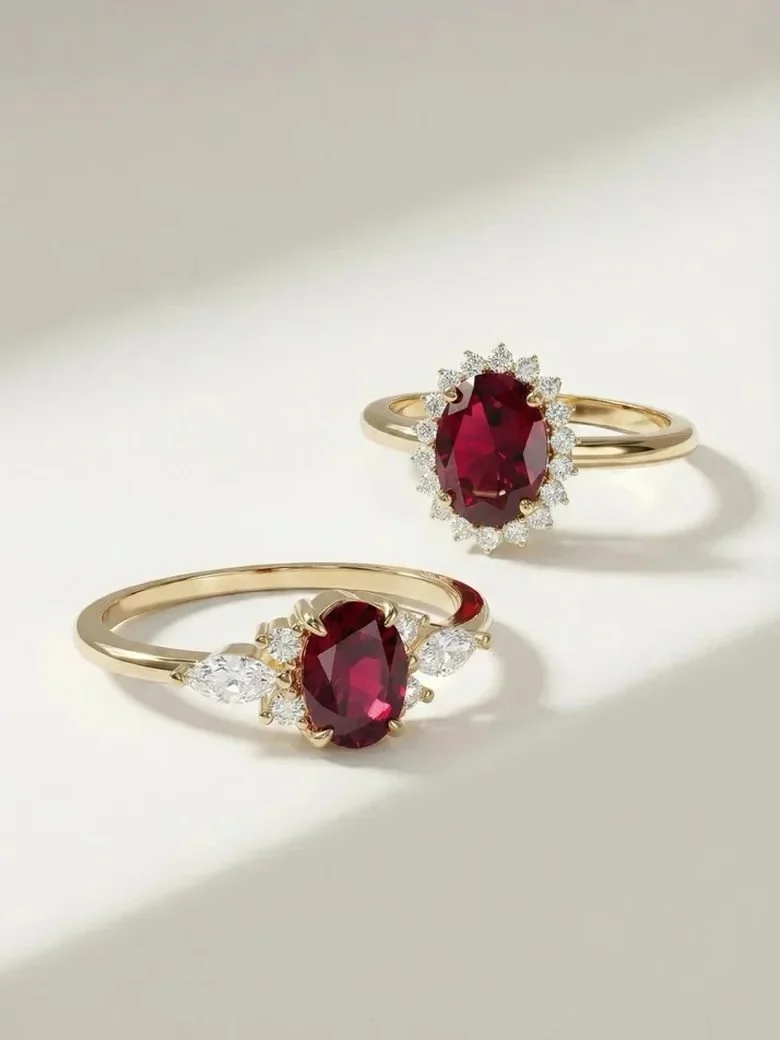
Trilogy Engagement Ring: Meaning, Proportions, and Buying Guide
Three stones say more than a solitaire—when their sizes, shapes, and settings complement each other. This guide shows you how to recognize a well-balanced trilogy ring.
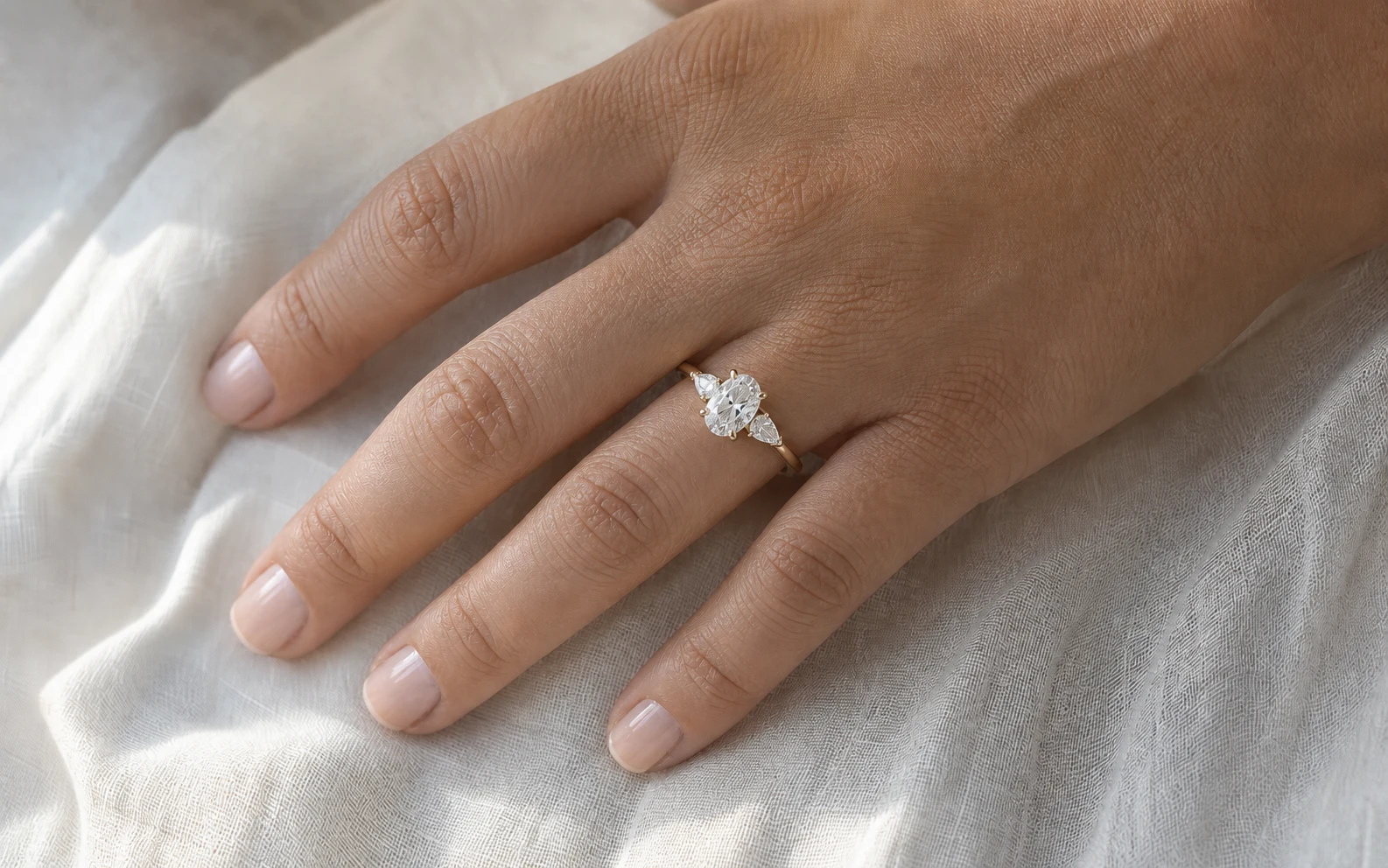
A trilogy engagement ring features three stones set in a row. They often symbolize the past, present, and future; from a design perspective, the key elements are the gradation between the center stone and the side stones, a clean, unified outline, and a setting suitable for everyday wear.
What is a trilogy engagement ring?
A trilogy engagement ring—also known as a three-stone ring—features a center stone and two flanking side stones. The center stone is usually larger. However, there are also designs with three stones of similar size, in which the row appears as a continuous band of light.
The difference from a solitaire is immediately apparent: a single stone draws the eye to the center, while a trilogy ring spans a wider area across the finger. This allows even a moderate total carat weight to appear more striking. At the same time, it creates additional transitions, prongs, and variations in height. This is precisely where a cleanly proportioned design differs from a ring that simply aims to showcase “more stone.”
If you’d like to get a handle on terms like center stone, band, setting, and gallery first, our guide to the anatomy of an engagement ring can help. For help choosing a basic style, you’ll also find an overview of engagement ring shapes and types that explains the differences between solitaire, halo, and pavé settings.
What is the significance of three stones in an engagement ring?
The most well-known interpretation is: past, present, and future. The larger center stone represents the shared present; the two side stones frame what lies behind you and what lies ahead. This isn’t a hard-and-fast rule. A couple can also interpret the same three stones as friendship, love, and loyalty—or as two people and the life they share together.
The Gemological Institute of America specifically mentions these different interpretations and classifies three-stone rings as a style that has been known for a long time. The phrase “can mean” is important. A ring doesn’t carry a universal message like a traffic sign. Its meaning comes only from what you say when you propose.
We wouldn't print the symbolism on a card and explain it the same way to every couple. Instead, write down three brief moments you've shared—one from the past, one from the present, and one from the future. This creates a personal explanation that doesn't sound like something from a catalog.
A trilogy ring is therefore a good choice if you want the ring’s story to play a role in the proposal. On the other hand, if you’re looking for a very minimalist design and want the center stone to stand out on its own, you’ll often be happier with a solitaire. Both choices are valid. The question isn’t which style is more meaningful, but which one best conveys your story.
What proportions look balanced on a trilogy ring?
The most important decision isn’t the total carat weight, but the ratio of the three visible surfaces. A dominant center stone with noticeably smaller side stones still looks like a classic engagement ring. Three stones of similar size appear wider, more understated, and almost band-like. There are many variations in between.
"Mittelstein" needs a clear leading role
If the center stone is meant to be the visual focal point, the side stones should complement it, not overwhelm it. Examine the ring from above at a normal viewing distance—not just in a close-up product photo. If your gaze is drawn to the center first, the hierarchy works.
The outer contour should be smooth, without any sharp breaks
Side stones with tapered shapes—such as teardrops, trapezoids, or crescents—guide the eye from the center toward the ring band. Round side stones create more distinct individual focal points. No one style is automatically better. The key factor is whether dark gaps, overloaded prongs, or abrupt changes in height result between the stones.
The width of a finger sets the limit
Three stones are acceptable, but the setting should not extend beyond the side of the finger. Otherwise, it’s more likely to catch on things, press against neighboring fingers, and appear top-heavy when viewed from an angle. Photos showing the ring on a finger are more effective here than simple close-ups.
Don't Just Compare Carats
Two trilogy rings with the same total weight can look completely different. The cut, the length-to-width ratio, the spacing, and the setting rim have a greater impact on the visible surface area than a single carat weight would suggest.
Which diamond shapes go well together in a trilogy engagement ring?
Round brilliant-cut diamonds work well because their outline remains consistent from almost any angle. Oval, cushion, princess, and emerald cuts are also common. Things get more interesting with mixed shapes: An oval center stone flanked by teardrop-shaped side stones elongates the center and tapers the outer edge. An emerald cut paired with trapezoids, on the other hand, creates a geometric, almost architectural line.
| Combination | Effect | Keep in mind |
|---|---|---|
| Oval + Teardrop | soft, elongated, tapering toward the rail | The tips of the side stones must be protected and set symmetrically |
| Round + round | classic, lots of brilliance, clear trio | Gaps and notches must not visually separate the stones from one another |
| Emerald + Trapezoid | graphic, subdued, broad areas of light rather than intense sparkle | Color and clarity are more noticeable in open-step cuts |
| Cushion + Half Moon | softly framed, compact, slightly vintage | The joint rounding and height must align perfectly |
The GIA recommends that three diamonds have closely matching colors. This makes sense: When the stones are placed directly next to one another, the eye notices differences more quickly than when they are set in separate pieces of jewellery. The clarity grades do not necessarily have to be identical, as long as distracting inclusions are not visible to the naked eye and the stones harmonize as a group.
The same optical examination applies to lab-grown diamonds. “Lab-grown” describes the origin, not the design. Therefore, continue to pay attention to the dimensions, color, clarity, symmetry, and how the diamond actually looks in the ring. Our guide to IGI, GIA, and GRA certificates explains what information a report provides—and what it does not.
How practical is a trilogy ring for everyday wear?
Three stones mean more setting areas than with a solitaire. That doesn’t automatically make the ring more fragile. However, it does make a clean construction even more important. Every prong, every prong tip, and every transition to the ring band should fit smoothly and protect the stone where it comes into contact with everyday objects.
A prong setting shows off a lot of the stone and allows light to enter from multiple angles. A bezel setting encloses more of the stone’s edge, providing greater protection, but also makes the metal more visible. The GIA lists both as common options for three-stone rings and recommends taking your lifestyle into account when making your decision. Anyone who works with their hands a lot, wears gloves, or exercises regularly should carefully check the height and the outer prongs.
Gently run a fine knit fabric over the setting—without applying pressure. If something catches even when the ring is brand-new, it’s unlikely to get any better with everyday wear. Also check the side view: Are the three settings aligned in a straight line? Is there a deep gap where cream and dirt can accumulate? Are the side stones accessible from below so the ring can be cleaned?
Check the prongs and side stones regularly, especially after an impact. To clean them, lukewarm water, mild dish soap, and a soft brush are usually sufficient. Our guide to caring for engagement rings shows you the proper procedure.
Trilogy rings with different effects
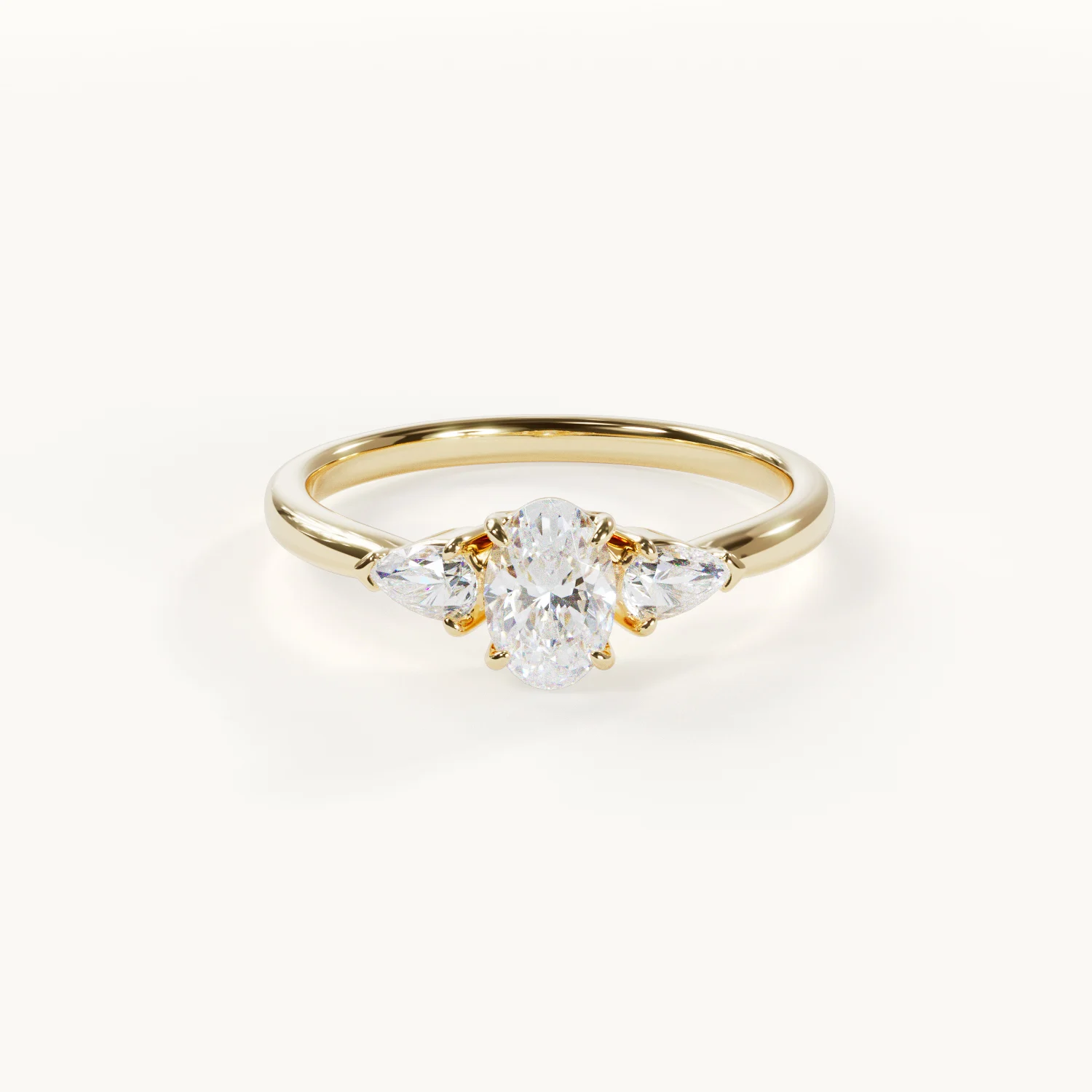
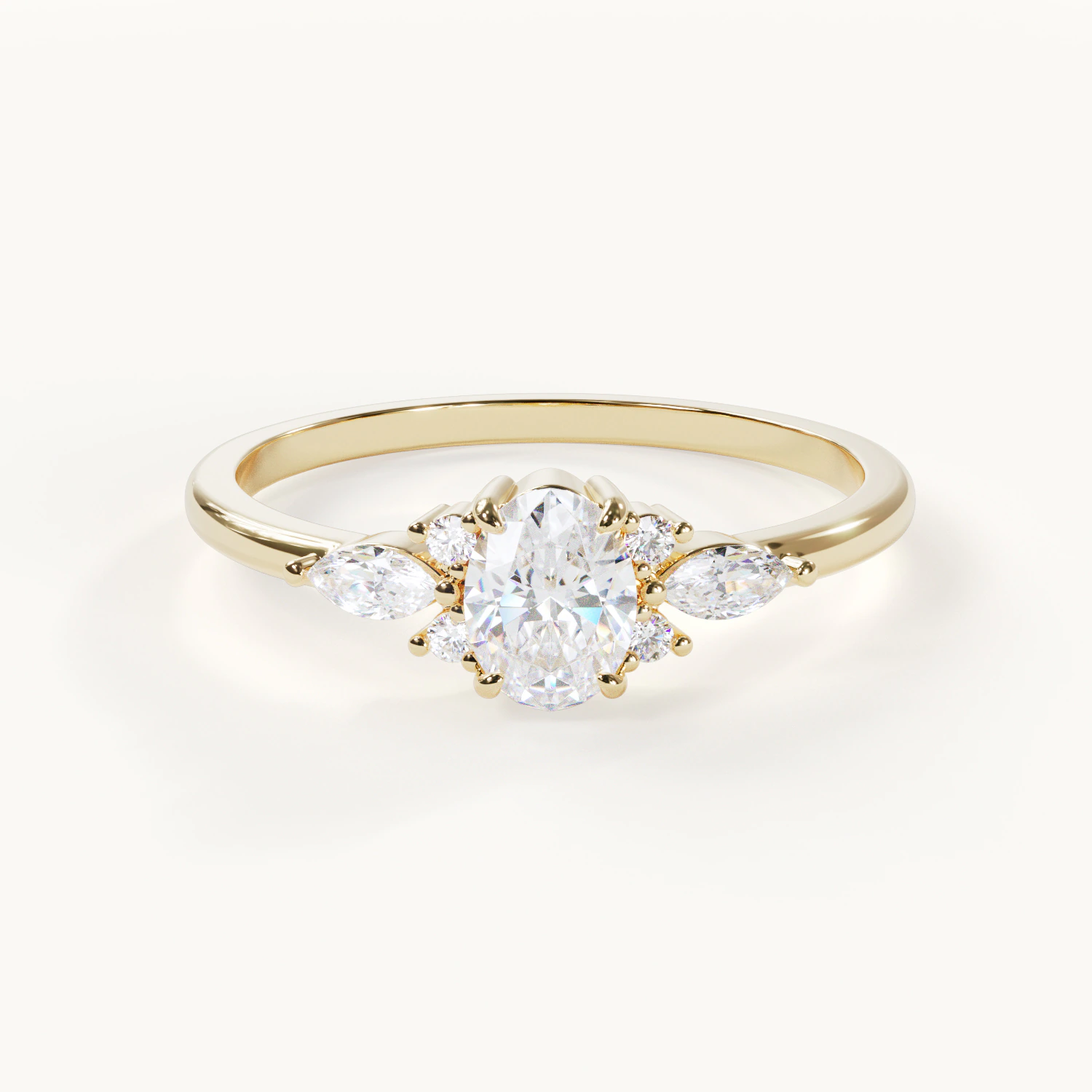
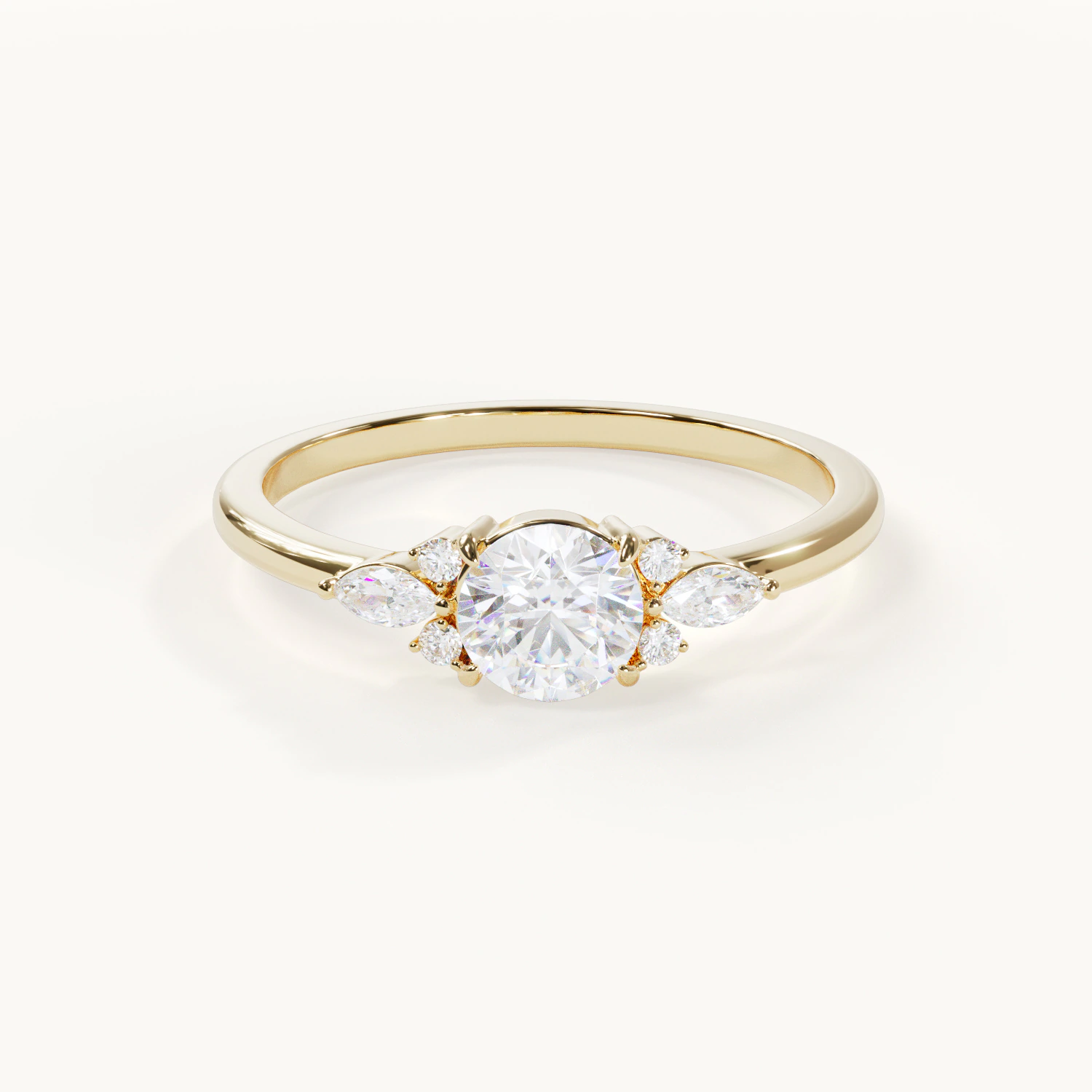
The Trinité Royale features an oval center stone and two teardrop-shaped side stones. The Muse Lumière ring adds subtle accents to the three-stone design; the Muse Lumière Brilliant interprets the same concept with a round center stone. Together, the three models demonstrate how significantly the basic design can be transformed by the choice of stones and their proportions. Current configurations, images, and prices are taken directly from the product data.
From the Velur Collection
Trilogy Rings at Velur


What should you consider before buying a trilogy engagement ring?
A certificate answers questions about the diamond, but not necessarily about the proportions of the finished ring. Therefore, be sure to examine the top view, side view, and hand view separately. If only highly magnified close-ups are shown, you’ll be missing important information about the actual width and height.
- Hierarchy: Is it immediately clear which tile is in the center?
- Width: Does the entire cluster of stones fit on your finger without pressing against the sides?
- Transitions: Do the contours and elevations flow smoothly from the center stone to the rail?
- Color: Do the three diamonds look like they belong together?
- Setting: Are the prongs secure, the bezels smooth, and all the stones firmly set?
- Wedding Band: Can the future wedding ring sit flush against it—or is a custom shape preferred?
- Service: Have the options for resizing, inspection, and repair been clarified?
One thing that’s often overlooked with wide band designs is that the wedding band will eventually meet the side setting. Some trilogy rings allow a straight band to fit flush against them, while others require a curved or contoured wedding band. If you want to wear both rings together, plan for this early on. Our stacking guide for engagement and wedding rings shows the most important combinations.
What if you're still torn between several basic styles? Don't start by focusing on the number of stones. Start by considering the person's daily life, hand shape, and the jewellery they already wear. In the Velur Buying Guide for Engagement Rings, we walk you through this decision step by step.
Frequently Asked Questions About the Trilogy Engagement Ring
What does a trilogy engagement ring mean?
Most often, the three stones represent the past, present, and future. However, they can also symbolize friendship, love, and loyalty, or a very personal story involving three elements.
Is the center stone in a trilogy ring always larger?
No. Usually, the center stone is larger to create a clear visual hierarchy. Three stones of similar size are also possible and give the arrangement a wider, ribbon-like appearance.
Which side stones go well with an oval center stone?
Teardrops, round brilliant-cut diamonds, half-moons, and trapezoids can frame an oval center stone. The key factors are a clean outer contour, appropriate heights, and protected stone points.
Does a three-stone ring sparkle more than a solitaire?
Given comparable stone quality and size, a trio offers more faceted surface area. However, the visible brilliance still depends on the cut, light, clarity, and setting of each individual stone.
Is a trilogy engagement ring suitable for everyday wear?
Yes, as long as the frame, height, and width are suitable for everyday use. External prongs and settings should be protected, finished smoothly, and checked regularly.
Does a plain wedding band go well with a trilogy ring?
That depends on the side setting and the height of the ring shank. Some models allow for a flush, straight wedding band, while others require a small gap or a customized contour.
Would you like to check the proportions, the ring's height, or how it will look paired with your wedding band? We'll go over your preferences together, with no pressure to buy.