












Understanding Jewelry Hallmarks: What Do 585, 750, 925, and Pt950 Mean?
The small markings on the ring or on the clasp of the chain provide clues about the metal. Here's how to identify them—and recognize which questions the number alone leaves unanswered.
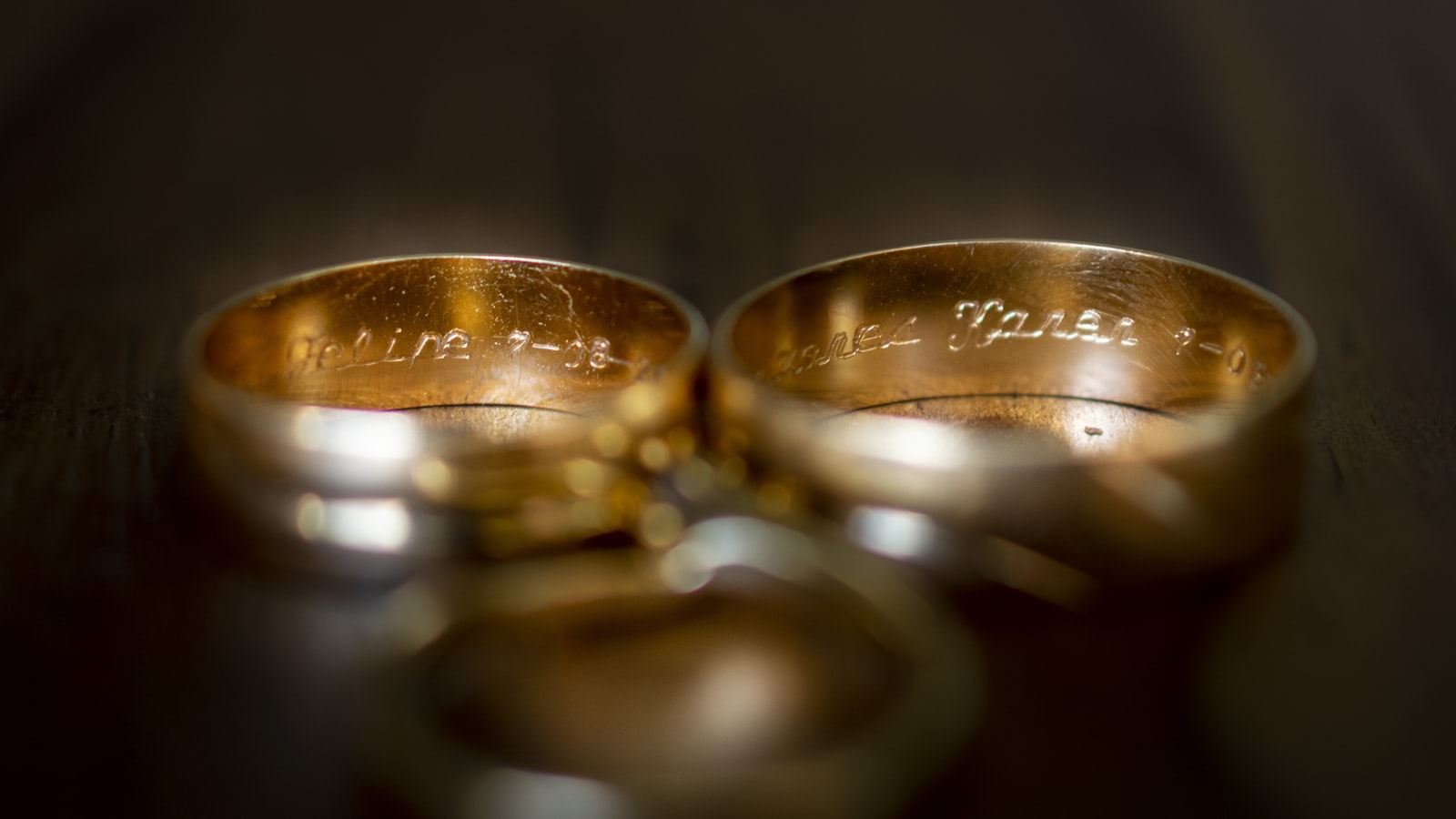
The hallmarks 585 and 750 indicate that gold contains 58.5 percent and 75 percent gold, respectively; 925 typically denotes sterling silver with 92.5 percent silver. Pt950 identifies a platinum alloy containing 95 percent platinum. These specifications help with identification but do not replace an examination of the specific piece of jewelry.
What do the numbers on jewelry hallmarks mean?
A fineness mark indicates the percentage of precious metal in an alloy. The number 750 means that, out of 1,000 parts by weight, 750 are gold. To find the percentage, divide the number by ten. The remaining portion consists of other metals that influence properties such as color and workability.
In everyday life, a jewelry hallmark is often called a “hallmark.” However, this term can refer to various marks: a fineness number, a manufacturer’s mark, or an assay mark. Therefore, reading a hallmark involves more than just the number. Be sure to also look for letters, borders, and symbols next to the number.
| Information | Standard Classification | Precious metal content |
|---|---|---|
| 375 / 9K | Gold | 37.5% gold |
| 585 / 14K | Gold | 58.5% gold at 585 |
| 750 / 18K | Gold | 75% gold |
| 925 / Sterling | Sterling silver | 92.5% silver |
| Pt950 / 950 Pt | Platinum | 95% platinum |
The table shows common classifications. For an unknown item, the complete designation is always what counts: “950” without any further context is less unambiguous than “Pt950.” The Birmingham Assay Office explains the basic principles of fineness marking; the British hallmarks described there are distinct from the German hallmarking system.
What is the difference between 585 and 750?
585 gold contains 58.5 percent gold, while 750 gold contains 75 percent. Both are gold alloys. An alloy is a mixture of metals; gold jewelry does not have to be made of pure gold to be classified as such.
The number does not indicate either the color of the gold or the final design. A ring marked 585 can appear yellow, white, or rose gold. The resulting color depends on the other metals in the alloy and, if applicable, a surface coating. Therefore, a white ring with a gold hallmark is not automatically silver, and a yellow ring is not necessarily made of 750 gold.
Why does it sometimes say 14K instead of 585?
For gold, karat refers to the fineness on a scale of 24 parts. 18 karat corresponds to 18 out of 24 parts, or 75 percent gold. Therefore, 18K and 750 are equivalent. 585 is a common designation for 14-karat gold; purely mathematically, 14 divided by 24 equals approximately 58.33 percent. You should therefore not confuse the trade designation 14K/585 with a mathematically exact equivalence. The GIA guide to gold alloys lists both 583 and 585 as designations for 14 karat.
When choosing a new ring, a higher number alone does not necessarily mean it is the better piece of jewelry. Design, desired color, and comfort are all factors in the decision. Our comparison of 14-karat and 18-karat gold discusses this purchasing decision in more detail. Here, the focus is on correctly interpreting an existing specification.
When it comes to precious metals, "karat" refers to the gold content. For a diamond, "carat" is a unit of weight. The number 750 on a ring therefore reveals nothing about the weight, purity, or origin of the stone set in it.
Why does gold-colored jewelry bear the 925 stamp?
925 usually refers to sterling silver: 92.5 percent silver and 7.5 percent other alloy components. The surface may still be gold-colored, for example, if the silver has been gold-plated. When marked correctly, the hallmark then describes the silver material beneath the coating, not its gold content.
A jewelry design like this is not a contradiction. What matters is that it is clearly described at the time of purchase. “925 silver, gold-plated” conveys something different from a piece made entirely of a gold alloy. The color in a photo is not enough to tell the difference.
Gold vermeil is also made of silver with a gold plating. However, the number 925 alone does not indicate the thickness of the plating, its gold fineness, or whether a particular product is eligible for the “vermeil” designation. For that, you’ll need additional product information. We explain the composition in “What Is Gold Vermeil?” The U.S. Federal Trade Commission (FTC ) also distinguishes between gold alloys, gold-plated products, and vermeil; its labeling rules apply to the U.S. market.
If a chain looks gold-colored and the clasp is marked “925,” be sure to ask the salesperson specifically about the base metal and the plating. Terms like “real gold” are too vague without this distinction. A piece of jewelry may have a layer of real gold, even though it is primarily made of silver.
What does Pt950 mean—and what do other symbols stand for?
Pt is the chemical symbol for platinum. Pt950 refers to an alloy containing 950 parts per thousand, or 95 percent, platinum. The remaining five percent consists of other alloying metals. The “Pt950” designation alone does not specify which metals these are.
A silvery-white color is not a reliable way to identify platinum: white gold, silver, and other metals can look similar. You should also not interpret the number 950 alone as proof of platinum without context. Depending on the full marking, 950 can mean platinum or palladium, for example. The FTC explains platinum markings and the significance of the composition; for an unknown hallmark, the complete sequence of characters remains decisive.
Manufacturer's mark, certification mark, or personalized engraving?
Letters next to a number may indicate a company or workshop. In some countries, official hallmarks are added to the fineness mark. Names, initials, and a date, on the other hand, may be a personal engraving. A small “50,” for example, may be part of another marking and should not automatically be interpreted as indicating the precious metal content.
So be sure to photograph the entire area. A single detail showing just two letters often reveals less than the complete row, including the border. For older or imported items, experts can compare the markings with country-specific catalogs. The overview of our precious metals then helps classify the identified materials.
Where can you find the jewelry stamp?
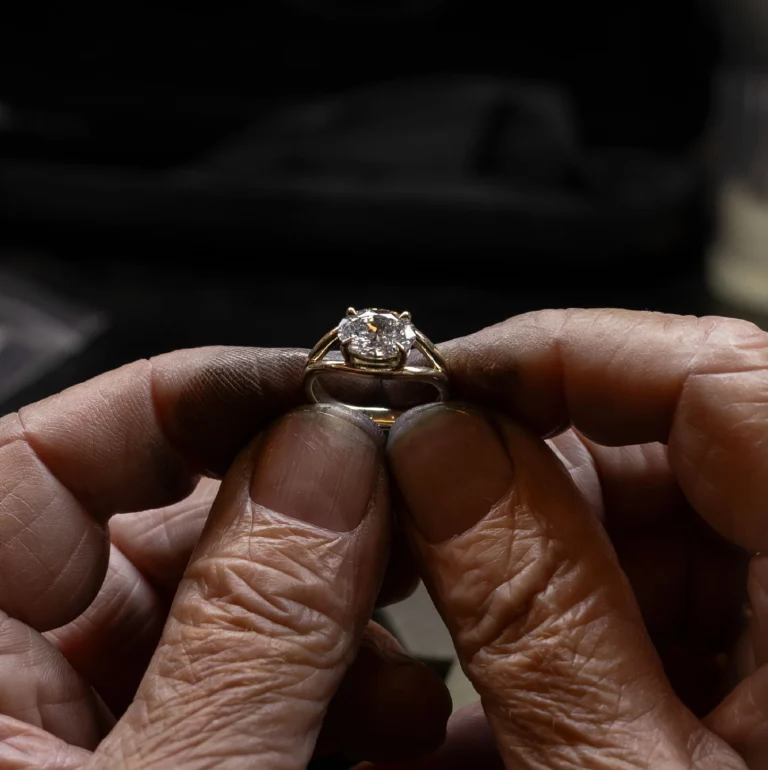
For rings, it’s best to start by looking at the inside of the band. On necklaces and bracelets, the markings are often found on the clasp or on a small adjacent plate. For pendants, check the back and the bail; for earrings, check the back or the post. The exact location depends on the design.
- Place it on a soft surface. This way, you can turn the piece without moving it on a hard surface.
- Look at it with light coming from the side. A small indentation often becomes more visible when light hits it at an angle. A magnifying glass or your phone's macro mode can help.
- Take several photos. Photograph the entire piece, the position of the mark, and the symbols up close. A sharp original photo is more helpful than a heavily enlarged, blurry one.
- Write everything down. Numbers, letters, and borders all go together. Add this to an existing invoice or product description.
Do not try to scratch away an unclear mark or treat it with harsh chemicals. This can damage the surface and the marking. If the marking is faint or worn, the best next step is to have it professionally inspected.
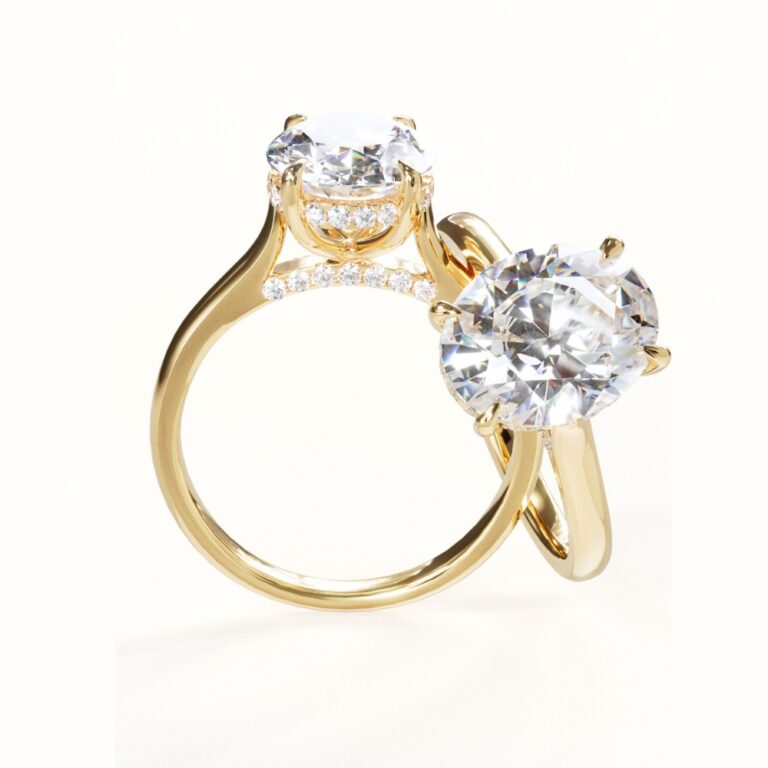
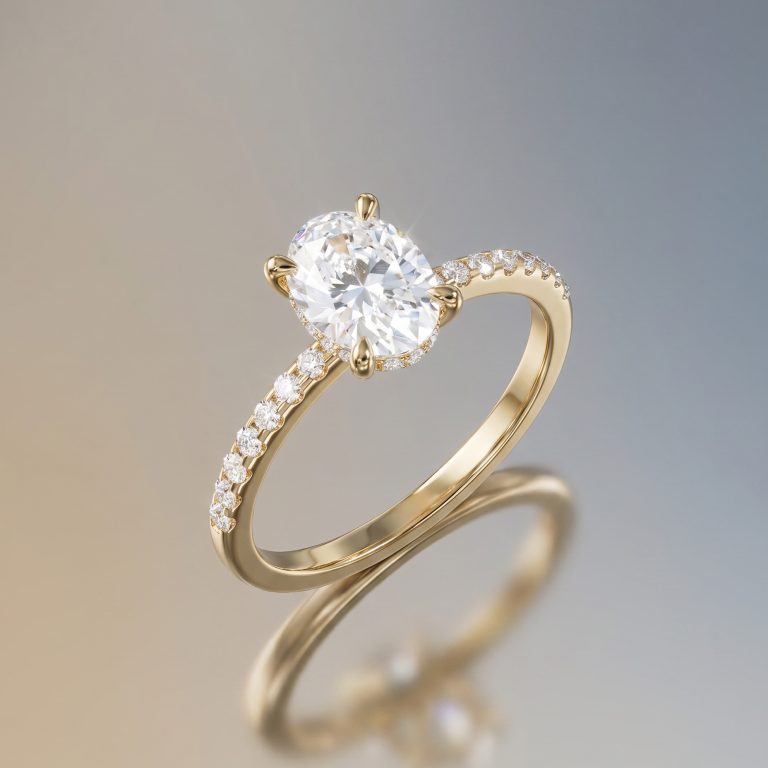
Our advice at Velur: Always compare the material specifications with the exact model you ordered. For customizable engagement rings, the same design may be available in different precious metals. The model name alone does not identify the alloy.
Does a hallmark prove that the jewelry is genuine?
A fineness mark is a statement of material composition, but the mere presence of a number does not replace testing. The Swiss Federal Office for Customs and Border Security expressly warns that fineness markings may be counterfeit or misused. You must also distinguish between a simple fineness mark and a complete, independently tested marking system. British hallmarks, for example, include several mandatory marks. This cannot be applied across the board to every item sold in Germany.
For gold and silver jewelry, Section 5 of the German Fineness Act stipulates that hallmarking is optional and requires the fineness to be indicated in parts per thousand. The Federal Institute for Materials Research and Testing also clarifies that this indication is voluntary. In the German context, therefore, the absence of a fineness stamp on gold and silver jewelry does not in itself prove that the item is counterfeit. Regulations in other countries may differ. For used pieces, other factors such as illegible markings or alterations to the jewelry may also be considered; the actual cause should be investigated.
What information cannot be determined from the stamp?
The number alone does not reveal either the weight of the piece of jewelry or its retail price. Nor does it identify a specific diamond or confirm a particular origin or quality of craftsmanship. 750 does not mean that a ring can be resold for 75 percent of its original purchase price.
A comprehensive analysis of the metal and an appraisal of the entire piece of jewelry are also different tasks. If you want to sell, repair, or insure an heirloom, let the jeweler or goldsmith know exactly what you’d like to find out. Bring photos and any existing documentation with you. That way, the examination can be tailored to your specific needs, rather than just confirming a hard-to-read number.
When making a new purchase, the most practical way to verify the item is simple: Do the description, the version you ordered, the invoice, and the labeling all match? If there’s a discrepancy, ask for an explanation before jumping to conclusions based on the color or stamp.
Frequently Asked Questions About Jewelry Stamps
Is 585 real gold?
585 refers to a gold alloy containing 58.5 percent gold. It is not fine gold. Whether a specific piece of jewelry meets this specification cannot be definitively determined by examining the hallmark alone.
Is 925 gold or silver?
925 typically refers to sterling silver containing 92.5 percent silver. A gold plating can give the surface a gold color. The thickness and fineness of this gold plating cannot be determined from the 925 marking alone.
Is a 750 ring always yellow?
No. "750" refers to a gold content of 75 percent, not the color. White gold and rose gold can also have this fineness.
Is jewelry without a hallmark automatically fake?
In Germany, the absence of a fineness mark on gold and silver jewelry does not in itself prove that the piece is a counterfeit. If the material or origin is unclear, documentation and a professional examination of the piece can provide further insight.
What is the difference between 950 and Pt950?
"Pt950" refers both to the metal platinum and to a purity of 95 percent. The number 950 on its own is less clear and must be interpreted in the context of the complete marking.
Our materials guide explains gold and platinum and helps you compare the available options.