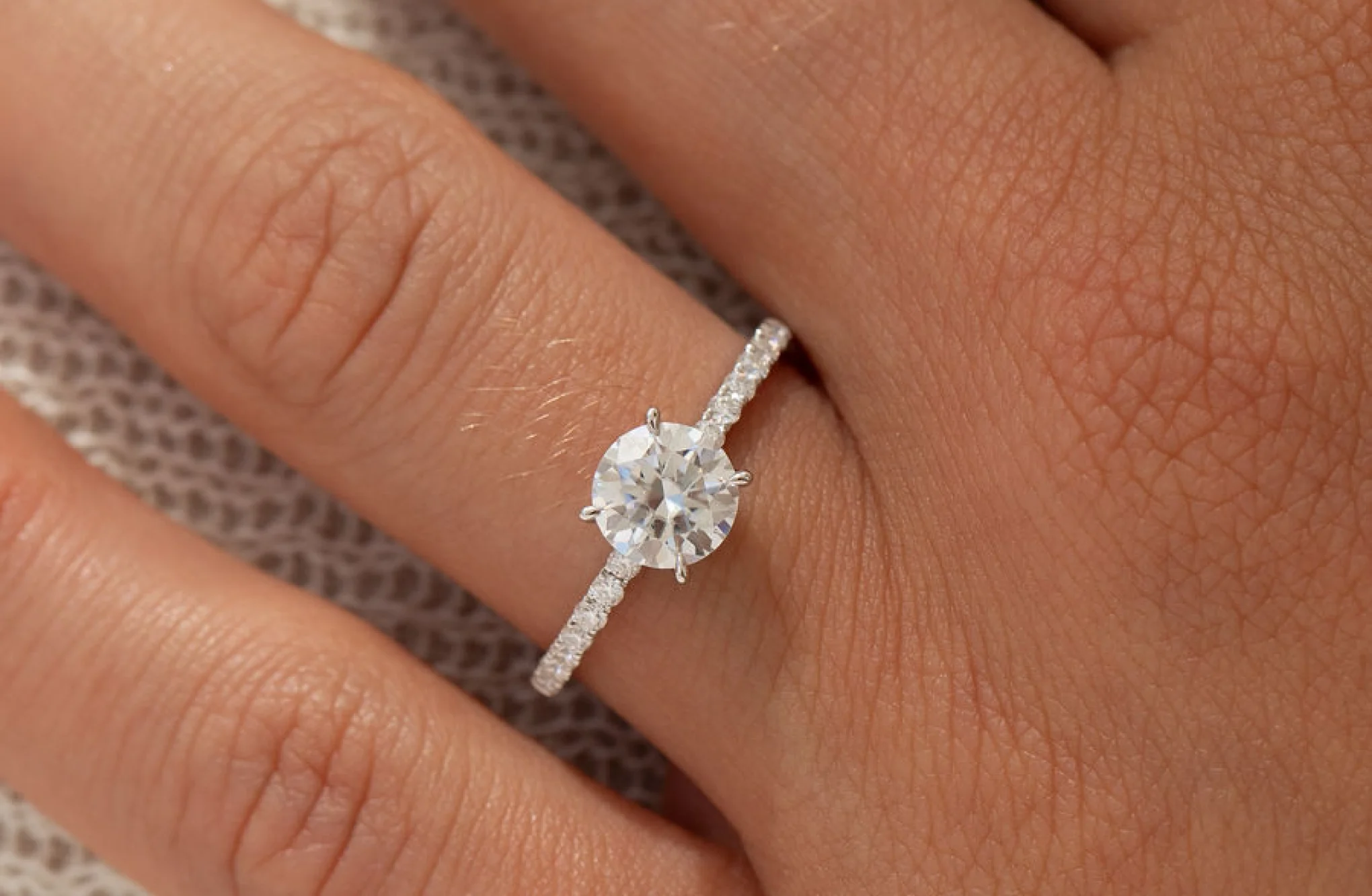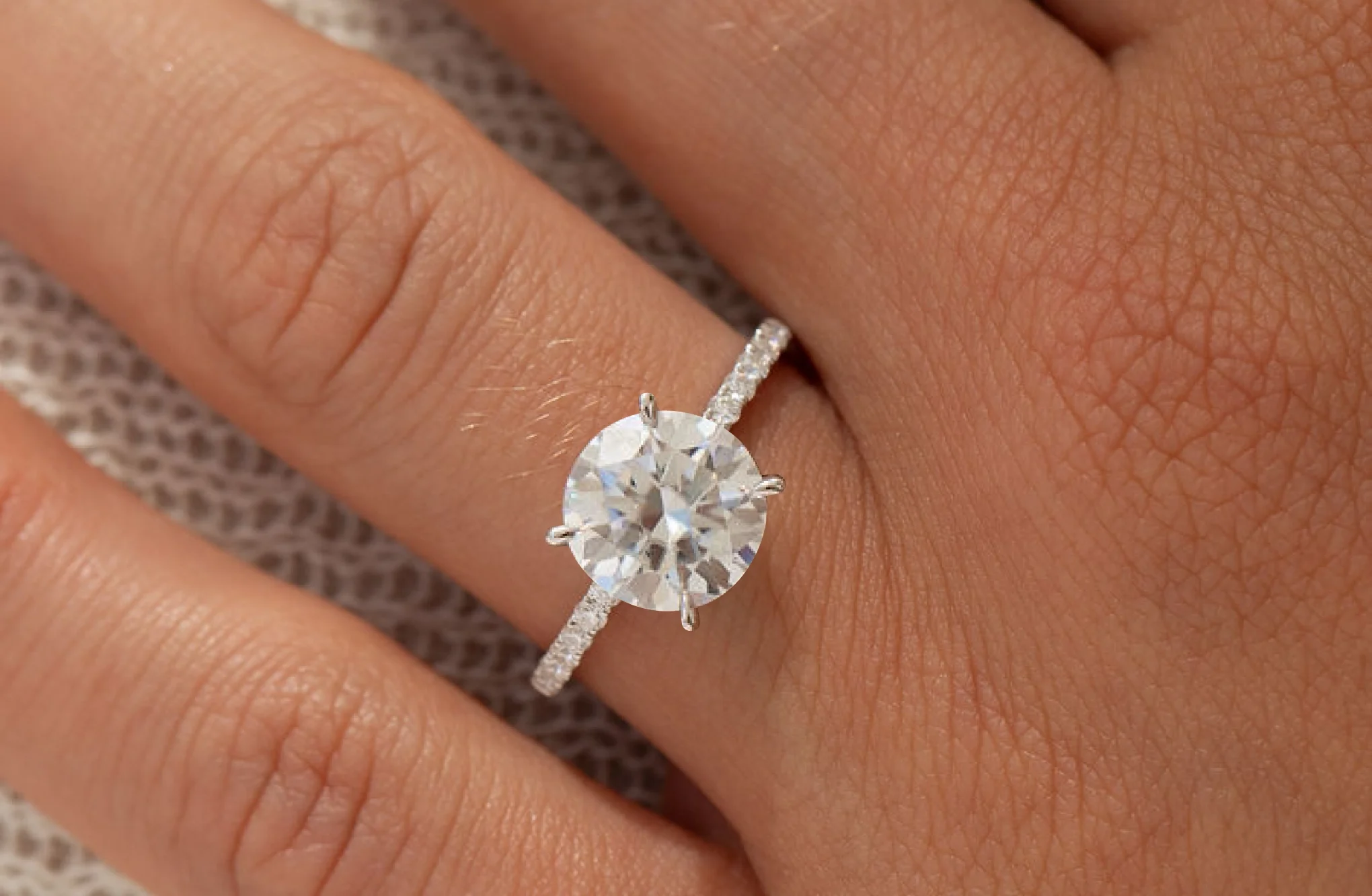



What is Moissanite?
From a meteorite crater to the world's most brilliant gemstone. Everything you need to know.
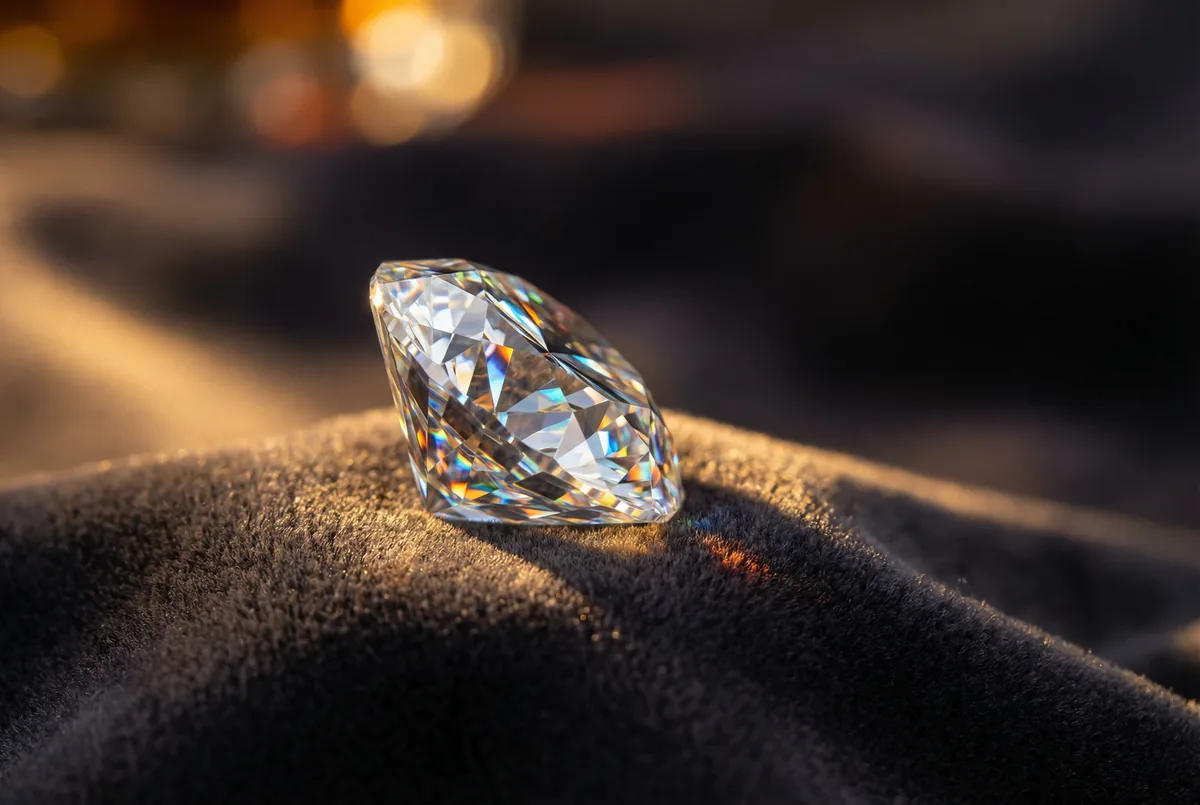
Moissanite—also spelled “Moissanite” internationally—is a gemstone that has enjoyed a remarkable rise in the world of jewellery. Originally discovered in a meteorite crater, it is now lab-grown and is considered one of the most brilliant stones in existence. Its fire is more than twice that of a diamond, and its hardness makes it resistant to scratches. However, laboratory production alone does not necessarily indicate a specific environmental or social impact.
Nevertheless, there are many half-truths surrounding this stone. Is it a “fake diamond”? Can you tell the difference? And why are more and more couples consciously choosing moissanite over a mined diamond? This article gives you all the answers you need.
A Quick Explanation
Moissanite is a laboratory-grown gemstone made of silicon carbide (SiC). It was discovered in 1893 by Henri Moissan in a meteorite crater and is named after him. With a hardness of 9.25 on the Mohs scale, it is the second-hardest gemstone in the world. Its dispersion (fire), at 0.104, is more than twice that of a diamond (0.044), which is why it sparkles particularly intensely when exposed to light.
The Discovery: From Meteorite to Gemstone
The story of moissanite does not begin in a laboratory, but in a crater. In 1893, French chemist Henri Moissan examined rock samples from Canyon Diablo in Arizona, an impact crater formed by a meteorite about 50,000 years ago. Among the debris, he found tiny, sparkling crystals that he initially mistook for diamonds.
It was only upon closer analysis that it became clear that it was something entirely different: silicon carbide, a compound of silicon and carbon with the chemical formula SiC. The mineral was named “moissanite” in his honor. Thirteen years later, in 1906, Moissan received the Nobel Prize in Chemistry, though for a different discovery: the isolation of the element fluorine.
Natural moissanite is extremely rare. In nature, it occurs almost exclusively in meteorites and in certain rock formations associated with volcanic activity. The quantities are so small that they have never been significant for jewellery production. It wasn’t until 1998 that the company Charles & Colvard succeeded in growing moissanite in a laboratory in sufficient quality and size to bring it to market as a gemstone.
As early as 1997, a research article in *Gems & Gemology* described synthetic moissanite as a new alternative to diamonds for jewellery.
Source: GIA, "Synthetic Moissanite: A New Diamond Substitute" (1997)Physical Properties in Detail
What makes moissanite so special as a gemstone are its optical and physical properties, which in several respects even surpass those of a diamond.
Hardness: Almost as hard as a diamond
With a hardness of 9.25 on the Mohs scale, moissanite is the second-hardest gemstone in the world. Only diamond (hardness 10) is harder. By comparison, sapphire and ruby rate at 9, and emerald at 7.5. This means that moissanite is virtually scratch-resistant in everyday use. It is ideal for engagement rings and jewellery worn daily.
Brilliance and Fire: More Than Just a Diamond
The refractive index of moissanite ranges from 2.648 to 2.691, compared to 2.417 for diamonds. This means that moissanite refracts light more strongly and reflects more of it back. The result is exceptional brilliance.
Even more impressive is dispersion—that is, the ability to break white light into its spectral colours. Moissanite has a dispersion value of 0.104, while that of a diamond is 0.044. That’s more than double. In practice, this manifests as intense “fire”: flashes of rainbow light that dance across the facets when light hits them.
Birefringence: The Only Visible Distinguishing Feature
Moissanite has a birefringence of 0.043, while diamond has no birefringence. This means that light rays are split into two rays as they pass through the stone. In larger stones, this can be visible under a magnifying glass as a slight doubling of the facet edges. In everyday life, without magnification, this effect is practically imperceptible.
Good to Know
Moissanite passes the standard diamond test because it has a similarly high thermal conductivity. Only specialised moissanite testers, which also measure electrical conductivity, can reliably identify it.
How is moissanite made?
Since natural moissanite is far too rare for use in jewellery production, it is grown exclusively in a laboratory. The process is complex and requires extreme conditions.
The most common method is based on the so-called Lely process, a modified sublimation technique. In this process, silicon carbide powder is heated to over 2,000 degrees Celsius in a high-temperature furnace. At these temperatures, the material sublimates—that is, it transitions directly from a solid to a gaseous state. The gas molecules then deposit onto a seed crystal and, layer by layer, form a new crystal.
This process takes weeks to months, depending on the desired size and quality of the stone. Unlike diamond synthesis, which can now be completed in just a few days, moissanite cultivation requires considerably more patience and precision.
After it has grown, the rough crystal is cut into the desired shape by experienced gem cutters. The quality of the cut is crucial to the stone’s visual impact: A well-cut moissanite maximises brilliance and fire, while a poor cut makes the stone appear dull.
When making a purchase, pay attention to the cut quality: it affects how the stone looks in the light. Ask to see photos or a video of the specific piece instead of relying solely on a description like “Ideal.” Discover our collection
Moissanite vs. Diamond: The Comprehensive Comparison Chart
The most common question we hear is, “How is moissanite different from a diamond?” Here are the facts, side by side.
| Property | Moissanite | Diamond |
|---|---|---|
| Chemical Composition | SiC (silicon carbide) | C (elemental carbon) |
| Hardness (Mohs) | 9,25 | 10 |
| Refractive Index | 2,648 to 2,691 | 2,417 |
| Dispersion (Fire) | 0,104 | 0,044 |
| Birefringence | 0.043 (available) | None |
| Density | 3.21 g/cm³ | 3.52 g/cm³ |
| Origin | Lab-grown | Mines or Laboratory |
| Certification | Depends on the provider; here, GRA according to product specifications | For example, GIA or IGI; check the specific report |
| Ethics | Laboratory origin; check the supply chain separately | Depending on origin |
Sources: GIA Gems & Gemology, Winter 1997; Charles & Colvard Technical Data Sheet
Moissanite and diamond are different materials. The GIA classifies synthetic moissanite as a diamond simulant: a gemstone that looks like a diamond but has different properties.
GIA: Understanding Diamond ImitationsQuality Levels and Certification
Just as with diamonds, there are differences in quality among moissanites. The most important criteria are colour, clarity, and cut.
Colour Grades
Moissanite is classified into three colour categories based on the diamond colour grading system:
| Colour level | Description | Comparable to |
|---|---|---|
| DEF (Colourless) | Completely colourless, highest quality | Diamond D-F |
| GHI (Near-Colourless) | Nearly colourless, with a minimal warm tint | Diamond G-I |
| JK (Lightly tinted) | A slight yellowish tint is visible | Diamond J-K |
What a Certificate Tells You
According to Moissanit’s product information, the Velur rings presented here are sold with a GRA certificate. You should check the specific report to verify the details it actually contains: Who is the issuer, what is the report number, and what information does it include regarding material, colour, clarity, and cut? A Moissanit report is not equivalent to a diamond report from the GIA or IGI.
Would you like to understand the certificate and stone specifications in more detail before making your decision? Ask our team for the documentation regarding the version you're interested in. Request the certificate via WhatsApp
Ethics and Sustainability
Jewellery-grade moissanite is produced in a laboratory. The main stone therefore does not come from a gemstone mine. This is a specific characteristic of its origin—but it does not prove that the entire ring was produced without harming the environment or in accordance with certain social standards.
Laboratory production also requires energy. The extraction and processing of the metal, as well as its transportation, are also relevant to the environmental impact of a finished ring. Without comparable data on the specific supply chain, it is not possible to provide a reliable, general estimate of CO₂ savings compared to a diamond ring.
If the origin is important to you, ask specific questions: Where was the stone produced? What information is available about the metal and the manufacturing process? A certificate describing the stone's characteristics does not automatically answer questions about working conditions or environmental impact.
Concrete details instead of empty promises
A laboratory origin is more verifiable than a blanket claim such as “environmentally friendly.” The U.S. Federal Trade Commission (FTC) also recommends in its guidance on jewellery advertising that environmental benefits be explained in concrete terms and substantiated. That is why we do not provide any unsubstantiated savings projections here.
Who is moissanite the right choice for?
Moissanite isn't for everyone. And that's a good thing. It's for people who know what they want and who aren't guided by convention.
Perfect for you if...
You’re looking for a stone with striking rainbow reflections. You want a lab-created centre stone and want to make an informed choice among different materials. The best way to determine whether you like the intense fire is to look at photos or videos taken under different lighting conditions. Discover our moissanite engagement rings.
Maybe not ideal if...
If the resale value of a stone is important to you (moissanite does not have an established secondary market). If you are looking for a stone with the specific prestige of a diamond. If you find moissanite’s slightly more intense fire to be “too much” and prefer a more subtle sparkle.
Three Ring Designs with Moissanite
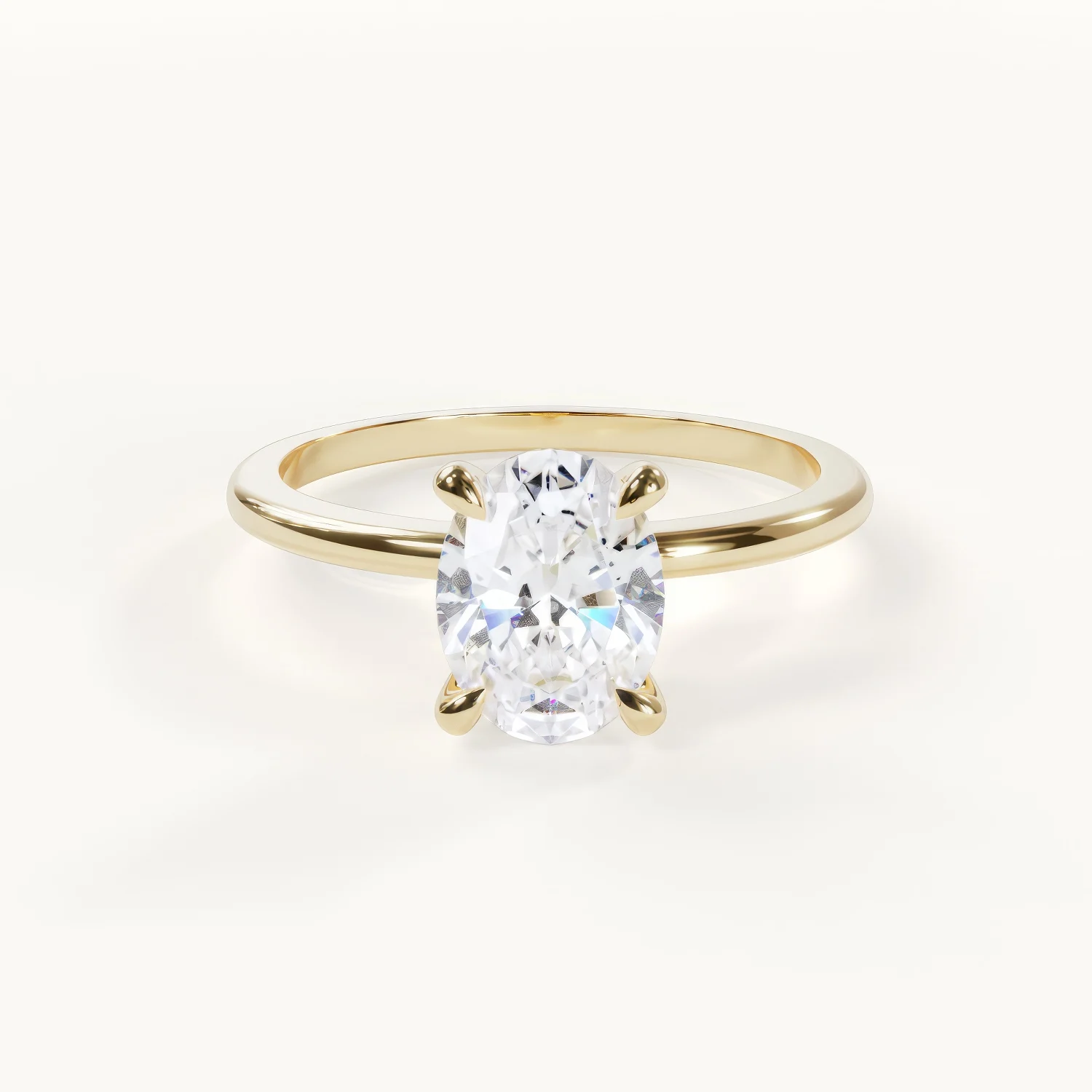
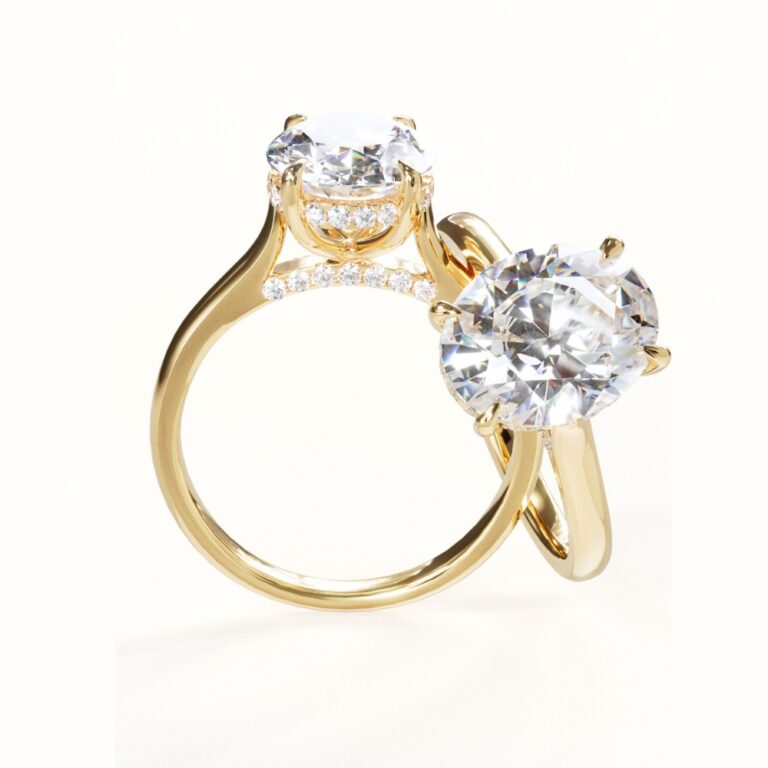
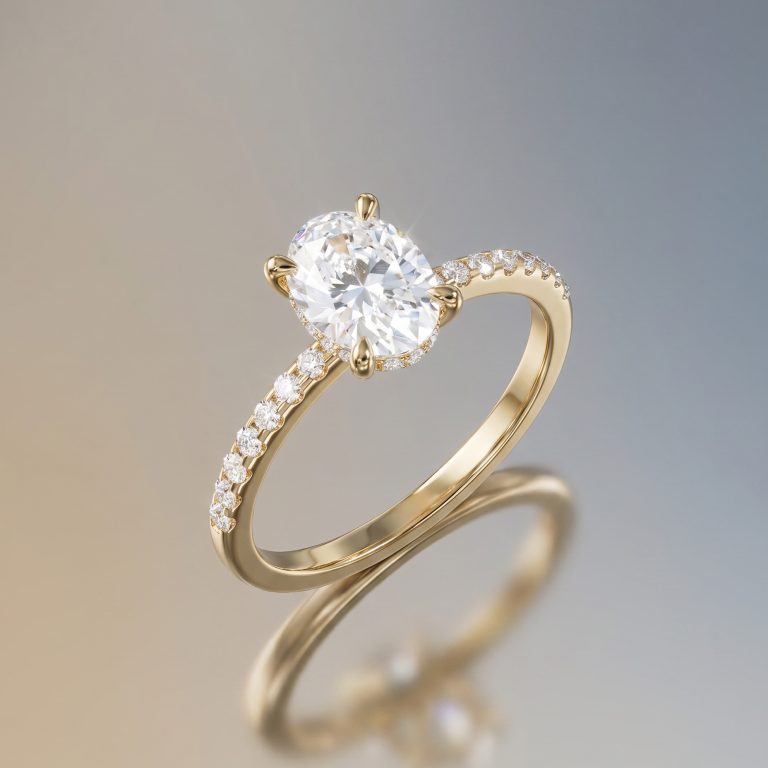
Elegance Solitaire Oval
Oval solitaire with a simple band; choose the metal and gemstone.
Discover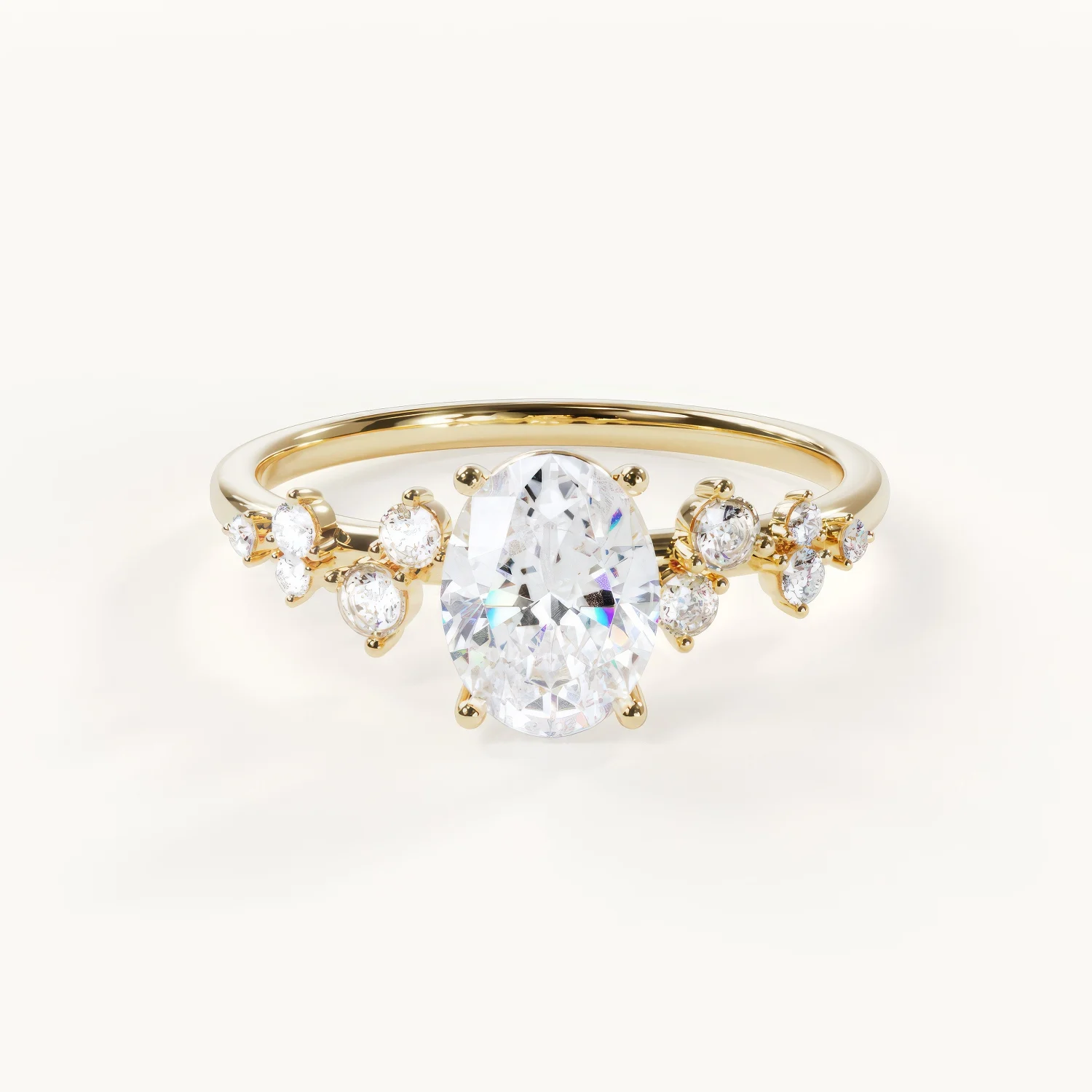
Floral Oval
Oval centre stone with accent stones arranged in a flower-like pattern.
Discover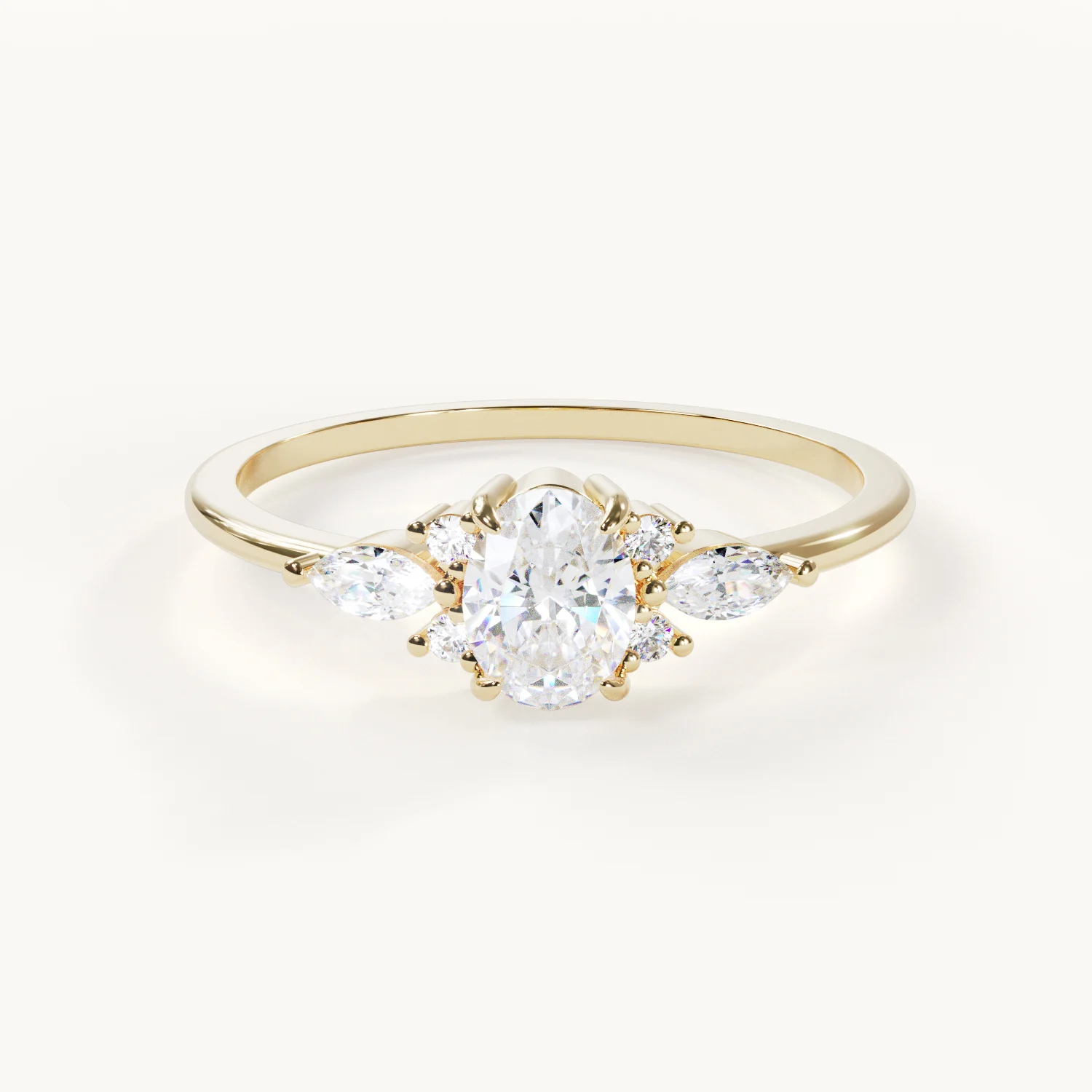
Muse Lumière
An oval centre stone with six accent stones arranged in a floral pattern and a slender band.
DiscoverFrequently Asked Questions About Moissanite
Is moissanite a real gemstone?
Yes. Moissanite is made of silicon carbide, not diamond. Gem-quality moissanite is created in a laboratory. Gemologically, it is classified as a diamond simulant: It resembles a diamond but is a different material.
Is it possible to tell moissanite apart from a diamond?
Yes. A more intense fire and faceted edges that appear double can be telltale signs. How noticeable this is also depends on the light, size, and cut. A simple thermal conductivity tester is not sufficient for reliable identification.
Does moissanite become cloudy or dull over time?
A dull appearance can result from buildup of grease, soap, or cosmetics. Gently clean the ring according to the care instructions. If the stone remains dull afterward, have it and its setting inspected by a professional rather than speculating about the cause.
How hard is moissanite compared to other gemstones?
Moissanite scores 9.25 on the Mohs scale, while diamond scores 10. This scale measures scratch resistance, not resistance to breakage. Even a hard stone should be protected from impacts.
Is moissanite the same as cubic zirconia?
No. Moissanite is silicon carbide; zirconia is cubic zirconium dioxide. The materials differ in terms of hardness and optical properties, among other things. Neither of them is a lab-grown diamond.
What certification does moissanite have?
That depends on the seller and the specific stone. For the Velur rings featured here, the product information lists a GRA certificate for the moissanite. Make sure to ask for an explanation of the lot number, report number, and documented characteristics before making a purchase. A moissanite certificate is not a diamond certificate.
Is moissanite suitable for an engagement ring?
Yes, if you're looking for a scratch-resistant stone with a striking fire. Other key factors include a suitable setting, regular care, and your personal taste. Discover our moissanite engagement rings
Related Articles
Ready for the perfect ring?
Discover our solid gold moissanite engagement rings. Designed in Munich, crafted to last a lifetime.