


Diamond Certificates Explained: GRA vs. IGI – What You Need to Know
When you buy an engagement ring, you’ll inevitably come across abbreviations like GRA and IGI. We’ll explain, transparently and honestly, what these certificates mean, what they stand for, and why they’re important.
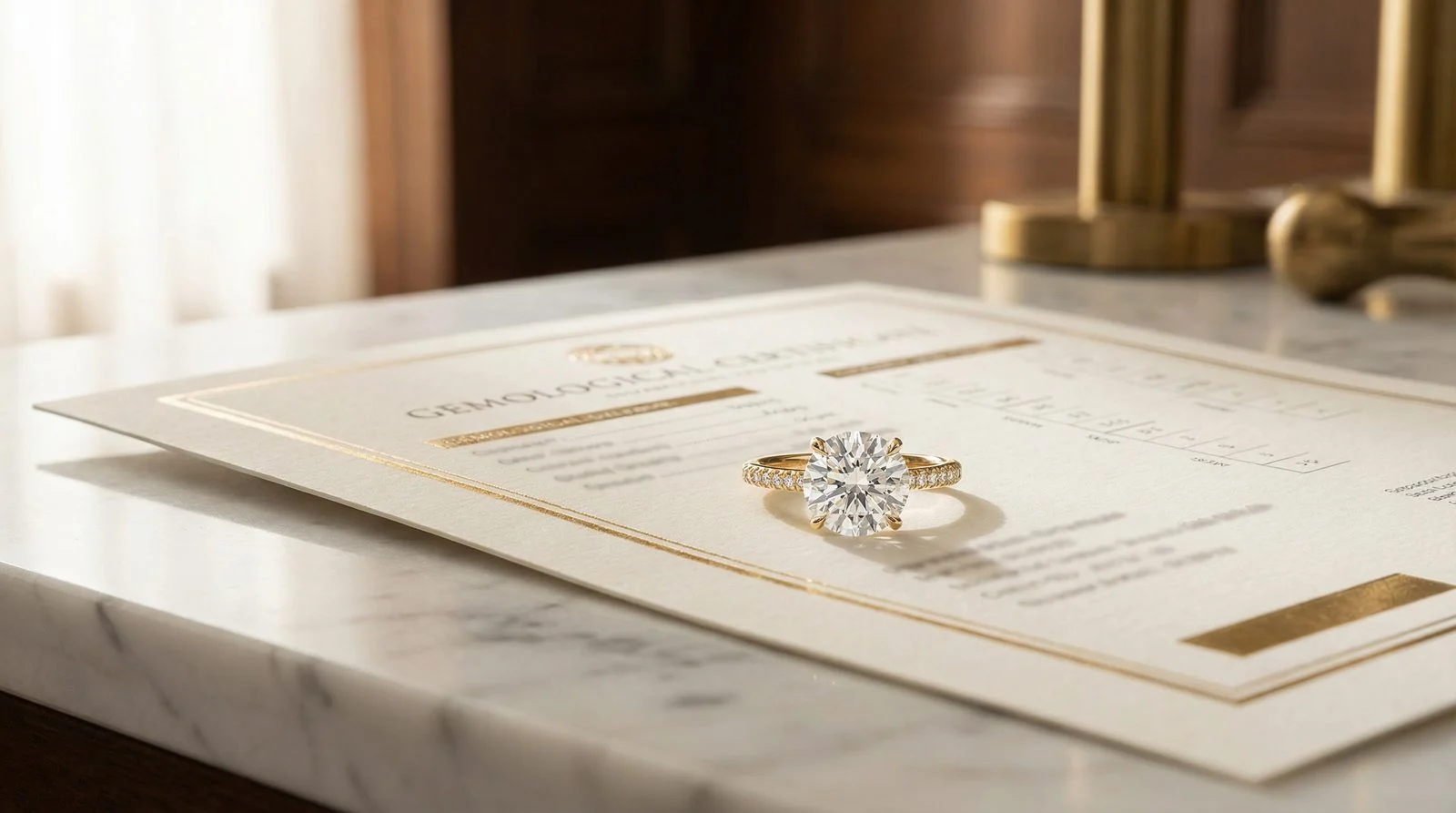
In a nutshell
A GRA certificate is a specification document used primarily for moissanite to confirm its dimensions and characteristics. An IGI certificate, on the other hand, is a rigorous, internationally recognised gemmological report that grades genuine diamonds (including lab-grown diamonds) according to the 4Cs and is also valid for insurance purposes.
Buying an engagement ring is an emotional decision, but it’s also a rational one. You want to be sure that the stone in your ring is what it claims to be. This is exactly where certificates come into play. But not all certificates are created equal. In the world of gemstones, there are various institutes with different standards and areas of focus.
In this article, we’ll explain the two most important certificates you’ll find at Velur: the GRA certificate for moissanite and the IGI report for lab-grown diamonds. We’ll give you an honest and transparent look at what each document covers, how they differ, and why we at Velur deliberately rely on both.
What is a GRA certificate? (The Moissanite Standard)
If you decide to buy a moissanite ring, you'll almost always receive a GRA (Global Research Academy) certificate with it. But what exactly is that?
Moissanite is a lab-grown gemstone that resembles a diamond in appearance but has its own crystal structure. Since the renowned Gemological Institute of America (GIA) does not grade moissanite, GRA has established itself as the standard for certifying these stones.
What's in a GRA report:
- Identification: Confirmation that the stone is genuine moissanite.
- Dimensions: The exact size of the stone in millimetres.
- Carat Equivalent: Since moissanite is lighter than diamond, the weight is given as the weight a diamond of the same size would have.
- Visual Characteristics: An assessment of colour and clarity.
Important to know: A GRA certificate is not a valuation report or a rigorous diamond appraisal. It’s more like a detailed specification sheet that provides transparency regarding the physical properties of your moissanite stone. It is a genuine document, but should not be confused with a high-end diamond appraisal.
What is an IGI certificate? (The Diamond Authority)
The International Gemological Institute (IGI), founded in Antwerp in 1975, is one of the largest and most respected independent gemological laboratories in the world. When it comes to lab-grown diamonds, IGI is the undisputed authority.
In fact, in 2005, IGI was the first institute in the world to officially certify lab-grown diamonds. An IGI certificate is a highly precise, scientific document.
IGI's Rigorous Evaluation
IGI grades every diamond under controlled laboratory conditions according to the internationally recognised 4Cs:
- Cut: How well does the diamond reflect light? (e.g., Ideal, Excellent)
- Colour: From D (completely colourless) to Z (slightly tinted).
- Clarity: From IF (flawless) to visible inclusions.
- Carat (Weight): The exact weight of the diamond.
Every IGI-certified diamond also features a microscopic laser engraving on the girdle (the edge of the stone) that matches the report number on the certificate. This certificate is internationally recognised and can be used for insurance purposes and to determine value.
GRA vs. IGI: A Head-to-Head Comparison
| Property | GRA Certificate | IGI Report |
|---|---|---|
| Mainly used for | Moissanite | Lab-Grown & Natural Diamonds |
| Document Type | Specifications & Reference Sheet | Scientific Gemmological Report |
| Rated according to the 4Cs | No (provides only estimates) | Yes (strict international standards) |
| Approved for Insurance | No | Yes |
| Laser Engraving on Stone | Often available (GRA number) | Always Available (IGI Report Number) |
Why Velur Relies on Both Certifications
"A certificate should never be a marketing gimmick, but rather a promise to our customers. That's why we make it clear: GRA for the specifications of our moissanite, IGI for the indisputable quality of our lab-grown diamonds."
Velur Editorial Team
At Velur, we believe in honest communication. We use GRA certificates responsibly for our moissanite collection: they serve as proof of your stone’s dimensions and identity. However, we will never tell you that a GRA report is equivalent to a diamond grading report.
For our exclusive lab-grown diamonds, we rely exclusively on IGI certificates. When you purchase a lab-grown diamond from us, you’ll receive a genuine, independently verified report that unequivocally attests to the outstanding quality of your stone.
Are you unsure whether a moissanite or a lab-grown diamond is the right choice for your engagement ring? Let us give you personalised advice. Just message us on WhatsApp!
Frequently Asked Questions (FAQ)
A GRA certificate is a document issued primarily for moissanite stones. It confirms the stone’s identity as moissanite and documents basic characteristics such as cut, dimensions, carat weight equivalent, and visual colour and clarity ranges. However, it is not a valuation report.
No. The GIA (Gemological Institute of America) is the world's leading authority on the grading of natural diamonds and does not grade moissanite. The GRA, on the other hand, has established itself as the standard for certifying lab-grown moissanite.
The International Gemological Institute (IGI) is one of the world's largest independent gemological laboratories. An IGI certificate is a highly accurate, internationally recognised appraisal that evaluates diamonds (both natural and lab-grown) according to the strict 4Cs (Cut, Colour, Clarity, Carat).
IGI is a pioneer in the certification of lab-grown diamonds and has been grading them since 2005. An IGI report for lab-grown diamonds (often with a yellow cover) confirms the diamond’s authenticity and provides an accurate assessment of its quality, which is also relevant for insurance and resale purposes.
At Velur, we prioritise maximum transparency. For our high-quality moissanite rings, we provide GRA certificates so you know the exact specifications of your stone. Our exclusive lab-grown diamonds come with rigorous, internationally recognised IGI reports to give you complete confidence in the quality and value of your diamond.
Moissanite vs. Lab-Grown Diamond vs. Natural Diamond
The Ultimate Comparison: Which Stone Is Right for Your Engagement Ring?
What is a lab-grown diamond?
Everything you need to know about the eco-friendly and affordable alternative to mined diamonds.
What is moissanite?
Learn more about the properties, origin, and unique brilliance of moissanite.
Find the Perfect Ring
Whether it's a sparkling moissanite or an IGI-certified lab-grown diamond—discover our handcrafted collection from Munich.